The best marketing agency software for client work in 2026 is GoHighLevel: one flat-rate platform that gives every client their own sub-account with a CRM, funnels, email and SMS automation, calendars and review requests. What it won’t do is run your agency’s internal operations, so most agencies pair it with a dedicated project management and time tracking tool, and this guide covers both halves.
We compared six platforms that sell themselves as all-in-one: GoHighLevel, HubSpot, ClickFunnels, Kajabi, ActiveCampaign and Keap. They solve different problems. A course creator and a home-services agency running ads for twelve clients both search for “all-in-one marketing platform,” and they need different products. Prices below come from each vendor’s pricing page, checked on October 2, 2026.
What software do marketing agencies actually need?
Ask agency leaders what they run, at digital shops and traditional marketing and advertising agencies alike, and you’ll hear two lists that rarely overlap.
The client-facing stack is the work you sell: a customer relationship management (CRM) system for client management and pipeline management, landing pages and funnels, email marketing and SMS automation, booking calendars, and reputation management. This is the stack an all-in-one marketing platform replaces.
The agency operations stack is how you run the business: project management, task management, time tracking, resource management, budgets and retainers, invoicing and accounting. Agency management software (a category also sold as professional services automation) lives here. Tools like Productive, Scoro and Asana compete for this job, and accounting usually sits in Xero or QuickBooks.
Most buyer regret in this category comes from expecting one product to cover both. A marketing platform with a task list won’t give you billable-hours reporting. A project management tool with a client portal won’t send a missed-call text at 9 p.m. Decide which stack you’re shopping for first, then pick the right software for that job.
| Job | Client-facing stack | Agency operations stack |
|---|---|---|
| Who uses it | Your clients’ leads and customers | Your own team |
| Core tools | CRM, funnels, email/SMS, calendars, reviews | Project management, time tracking, resource planning, accounting |
| Typical pricing | Flat rate or per contact | Per user per month |
| Our pick | GoHighLevel | A dedicated tool such as Productive |
Our pick for client work: GoHighLevel
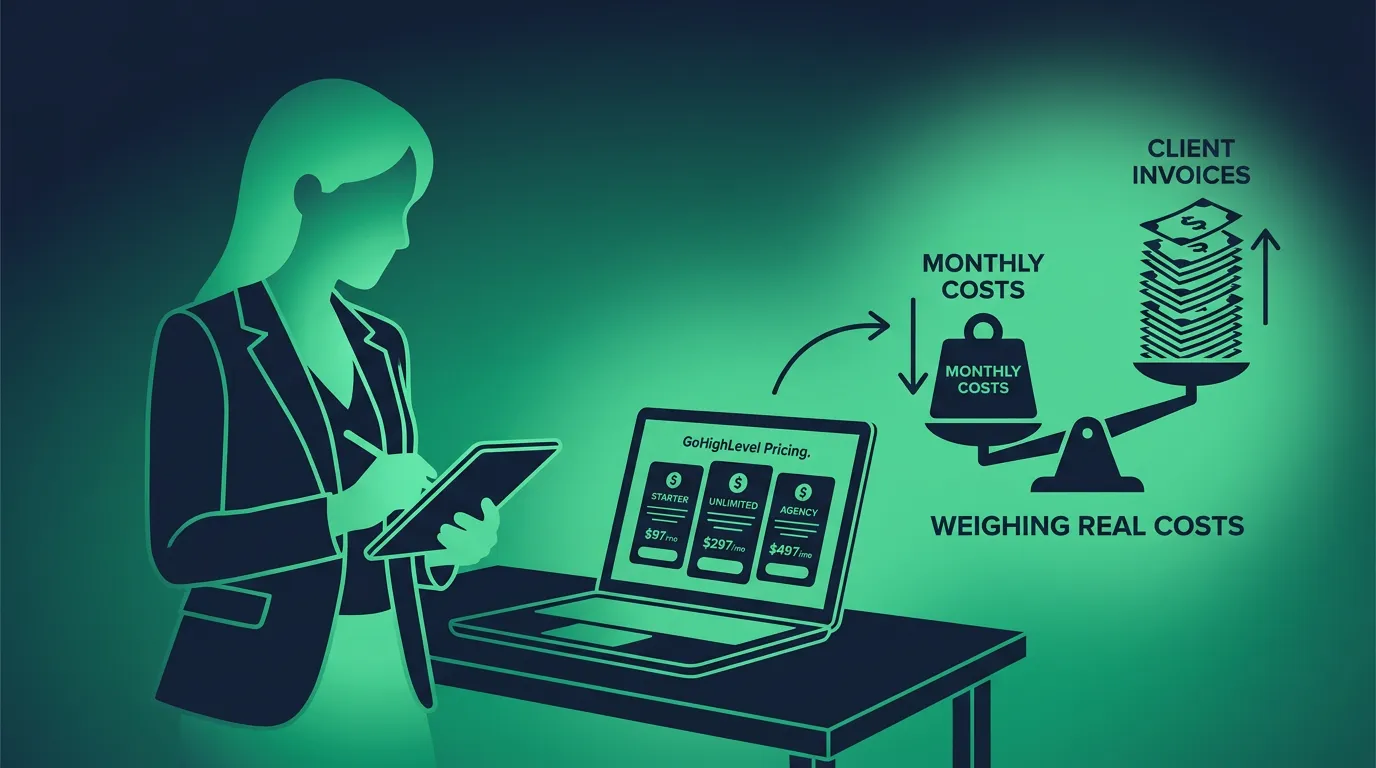
GoHighLevel was built for agencies from the start, and it shows in the parts other platforms bolt on later. The $97 Starter plan includes 3 sub-accounts. The $297 Unlimited plan removes the cap, so every client gets an isolated account with its own contacts, automations, calendars and branding, all reachable from one agency login. Both plans include unlimited contacts and users. That model fits how a creative agency or performance shop actually works: one team, many clients, no per-client software bill.
Snapshots, client management and onboarding
Snapshots are the feature that changes an agency’s economics. Once you’ve built a working setup for one client (funnel, pipeline stages, follow-up workflows, calendar), you save it as a snapshot and load it into the next sub-account. Onboarding becomes a template load plus brand swaps. Agencies that specialize in one vertical, say dentists or roofers, get the most from this, because their client setups are nearly identical. Our guide to GoHighLevel snapshots covers how they work in detail.
Email marketing, automation and how the AI is billed
The workflow builder handles multi-step email and SMS sequences with conditional branching, which is the workflow management most small businesses pay ActiveCampaign or Keap for. Calendars cover calendar management for each client, with booking links that feed straight into the pipeline. Missed Call Text Back sends an automatic SMS when a call goes unanswered, which matters for local service clients who lose leads every time nobody picks up.
The AI tools (Conversation AI, Voice AI, Content AI and Reviews AI) are available on every plan, but they’re billed per use. Content AI costs $0.063 per image and $0.0945 per 1,000 words; Reviews AI costs $0.01 per review reply. A sub-account can switch to AI Employee Growth at $50/mo or AI Employee Unlimited at $97/mo per sub-account for flat-rate use. None of the agency plans bundles AI for free, so build it into client pricing.
White-label and SaaS Mode
Unlimited adds a white-label desktop web app and custom domains, so the client and agency both see your agency branding instead of HighLevel’s, plus rebilling of phone and email costs at cost. Agency Pro at $497/mo adds SaaS Mode: automated sub-account creation, your own pricing, and the ability to mark up SMS, email and AI usage. That’s how agencies turn a software expense into a recurring product line. The white-label mobile app is a separate add-on at $497/mo (included only on Enterprise), so don’t promise clients a branded app on Agency Pro alone. The GoHighLevel pricing breakdown walks through every tier and add-on.
Project management inside GoHighLevel
HighLevel has task management inside the CRM: tasks tied to contacts and opportunities, recurring tasks, and an “Add Task” workflow action that assigns work automatically. A newer Project Management feature adds Spaces, Folders, Lists and subtasks with Kanban and list views. HighLevel’s help center describes it as still in a feedback phase before general release, and its documentation mentions no time tracking, budgets or resource planning. Time tracking per task is an open request on HighLevel’s ideas board. Use it for client-delivery checklists, and use something else for timesheets.
Agency project management software: the other half of the stack
If you bill hourly or run retainers, you need a tool that connects logged hours to budgets. That’s the job agency management software does, and it’s where an all-in-one marketing platform can’t help agencies much. Every agency hits this point once it has more than a handful of people: agency tasks get spread across email threads, nobody can see workload management at a glance, and profitability per client becomes a guess.
What a dedicated agency management system adds
Productive is a good example of the category. It combines project management, resource planning, budgeting, time tracking, invoicing and profitability reporting, and integrates with Xero, QuickBooks and Zapier. Its published plans are per user: Essential runs roughly $10 to $12 per user per month depending on billing, Professional about $24 to $25, with Ultimate on custom pricing and a 14-day free trial. A ten-person agency pays a few hundred dollars a month for it, which is why per-user pricing matters more as the agency grows. Compare management features side by side before you commit: how each tool handles approvals, how agencies manage retainers that roll over, and whether the client portal is free for clients to use.
If your projects are simpler, work management software like Asana covers task management and project planning without the financial layer, and your bookkeeping tool handles invoices. Advertising agency software sits at the heavier end, adding media budgets and traffic management for creative approvals. The question to ask any project management platform is simple: do your timesheets feed directly into your budgets? If they don’t, someone is reconciling spreadsheets every month.
Financial management and agency accounting
Agency accounting has its own quirks: retainers that roll over, fixed-fee projects that run over, and media spend passed through to clients. Dedicated agency management platforms handle retainer management and budget management at the project level, then push invoices to Xero or QuickBooks. Larger shops use full ERP-style software systems like Sage Intacct for multi-entity financial management. GoHighLevel handles client payments and invoices for your clients’ customers, but it won’t tell you whether your own retainer with a client is profitable.
The cleanest setup for agency workflows is GoHighLevel for everything the client’s customers touch, a project management tool for everything your team touches, and Zapier or Make between them, for example creating a project when a deal moves to “Won.”
Other marketing agency software tools compared
| Platform | Starting price | Client sub-accounts | Best fit |
|---|---|---|---|
| GoHighLevel | $97/mo (3 sub-accounts); $297/mo unlimited | Unlimited from $297 | Agencies running many client accounts |
| HubSpot | Free CRM; Starter $20/seat/mo ($15 annual) | None (one company per portal) | One B2B company with deep reporting needs |
| ClickFunnels | $97/mo Launch | 1 to 20 workspaces by plan | Funnel-led businesses |
| Kajabi | $179/mo Basic | None | Course creators and coaches |
| ActiveCampaign | $19/mo for 1,000 contacts | None | Email automation depth |
| Keap | $299/mo ($249 annual) | None | Small businesses wanting guided onboarding |
HubSpot is the strongest option if you’re a single mid-market B2B company with an operations person and real attribution needs. The Free CRM is permanently free and a sensible starting point. For agency use it breaks down on structure: pricing is per seat and per marketing contact, Marketing Hub Professional costs $890/mo billed monthly or $800/mo billed annually with a mandatory $3,000 onboarding fee, and Professional plans typically run on 12-month contracts. Our HubSpot review covers the contract terms.
ClickFunnels wins when funnels and split testing are the job. Launch is $97/mo, Scale $197/mo, Optimize $297/mo, and Dominate is annual-only at $5,997/yr. Workspaces give some multi-business separation (5 on Scale, 20 on Dominate), but that’s a capped count, and the CRM is secondary to the funnel builder. See the ClickFunnels review.
Kajabi fits individual course creators and coaches. Courses, communities, email and a website builder sit in one dashboard at $179, $249 or $499 a month. It has no sales pipeline worth the name and no client sub-accounts, so it’s a poor match for agency work. The Kajabi review explains who it suits.
ActiveCampaign has the deepest email automation of the group, starting at $19/mo for 1,000 contacts and scaling with list size; the full sales CRM is a paid add-on. Keap sells one plan from $299/mo with done-for-you onboarding included, aimed at a founder who wants a person walking them through setup. Both assume one company running its own marketing, which is the same mismatch HubSpot has for agencies.
Pricing for agency management software: what a full stack costs
Sticker price is the easiest number to compare and the least useful on its own. Every platform here bills something outside the headline rate.
On GoHighLevel, the extras are usage. SMS costs $0.00747 per segment in the US and Canada plus carrier fees, LC Email costs $0.675 per 1,000 sends, WhatsApp is a $10/mo add-on per sub-account plus Meta’s message fees, and AI is per use unless a sub-account is on an AI Employee plan. On HubSpot, the extras are seats, marketing contacts and onboarding fees of $1,500 to $7,000 depending on Hub and tier. On ActiveCampaign and Keap, price climbs with contact count.
For a small agency, a realistic monthly budget looks like this: $297 for GoHighLevel Unlimited, client usage that you rebill (Unlimited passes phone and email through at cost; only Agency Pro can mark it up), a per-user project management and time tracking tool, and accounting software. Compare that with assembling the client-facing stack from point solutions. HubSpot Marketing Hub Professional alone costs more than GoHighLevel’s top self-serve tier before you add a second client, and ClickFunnels plus ActiveCampaign covers funnels and email for one business at $97 plus $59 (Plus, 1,000 contacts) before scheduling, reviews or SMS.
Time is the hidden cost. A platform that’s cheap but takes months to configure costs more once you count hours. GoHighLevel’s setup curve is the most common complaint against it. The offset is that snapshots let you pay that setup cost once and reuse it for every client after.
Choosing software: what to look for in marketing agency software
Agencies that need a fast shortlist can compare software options against six questions, asked before the demo:
- Does it separate clients? Sub-accounts with isolated data and branding, or one shared database you’ll have to partition by tags.
- What’s billed outside the subscription? SMS, email, AI, seats, contacts and onboarding fees.
- Can you rebill clients? On GoHighLevel, Unlimited rebills at cost and Agency Pro with markup. Most competitors don’t support it at all.
- Does it integrate with the tools your team already uses? Check native integrations first, then Zapier or Make, then the API.
- What’s the contract? GoHighLevel and ClickFunnels are month-to-month. HubSpot’s paid tiers usually aren’t.
- Who owns the data if you leave? Confirm CSV export for contacts, deals and conversations.
Agency size matters less than the buying pattern. A solo owner and a 25-person shop face the same software stack problem; the larger one just needs per-user operations tools sooner. Running an agency on too many software tools is the common thread, and every additional tool adds another login, another invoice and another place where client data drifts out of sync.
Where GoHighLevel loses
Email deliverability is the first. LC Email runs on Mailgun, and users report inbox-placement problems when sending domains aren’t authenticated and warmed. A dedicated IP is available as a $59/mo add-on.
Second, the native mobile apps are free, but a white-label branded app costs $497/mo extra. Some users report stability complaints with it; we couldn’t verify those, so treat them as anecdotes.
Third, it’s built for inbound leads. Agencies running cold outbound prospecting usually add a dedicated sales engagement tool.
And it’s broad rather than deep. A best-in-class funnel builder, email editor or social media management tool will beat the matching GoHighLevel module. GoHighLevel has a social planner, but most marketing teams still run a dedicated social scheduling tool for their content marketing calendar.
How we evaluated these platforms
We asked three questions of each platform: what it replaces, what the sticker price leaves out, and who the product is built for based on its own feature priorities. Prices, plan limits and trial terms come from vendor pricing pages and help docs, checked October 2, 2026. ActiveCampaign renders prices client-side, so its figures come from agreeing 2026 third-party sources and are quoted as starting prices for 1,000 contacts. We didn’t run paid test accounts for this comparison; where we mention user complaints, they come from reviews and vendor community boards.
On ROI, measure the hours your team stops spending on re-entering leads across tools, and the revenue recovered from automated follow-up such as missed-call texts and reminder sequences. That’s a more honest yardstick than any dashboard the software shows you.
Where to go from here
If one login for all client work, with sub-accounts built in, is the goal, start with the full GoHighLevel review and the plan-by-plan pricing guide. For a wider field, our GoHighLevel alternatives hub covers every competitor we’ve reviewed, and the best CRM for agencies narrows it to agency CRMs.
The quickest test is a real client account. GoHighLevel’s 14-day free trial (card on file, billed at the end unless you cancel) is long enough to build one sub-account end to end and see whether the setup time is worth it for your client mix.