The best CRM for distributors is the one that reads your ERP: it shows each rep what an account buys, what it pays, and what’s in stock before they quote. For most wholesale distributors that points to Zoho CRM, Pipedrive, Dynamics 365, NetSuite CRM or a distribution-specific platform such as WizCommerce, and only a small group of distributors should run GoHighLevel as their main CRM.
That group exists, and this page spells out who’s in it. GoHighLevel is a low-cost lead-response and marketing CRM platform with a flat price. Distribution sales runs on repeat orders, contract pricing and inventory, which is where it’s weakest. If you’re a wholesaler looking for a CRM, the sections below cover the best CRM for wholesalers at each size, plus the questions that help distributors pick between them.
What makes a CRM for distributors different from a generic CRM
Most CRM software for distributors gets sold as if distribution were ordinary B2B sales. A generic CRM is built around a pipeline. A lead comes in, a rep works it through stages, and the deal closes once. Wholesale distribution runs differently. Most revenue comes from accounts that already buy, reordering on a cycle, so the sales team’s daily work is spotting the account that’s late on its usual order, quoting a contractor’s next job at the right contract price, and checking whether the item is on the shelf or on backorder.
That changes the feature list. A distribution CRM needs:
- ERP integration that pulls order history, open orders, invoices and credit status into the account record
- Inventory visibility so a rep can see stock by warehouse before promising a ship date
- Pricing logic for customer price lists, volume breaks, contract pricing and rebate programs
- Reorder and wallet-share tracking that flags an account buying less than it used to
- Territory and account ownership that handles outside reps, inside sales and product specialists sharing the same customers
- A mobile CRM app that works for reps visiting job sites and branches
Pipeline management, email automation and lead scoring still matter for winning new accounts, and any basic CRM covers them. They just aren’t what distributors and wholesalers lose sleep over. A standard CRM set up for one-time deal closing gives reps who work repeat accounts very little reason to log in.
CRM vs. ERP: how CRM systems connect to ERP systems
For a distributor, the ERP (NetSuite, Epicor Prophet 21, Acumatica, Microsoft Dynamics 365 Business Central, SAP Business One, Sage or QuickBooks for smaller shops) is the system of record for inventory management, purchasing, pricing, orders and accounting. The CRM is where the sales team logs calls, visits, quotes and follow-ups, and where managers get visibility into sales activities across the territory.
The two have to share data. If the CRM shows a price or stock level that the ERP disagrees with, reps stop trusting it and go back to calling the warehouse. So the first question in any CRM evaluation is “can this integrate with our ERP, and in which direction?” Ask the vendor whether the sync is native or runs through middleware, how often it refreshes, and whether a quote or order created in the CRM writes back to the ERP as a sales order.
Distributors already on NetSuite or Microsoft’s ERP have the simplest answer. NetSuite’s CRM functions live inside the same database as its ERP, and Dynamics 365 Sales sits in the same Microsoft ecosystem as Business Central. Everyone else is choosing between a flexible CRM with good connectors and a platform built specifically for distribution.
Which kind of distributor GoHighLevel suits
GoHighLevel does some useful things for a distribution business, and we checked each one against HighLevel’s help documentation.
- Lead response. Missed Call Text Back texts a caller automatically when nobody picks up, and multi-step SMS and email workflows chase quote requests that went quiet. Voice AI and Conversation AI can answer after-hours calls and chats, billed per use unless the sub-account is on an AI Employee plan ($50 or $97 a month per sub-account).
- Estimates. Reps can build an estimate from the product list, send it by email or SMS, track it through Draft, Sent, Accepted, Declined and Invoiced, link it to an opportunity, and convert an accepted estimate into an invoice. Workflows can trigger when an estimate is sent, accepted or declined.
- QuickBooks Online. HighLevel’s native two-way integration creates customers in QuickBooks, pushes sent invoices and payments across, and imports QuickBooks customers into the CRM.
- Shopify. The native Shopify integration syncs contacts, orders, transactions, products and collections into HighLevel, which helps a distributor that also sells online.
- Custom objects. You can create record types beyond contacts and opportunities, such as ship-to locations or product lines, and associate them with contacts.
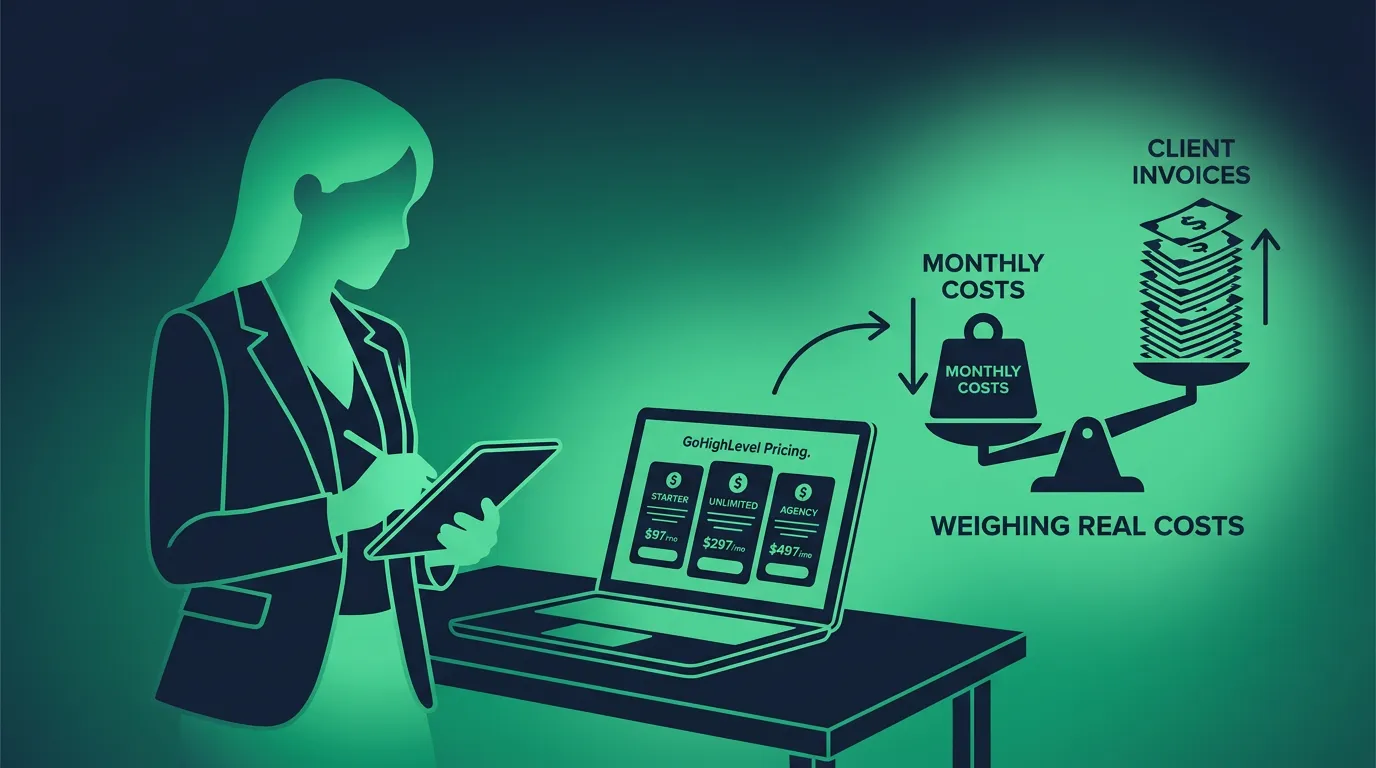
- Price. The Starter plan is $97 a month with unlimited contacts and users, and the Unlimited plan is $297. A 14-day trial is available with a card on file. See GoHighLevel’s pricing tiers for what each plan adds.
That makes GoHighLevel a sensible CRM solution for these kinds of distributors:
- Small distributors on QuickBooks Online with a short catalog, where pricing is mostly list price and the bottleneck is finding and converting new accounts.
- Distributors with a counter, showroom or will-call branch that gets local search traffic and phone calls, where review requests and missed-call follow-up pay off quickly.
- Distributors that also sell direct online through Shopify or HighLevel’s own store and want marketing automation tied to those orders.
- A marketing team running inbound campaigns for a larger distributor, as a lead-capture layer that hands qualified accounts to the main CRM.
Where GoHighLevel falls short for a wholesaler’s sales team
The gaps sit right on the core distribution workflow, and each one matters more as the catalog and the account list grow.
No native ERP integration. We found no app in HighLevel’s marketplace for NetSuite, Epicor, Acumatica, SAP or Dynamics, and an Acumatica integration shows up as a user request on HighLevel’s ideas board. You can bridge the gap with automation tools, a managed sync service such as Commercient SYNC (which sells GoHighLevel connectors for several ERPs, priced on request), or your own build on the HighLevel API. All three mean you own an integration that a distribution CRM would ship with.
Inventory stops at the online store. HighLevel’s inventory page tracks quantities per product variant and SKU for its own online store. It has no multi-warehouse view and no link to ERP stock, so it can’t tell a rep what’s available at the branch nearest the customer.
No B2B pricing engine. Estimates pull from a product list. HighLevel’s documentation doesn’t mention customer-specific price lists, volume tiers, contract pricing or rebate program tracking, and we found no feature that provides them. For distributors with complex pricing structures, that’s a dealbreaker on its own.
No EDI. Purchase orders, invoices and advance ship notices with trading partners have to run through your ERP or an EDI provider.
Basic territory structure. There’s no territory management module, so overlapping assignments (one rep owns electrical, another owns plumbing, both sell to the same contractor) need workarounds with custom fields and user permissions.
If your sales team spends its day on repeat orders and account pricing, these gaps decide the question against GoHighLevel, so it shouldn’t be your wholesale CRM. For more detail on what the platform does well, read our full GoHighLevel review.
Top CRM software for distributors and wholesalers, compared
Here are the CRM options worth shortlisting, from flexible CRMs to leading CRM software built for distribution, with prices we checked in October 2026. Prices are per user per month on annual billing unless noted.
| CRM | Starting price | Distribution strengths | Best fit |
|---|---|---|---|
| GoHighLevel | $97/mo flat (Starter), unlimited users | Lead response, SMS, estimates, QuickBooks Online and Shopify sync | Small distributors focused on new accounts |
| Zoho CRM | Free for 3 users; $14 Standard; $23 Professional; $40 Enterprise | Inventory module (quotes, sales orders, purchase orders, invoices) from Professional; territory management on Enterprise; Zia AI | Small and mid-market distributors wanting one flexible CRM |
| Pipedrive | $14 Lite; $39 Growth | Product catalog with price variations and per-deal line items; quote documents through Smart Docs | Small outside sales teams with simple pricing |
| HubSpot | Free CRM; Sales Hub Professional $90 ($100 monthly) plus $1,500 onboarding | Strong marketing automation and reporting, large app marketplace | Distributors investing heavily in inbound marketing |
| Salesforce Sales Cloud | $25 Starter Suite; $100 Pro Suite; $195 Core | Deepest customization and partner ecosystem | Enterprise distributors with an admin team |
| Microsoft Dynamics 365 Sales | $65 Professional; $105 Enterprise | Fits distributors on Business Central or other Microsoft ERP; Copilot AI in Enterprise | Microsoft shops |
| NetSuite CRM | Quote from Oracle | CRM in the same database as the NetSuite ERP | Distributors already on NetSuite |
| Odoo | One app free; Standard about $31 list (US) | CRM, inventory, purchasing and accounting in one suite | Smaller distributors replacing spreadsheets and QuickBooks together |
| WizCommerce | Quote only | Rep order-taking app, B2B ordering portal, vendor-listed connectors for NetSuite, SAP Business One, Prophet 21 and QuickBooks | Wholesalers built around rep and portal ordering |
A few notes on the table. Zoho’s US prices come from consistent 2026 third-party guides because Zoho’s pricing page localizes by region, though the feature split by plan comes from Zoho directly. Pipedrive’s Growth price is $39 on its current page per recent guides, while older articles still show $24. Odoo’s US list price comes from partner sources, and Odoo also runs a first-year discount. Spiro, once a common name in roundups of CRMs for distributors, now markets itself as a CRM for manufacturers; distributors should ask how it supports them before shortlisting it.
How distributors choose between a purpose-built CRM and flexible CRMs
Small and mid-market distributors without a big IT team usually do best with Zoho CRM. It’s the cheapest CRM for wholesale distribution on this list that puts quotes, sales orders and purchase orders in the CRM itself. Professional ($23) covers that inventory module, and Enterprise adds territories for $40. Pipedrive is the simplest tool for a five-rep outside sales team that wants a clean pipeline and product line items, though its product catalog covers prices and variations, with no stock levels.
Enterprise distributors and anyone with heavy customization needs should start with whatever CRM module their ERP vendor sells. Running NetSuite’s CRM module on NetSuite, or Dynamics 365 Sales alongside Business Central, removes most of the integration project. Salesforce makes sense when you need extensive customization and have the budget for admins or a partner.
Purpose-built CRM software solutions for distribution, such as WizCommerce and Proton, focus on order-taking, account-level sales plays and AI recommendations from transaction history. Neither publishes prices, so expect a sales process and a quote, but they’re the only options here built specifically for distribution workflows from the start.
GoHighLevel belongs in this decision as either the main CRM for the small, acquisition-focused distributor described above, or as the marketing layer next to one of the CRMs listed here. For a wider comparison beyond distribution, see our guide to the best CRM software.
Pricing structures and rebate programs
Complex pricing is where generic CRMs break first. A typical wholesale distributor has list prices, customer-specific price lists, quantity breaks, contract prices for big accounts, and rebate programs that pay out once an account crosses a purchase threshold.
Those rules usually live in the back-office system. A good CRM for distribution reads them, so the quote a rep builds in the field matches the invoice. If your CRM can’t, reps either quote list price and correct it later, or they skip the CRM. Ask every vendor on your shortlist to build a quote for a real customer with a real contract price during the demo.
GoHighLevel can’t do this. Its estimates use the product price you set, with no customer price lists or rebate tracking.
Mobile app, AI and visibility for the sales team
Distribution sales teams split between outside reps who visit accounts and an inside sales desk that handles inbound orders, price checks and small quotes all day. The CRM has to serve both.
For outside reps, check whether the mobile app shows order history and stock, logs visits, and works offline in a warehouse with poor signal. WizCommerce lists offline mode for its rep app. GoHighLevel’s mobile app lets reps create estimates from templates (templates are built on the web), handle conversations and update contacts, but it can’t show ERP data it doesn’t have. Some GoHighLevel users report stability problems with the mobile app, though that’s user feedback rather than something we’ve measured.
For inside sales, the priority is speed: a screen showing the caller’s account, recent orders and open quotes the moment the phone rings. That depends on the back-office integration more than the CRM’s call features.
AI features are now in almost every CRM, and their value for distribution depends on the data underneath. Zoho’s Zia AI comes with the Enterprise plan. Dynamics 365 Sales Enterprise includes Copilot, and Sales Premium adds 1,000 Copilot Credits a month. Distribution-focused tools such as Proton pitch AI that reads transaction history to suggest which account to call and what to offer. GoHighLevel’s Voice AI and Conversation AI handle inbound calls and chats well, but with no order data in the system, they can’t tell a sales rep which account has stopped buying. CRM analytics follow the same rule: reorder and margin dashboards need ERP data, and a CRM without it can only report on pipeline and activity.
Implementation, CRM adoption and ROI
Plan the rollout in two parts. Setting up the CRM itself (pipelines, users, email and phone) is the quick part. Mapping customers, products and pricing from the back office, cleaning duplicate accounts and testing the sync takes longer. WizCommerce quotes 30 to 60 days for its ERP-connected onboarding. Larger CRM projects with a Dynamics 365 or Salesforce partner add their own discovery and configuration time on top.
CRM adoption decides the return on any new CRM. Reps who already know their accounts won’t log visits and quotes unless the CRM gives them something back, usually order history and reorder alerts they couldn’t get before. Measure ROI with numbers your order system already tracks: reorder rate from existing accounts, the count of lapsed accounts won back, quote-to-order conversion, and revenue from new accounts. Run those before and after go-live rather than relying on vendor ROI claims.
Choosing the right CRM for your distribution business
To find the right CRM for your wholesale business, start with your ERP. If you’re on NetSuite or Microsoft’s ERP, price that vendor’s CRM first. If you’re on Epicor, Acumatica, Sage or SAP Business One, shortlist CRMs with native connectors for your exact ERP version and ask for references from distributors on that system.
Then decide which problem costs you more money. If it’s reorders slipping, pricing errors and reps quoting out-of-stock items, you need ERP-connected CRM functionality, and GoHighLevel won’t fix it. If it’s missed calls, slow follow-up on new-account quote requests and no marketing system at all, GoHighLevel’s $97 Starter plan is worth a trial.
Plenty of distributors end up running both: a connected CRM for account management and GoHighLevel for inbound marketing and lead response. If that’s you, budget for the two separately and keep the connected CRM as the system of record for customer relationships.
Manufacturers face a similar split between operations software and sales tools, covered in our CRM for manufacturing guide. If you’re launching a new distribution business with no back-office system yet, our CRM for startups page covers the lighter-weight version of this decision. The same trade-off between lead response and operations also shows up in CRM for automotive dealers and CRM for financial advisors.