The best CRM for a call center depends on how many agents you have and which way the calls go. A staffed contact center with queues, outbound dialing and supervisors needs contact center software such as NICE CXone, Five9 or Talkdesk integrated with a service CRM; a small inbound team doing appointment setting or lead qualification can run on GoHighLevel, which handles calls, texts and follow-up for $97 a month but has no call queues or dialer.
That split between the phone layer and the customer data layer is the most useful thing to understand before you compare call center CRM software.
What a call center CRM does
Customer relationship management software for a call center stores who each caller is and what has happened with them: customer information, interaction history across calls, emails and chats, open cases, and the next follow-up. When a call connects, the CRM shows the agent a complete customer view so the caller doesn’t repeat themselves. After the call, it logs the outcome and triggers whatever comes next. Call center CRM software helps call center agents manage customer interactions across the whole customer journey, from the first inquiry to the latest support ticket, and gives service teams one place to see customer needs and history.
Contact center software does a different job. It runs the phone side: an automatic call distributor (ACD) that queues callers and routes each one to the right free agent, dialers that work through outbound lists, call recordings, real-time dashboards of queue depth and agent status, and workforce management for shift scheduling.
Small teams can get by with one tool. Once callers start waiting in line for agents, you need both, and the integration between them decides how well the center runs. An integrated call center CRM pops the caller’s record on screen, logs the call automatically, and writes the disposition back so supervisors can report on center performance.
Call center CRM software features
When you evaluate CRM options for a call center, these features decide whether agents use the system or work around it:
- Screen pop and interaction history. The record should open on its own when a call arrives, with every past call, ticket, text and email in one timeline.
- CRM integration with your telephony. Native connectors beat custom builds. Ask how calls are logged, how dispositions sync and whether call recordings attach to the record.
- Case management. Support-focused service teams need tickets with owners, priorities and SLAs. Sales-focused teams need pipeline stages and callback tasks.
- Workflow automation. Post-call texts, follow-up emails and scheduled callbacks should fire automatically from the call outcome.
- Real-time and historical analytics. Supervisors need live agent status, and managers need trends in handle time, first-call resolution and customer satisfaction.
- Compliance controls. Outbound teams need do-not-call handling and consent records for TCPA; recorded calls need disclosure and retention rules.
Every one of these exists to improve customer experience and agent efficiency. If a feature doesn’t do either for your center, don’t pay for it.
Best call center CRM software and contact center CRM options
Prices below were checked on vendor pricing pages on 2 October 2026.
| Platform | Type | List price |
|---|---|---|
| Talkdesk | Contact center software | Digital Essentials $85, Voice Essentials $105, Elite $165, Industry Experience Clouds $225 per user per month |
| NICE CXone | Contact center software | Omnichannel $110, Essential $135, Core $169, Complete $209, Ultimate $249 per agent per month, billed monthly in arrears |
| Five9 | Contact center software | Digital $119 and Core $159 per seat per month; Plus, Pro and Enterprise by quote; 50-seat minimum |
| Aircall | Cloud phone system for small teams | Essentials $30 and Professional $50 per license per month, 3-license minimum |
| Salesforce Service Cloud | Service CRM | Starter Suite $25, Pro Suite $100, Core $195, Advanced $395, Max $550 per user per month |
| Zendesk Suite | Service CRM and help desk with telephony | Team $55 billed yearly ($69 monthly), Professional $115 yearly ($149 monthly) per agent |
| GoHighLevel | Marketing CRM with built-in phone | $97/month flat, unlimited users, calling and SMS billed per use |
How these combine in practice: a 50-seat support center might run NICE CXone or Five9 for telephony and Salesforce Service Cloud or Zendesk as the CRM. A 10-seat team might use Zendesk alone, since its Suite plans include telephony, or Talkdesk with a CRM integration. A small sales team that mostly needs a power dialer and call monitoring might pair Aircall Professional, which lists power dialer, live monitoring, whisper and barge on that tier, with whatever CRM it already uses.
Zoho CRM is another common choice for smaller service operations, though we couldn’t confirm its US pricing on Zoho’s pricing page, which rendered in rupees when we checked. Its free edition covers up to 3 users.
CRM integration: connecting the contact center and CRM
There are two ways to put a contact center and CRM together. An integrated setup connects separate products: the contact center software handles call routing and dialing, and a connector writes every call, recording link and disposition into the CRM in real time. A unified CRM puts telephony and customer data in one product, as Zendesk does with its Suite telephony or GoHighLevel does with its built-in phone.
Integrated setups suit larger center operations because each side is best of breed: the contact center solution handles queues and workforce management, while a service CRM like Salesforce Service Cloud handles cases, customer support workflows and analytics. The cost is integration work and two vendor bills. Unified systems are cheaper and simpler to run but cap out sooner, since a CRM application with a phone bolted on rarely matches dedicated contact center software on routing.
Whichever model you choose, check where CRM data lives and how agents reach it. Agents should work within the CRM screen during a call, with no tab-switching to find the order number or the last complaint. Supervisors should be able to tie call outcomes to customer satisfaction and customer engagement metrics without exporting spreadsheets.
Where GoHighLevel fits a call center
GoHighLevel is a marketing and sales CRM with its own phone system. It fits small inbound teams whose problem is answering and following up with every lead: appointment setters for clinics or home services, lead qualification teams for agencies, and light customer support desks.
HighLevel’s inbound call guide describes what the phone side can do. An IVR collects keypad input and routes callers through workflow logic. Calls can ring up to six additional users at once, and the first to answer gets the caller. A whisper message tells the agent about the call before it connects. Calls can route by business hours, fall through to Voice AI, or go to voicemail. Recording is available, and the refreshed web dialer (rolled out in February 2025) supports click-to-call, incoming call transfers and post-call notes and tags. Custom call dispositions let agents log outcomes.
The CRM side is where it earns its place. Every call, text, email and form fill lands on one contact record. Missed Call Text Back replies to a caller automatically when nobody answers. Workflows fire follow-up texts, emails and callback tasks from a call outcome, so a lead who didn’t book gets three more touches without anyone tracking it in a spreadsheet. Pipelines show where every lead sits. For a team of five setters, that automation often matters more than queueing.
What it costs
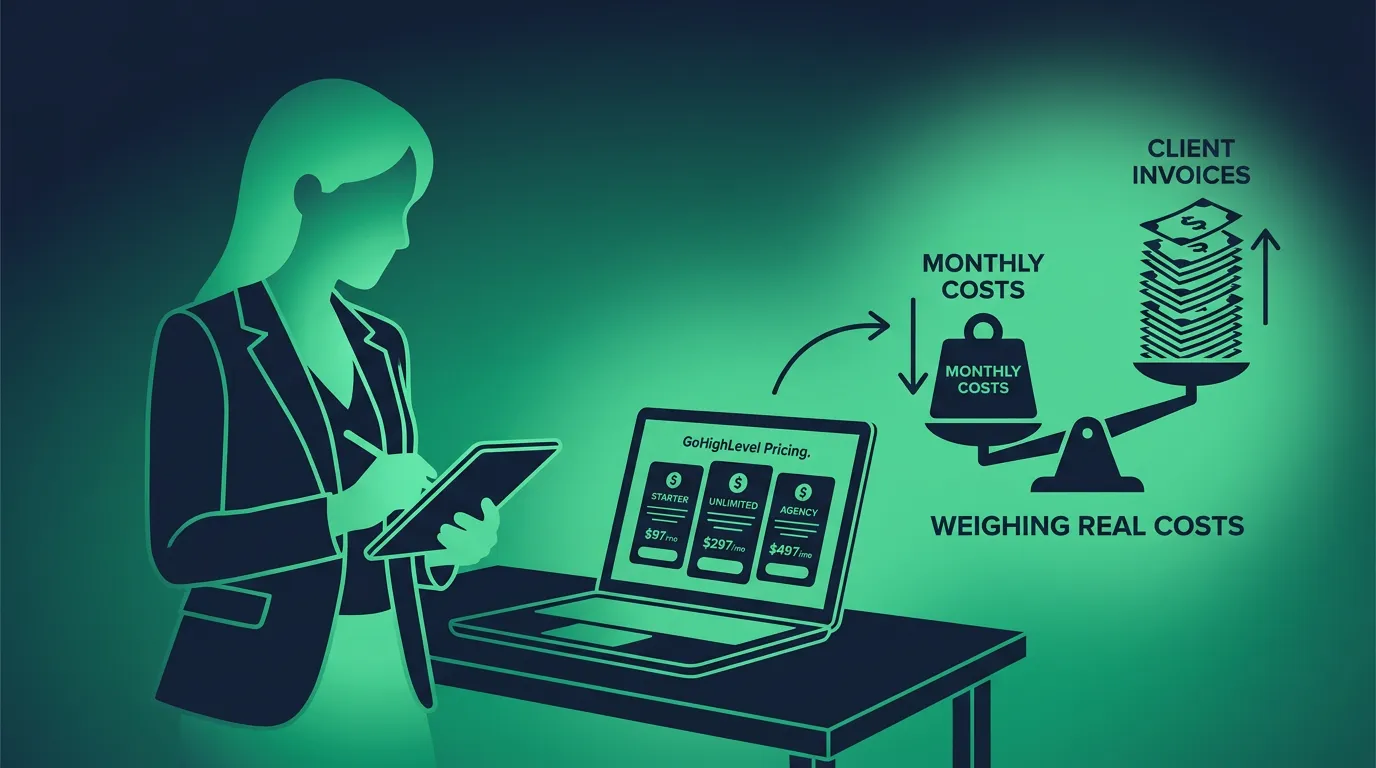
GoHighLevel’s Starter plan is $97/month ($970/year) with unlimited users and contacts. Agency Pro ($497/month) adds user and agent reporting, which matters if you’re running a team. Usage is billed on top, and at call center volume it adds up. Voice runs $0.0166 per minute outbound and $0.01165 per minute inbound in the US and Canada, local numbers cost $1.15 a month, recording costs $0.0025 per minute and transcription $0.024 per minute. SMS costs $0.00747 per segment plus carrier fees.
A worked example: five agents each handling 4 hours of outbound talk time a day for 22 days is 26,400 minutes, about $438 a month in outbound voice before recording. That’s still cheaper than five Talkdesk Voice Essentials seats ($525 a month), but it’s no longer a $97 tool.
Voice AI is billed per use, starting at $0.045 per minute for the voice engine plus text-to-speech, language model tokens and phone minutes, unless the sub-account has an AI Employee plan ($50 or $97 per month). See our GoHighLevel pricing breakdown for every tier.
Where GoHighLevel stops
The missing pieces are the ones that define contact center operations. HighLevel’s docs describe simultaneous ringing and IVR routing, but no call queue where callers wait on hold for the next free agent, no sequential or skills-based routing and no ACD. Its dialer changelog shows a click-to-call softphone; we found no predictive or power dialer and no answering-machine detection. There’s no live monitoring, whisper coaching or barge for supervisors, and no workforce management for schedules and adherence.
That rules GoHighLevel out as the phone system for any BPO, high-volume support desk or outbound telemarketing floor. It can still be the CRM underneath a separate phone platform, connected through its API or Zapier, if your team wants its follow-up automation. Most enterprise service teams will be better served by a service CRM with native contact center integration, such as Salesforce Service Cloud or Zendesk.
Choosing a call center CRM system
Start with call direction and concurrency. If callers regularly outnumber available agents, you need queues, and that means a contact center platform. If agents mostly call leads back or take a manageable stream of inbound calls, a CRM with a built-in phone can work.
Then count seats. Five9 requires 50 seats. Talkdesk and NICE CXone price per agent from $105 to $110 at entry level. Aircall starts at three licenses. GoHighLevel’s flat price favors small teams with many users and moderate call volume.
Check outbound compliance next. Teams dialing consumers need TCPA consent records and do-not-call list handling, and contact center platforms build those controls into their dialers. In GoHighLevel, consent and Do Not Disturb settings live on the contact record, so your workflows have to respect them.
Finally, evaluate CRM integration with real calls from your own queue during a trial. The best call center CRM is the one that gets interaction history in front of agents without extra clicks.
For the platform in full, read our GoHighLevel review. Related industry guides cover CRM for banking, CRM for service businesses, CRM for hotels and CRM for retail, and our best CRM software guide compares tools across industries.