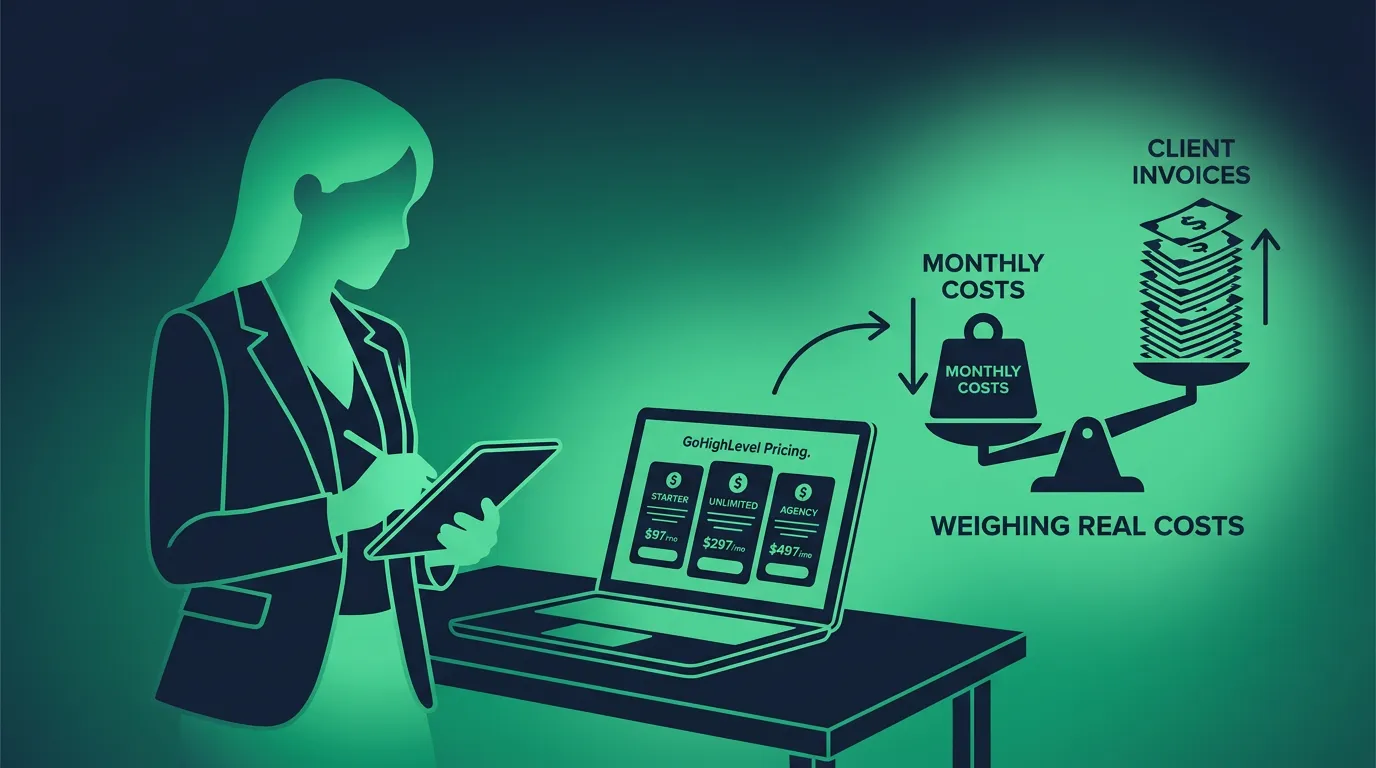
GoHighLevel is worth it if you run a marketing agency or a service business and would otherwise pay for five or six separate tools: a CRM, a funnel and website builder, an email and SMS platform, a scheduler, a review tool and a course host. It isn’t worth it if you want one simple, polished tool you can learn in an afternoon, because GHL’s breadth comes with a real learning curve and usage costs on top of the subscription.
This honest review is written for agency owners and service business operators. It covers what the platform does, what it really costs (including the usage fees most reviews skip), where it falls short, and who should use it. Prices and plan details come from HighLevel’s pricing page and help center, checked on October 2, 2026. If you need the short version on plans and fees, read our GoHighLevel pricing breakdown.
What is GoHighLevel and how does it work?
GoHighLevel (also written Go High Level, sold as HighLevel, and shortened to GHL) is an all-in-one platform for marketing agencies and local businesses, founded in 2018 in Dallas by Shaun Clark, Varun Vairavan and Robin Alex. It was bootstrapped at first, then took a $60M+ minority investment led by PeakEquity Partners in 2021 and a growth investment from General Atlantic in 2024.
The structure is built for agencies. You get an agency account, and inside it you create sub-accounts, one per client business. Each sub-account has its own contacts, pipelines, funnels, phone numbers, calendars and automations, walled off from the others. A local business owner can also buy GoHighLevel for themselves and run a single sub-account. Our explainer on what GoHighLevel is covers the account model in more depth.
Key GHL features, module by module
GHL’s feature list is long. Here are the parts that matter in day-to-day use; the full module-by-module tour is on our GoHighLevel features page.
CRM and pipeline management
The CRM stores contacts, companies, conversations and opportunities, with drag-and-drop pipeline boards for tracking deals through stages. Every text, email, call and social message lands in one conversations inbox per sub-account. Pipeline management works well for service businesses with simple sales stages. Sales teams that live in a CRM all day usually find Pipedrive or HubSpot more intuitive, and the reporting is shallower than HubSpot’s.
Funnels, websites and landing pages
The drag-and-drop builder handles funnels, landing pages and full websites, with templates, forms, surveys, order forms and one-click upsells. You can build funnels for lead capture or sales, host them on custom domains and connect them straight to the CRM and workflows. It does the job, but ClickFunnels’ editor is more refined and has more polished templates.
Email and SMS marketing automation
The workflow builder is the core of the platform. Triggers (form submitted, appointment booked, tag added, payment received) start multi-step sequences with conditional branching, waits, emails, texts, calls, internal tasks and webhooks. This is where GHL earns its keep: you can automate lead follow-up across email, SMS, Facebook Messenger and Instagram DMs from one place. WhatsApp is available as a $10/mo per sub-account add-on plus Meta’s message fees.
As an email marketing tool, the editor and segmentation are more basic than ActiveCampaign’s. For most agency follow-up sequences that doesn’t matter. For a newsletter-heavy business, it might.
Missed-call text back and voicemail drops
When a lead calls and nobody answers, GHL can send automatic SMS messages within seconds. Paired with ringless voicemail drops and workflow follow-up on incoming calls, this is one of the most valuable automations for local service businesses (contractors, dentists, law firms), where a missed call is usually a lost job.
Reputation management
Sub-accounts can send automated review requests by text or email after a job or appointment, monitor Google reviews and reply from inside the platform. Reviews AI can draft replies at $0.01 per review unless the sub-account is on an AI Employee plan. For local businesses whose customers check Google reviews before calling, this module alone replaces a paid review tool.
Calendars, courses and memberships
Booking calendars cover round-robin team scheduling, reminders and payments at booking, so most users can drop a separate scheduler like Calendly. Course and membership hosting is included for selling or delivering training, communities and client portals.
Snapshots
A snapshot is a template of an entire sub-account: workflows, pipelines, calendars, funnels, forms, templates and custom fields, without live contact data. Agencies build one setup per niche and load it into each new client account, or buy one from the snapshot marketplace. This is GHL’s best tool for onboarding many similar clients quickly. Some agencies sell their snapshots to other agencies as a side revenue stream. See our guide to GoHighLevel snapshots.
GoHighLevel AI features and what they cost
GoHighLevel’s AI tools are available on every plan, and none is free by default. Conversation AI answers texts and chats, Voice AI handles inbound and outbound phone calls, Content AI writes copy and images, and Reviews AI drafts review replies. Billing works like this:
| AI option | Price | What you get |
|---|---|---|
| Pay-per-use (default) | Metered | Voice AI: $0.045/min engine + text-to-speech (from $0.015/min) + LLM tokens + phone minutes. Reviews AI $0.01/review. Content AI $0.063/image, $0.0945 per 1,000 words |
| AI Employee Growth | $50/mo per sub-account | 1,000 Conversation AI responses, 100 Voice AI minutes, unlimited Reviews AI and Content AI |
| AI Employee Unlimited | $97/mo per sub-account | Unlimited Conversation, Voice, Reviews and Content AI under fair use; Agent Studio and phone charges still extra |
Only Agency Pro can rebill AI usage to clients. If an older review tells you AI is “bundled” into a tier, it’s out of date. Test Voice AI on your own call scripts before trusting it with live client leads.
GoHighLevel pricing breakdown and hidden costs
GoHighLevel offers three published plans and a custom Enterprise tier. Contacts and users are unlimited on all of them.
| Plan | Monthly | Annual | Sub-accounts | Key additions |
|---|---|---|---|---|
| Starter | $97 | $970 | 3 | All core features; no rebilling |
| Unlimited | $297 | $2,970 | Unlimited | White-label desktop app, custom domains, rebill phone and email at cost, basic API |
| Agency Pro | $497 | $4,970 | Unlimited | SaaS Mode, automated sub-account creation, rebilling with markup (including AI), advanced API |
| Enterprise | Custom | Custom | Unlimited | Dedicated support, custom development, white-label mobile app, HIPAA |
Some partner pages still use the old name for Agency Pro (formerly marketed as SaaS Pro).
The hidden costs are usage. SMS is $0.00747 per segment in the US and Canada, plus carrier fees. Local numbers are $1.15/mo. Outbound calls are $0.0166/min. LC Email is $0.675 per 1,000 sends. Every business texting US customers also needs A2P 10DLC registration, which carries a one-time brand fee plus monthly campaign fees. Add-ons include WhatsApp ($10/mo per sub-account), HIPAA compliance ($297/mo), a dedicated email IP ($59/mo) and the white-label mobile app ($497/mo).
Agencies on Unlimited can pass phone and email usage through to clients at cost; Agency Pro can mark it up. Starter can’t rebill. Our SMS pricing guide and full GoHighLevel pricing breakdown model real monthly totals.
White-label and SaaS Mode
Can you white-label GoHighLevel? Yes, in layers. Unlimited lets clients log in to a desktop web app on your domain with your branding. Agency Pro adds SaaS Mode: you set your own subscription prices, sub-accounts are created automatically when a client pays through Stripe, and you rebill usage with a markup. That’s how agencies resell it to clients as their own branded software and build recurring revenue on top of services.
The branded mobile app is the exception. It’s a $497/mo (or $1,491/quarter) add-on, included only on Enterprise. Some users report stability problems with it, such as unreliable push notifications; treat those as anecdotal and test it yourself. Our SaaS Mode guide and the GoHighLevel for agencies page go deeper on the resale setup.
Using GoHighLevel: is the learning curve steep?
Yes, more than most marketing tools. Users on Reddit and in the HighLevel community commonly describe several weeks of setup and a couple of months before they’re comfortable. Two things drive that: the platform has a dozen modules, and the workflow builder can do a lot, so there’s a lot to learn.
You can shorten the ramp. Start from a snapshot for your niche instead of a blank account. Use HighLevel’s help center and 24/7 support. HighLevel also runs a paid certification program ($97/mo or $970/yr) for admins who want structured training; see our GoHighLevel certification page. Budget the setup time like any other cost, because agencies that expect a plug-and-play tool are the ones who quit during the trial.
Email deliverability
LC Email, GoHighLevel’s built-in email service, runs on Mailgun. Deliverability complaints show up in user reviews, usually from accounts sending from an unauthenticated domain on shared infrastructure. Set up a dedicated sending subdomain, configure SPF, DKIM and DMARC, warm the domain up slowly and clean your lists. If volume justifies it, the $59/mo dedicated IP gives you your own sender reputation. You can also connect your own Mailgun or SMTP provider.
Integration options
GoHighLevel connects natively to Stripe, PayPal, Authorize.net and NMI for payments, Google (Calendar, Business Profile, Ads), Facebook and Instagram, Shopify, Zoom and Slack. Its REST API v2 and webhooks cover custom builds, and Zapier or Make handle the long tail. WordPress hosting is available as an add-on. Check any integration you depend on, such as accounting software, inside a trial account before you commit. Our GoHighLevel integrations page has the full list.
GoHighLevel pros and cons in practice
The pros are real: one login, unlimited sub-accounts on Unlimited and Agency Pro, and automations that replace hours of manual follow-up. The cons come from the same breadth. The funnel builder is less refined than ClickFunnels, the CRM less intuitive than Pipedrive, and the email marketing tools more basic than ActiveCampaign. Each gap is small on its own; together they’re the price of having one platform.
Costs are harder to predict than the headline suggests, because texts, calls, email, A2P fees and AI all meter separately. The platform is built for inbound lead follow-up, so teams doing heavy cold outbound usually need a dedicated prospecting tool too.
GoHighLevel vs ClickFunnels, HubSpot and Zoho
Against ClickFunnels, GoHighLevel adds a full CRM, two-way SMS, calendars, reputation management and client sub-accounts at the same $97 entry price. ClickFunnels has the better funnel editor. Details in GoHighLevel vs ClickFunnels.
Against HubSpot, GoHighLevel is far cheaper for agencies: HubSpot’s Marketing Hub Professional is $800/mo billed annually plus a $3,000 onboarding fee, and HubSpot prices by seat and marketing contact. HubSpot has the better CRM, reporting and integration marketplace. See GoHighLevel vs HubSpot.
Against Zoho CRM, the question is what you need. Zoho is a customizable sales CRM, free for up to 3 users with per-user paid editions. It has no funnel builder, booking-led SMS follow-up or white-label sub-accounts. If you only need a sales CRM, Zoho is cheaper. If you need the marketing tools, GHL replaces more. For more options, see our GoHighLevel alternatives.
Who should use GoHighLevel, and who should skip it
Use it if you’re an agency owner managing several client accounts, a local service business that lives on calls, texts, bookings and reviews, or an agency that wants to build a white-label SaaS product. The more tools it replaces, the better the deal.
Skip it if you only need email marketing, only need a sales CRM, sell mostly through cold outbound, or need something working this week with no time for setup. A focused tool will be cheaper and faster to learn.
Is GoHighLevel really worth it?
Do the replacement math. Add up what you pay now for a CRM, an email tool, an SMS platform, a funnel or website builder, a scheduler and a review tool. If that total is above $97 for one business, or above $297 for an agency with clients, GoHighLevel probably saves money, even after usage fees. Then add the per-client view: Unlimited costs $99 per client at 3 clients and $29.70 per client at 10. Contact-priced tools move the other way as you grow.
If the numbers work, run the 14-day free trial against one real client workflow, not a demo, and track what it would cost in usage. Our page on whether GoHighLevel is worth it walks through worked examples for agencies and single businesses.