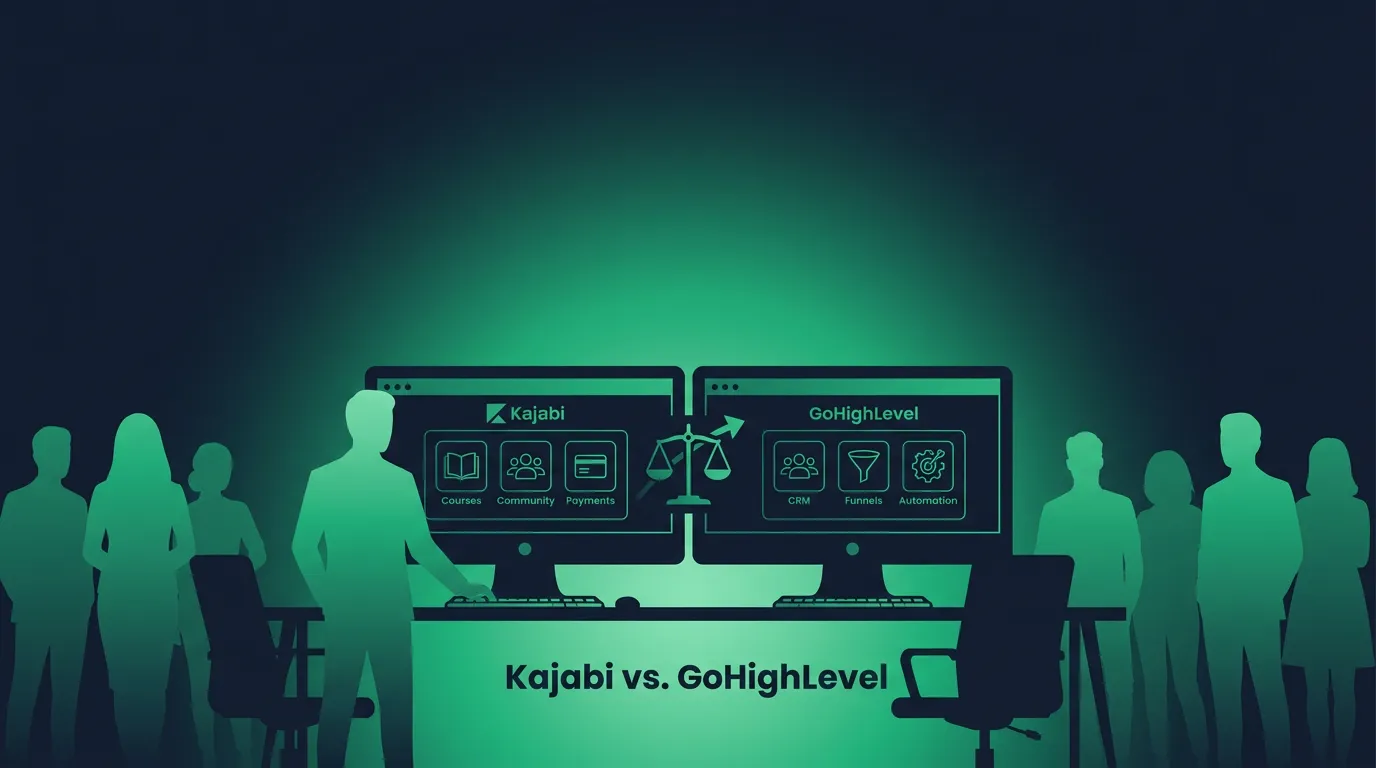
Kajabi is the better choice for course creators whose business is the course, because building, selling and delivering online courses and memberships is what the whole platform was designed around. GoHighLevel is the better choice when the course is one part of a business that also sells coaching calls, consulting or services, because its CRM, pipeline, booking and SMS follow-up do the selling work Kajabi doesn’t.
Both platforms call themselves all-in-one, which is why the Kajabi vs GoHighLevel question is confusing at first. They start from opposite ends. Kajabi starts with the product you sell. GoHighLevel (HighLevel, or GHL) starts with the lead you’re trying to close.
The key differences between GoHighLevel and Kajabi
Kajabi focuses on content creators: course creators, coaches and other business owners who sell knowledge. Kajabi offers a course builder, coaching products, communities, email marketing, funnels and landing pages, a website builder, quizzes and native checkout in one dashboard. It’s the platform for someone who wants to build and sell online courses without stitching together an LMS, an email tool and a cart.
GoHighLevel is an all-in-one marketing platform built for agencies and service businesses, and HighLevel’s multi-channel tools (SMS, calls, email, social messages) are the core of it. GoHighLevel offers a full CRM with pipelines, a funnel and website builder, booking calendars, email and SMS marketing, calling, reputation management, workflow automation, and courses and memberships. Agencies can manage multiple clients under one login with sub-accounts and resell the platform on Agency Pro. Course hosting is included, but it’s one feature among many.
GoHighLevel pricing vs Kajabi pricing
| GoHighLevel | Kajabi | |
|---|---|---|
| Entry plan | Starter, $97/mo ($970/yr) | Basic, $179/mo ($143/mo annual) |
| Middle plan | Unlimited, $297/mo ($2,970/yr) | Growth, $249/mo ($199/mo annual) |
| Top plan | Agency Pro, $497/mo ($4,970/yr) | Pro, $499/mo ($399/mo annual) |
| Contacts | Unlimited on every plan | 2,500 / 25,000 / 100,000 |
| Products | No published product cap | 5 / 50 / unlimited |
| Usage costs | SMS $0.00747 per segment plus carrier fees, LC Email $0.675 per 1,000, AI per use | AI credits included (0 / 500 / 1,000) |
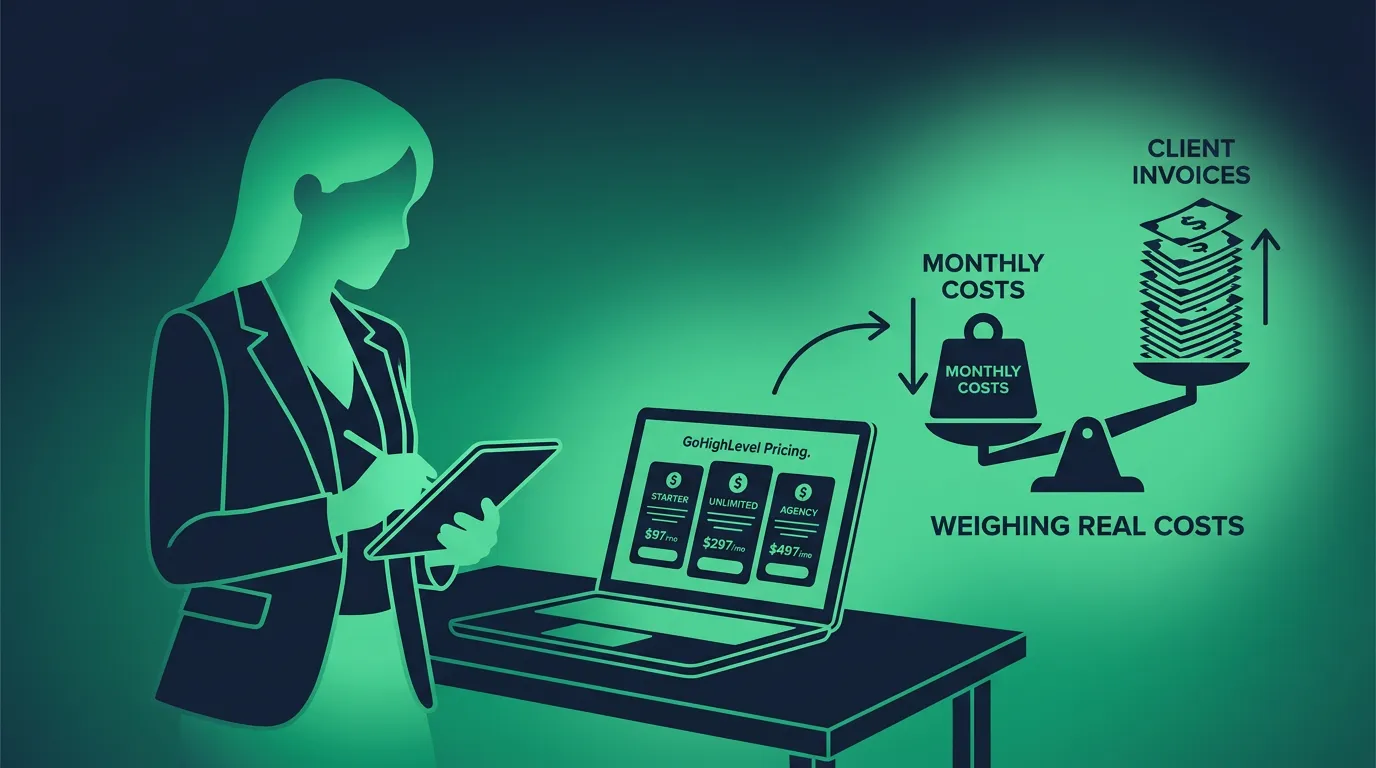
Contacts are where the two diverge. A creator with a 3,000-person email list has already outgrown Kajabi Basic and needs Growth at $249/mo. That same list fits GoHighLevel Starter at $97/mo, because GoHighLevel offers unlimited contacts on every plan. GoHighLevel’s costs show up as usage instead: email sends, texts and AI are billed on top. For a creator who mostly emails, that usage is small; for one who texts thousands of leads a month, it adds up. Our GoHighLevel pricing guide shows how those usage fees stack.
According to third-party coverage, Kajabi raised prices in January 2026 (Basic was previously $149/mo) and dropped its cheaper Kickstarter plan. The current prices above come from Kajabi’s own pricing page.
Payments differ too. Kajabi Payments charges 2.9% + $0.30 on Basic, 2.8% on Growth and 2.7% on Pro. If you use a third-party processor instead, Kajabi adds a platform fee of 2%, 1% or 0.5% depending on plan. GoHighLevel connects to Stripe and other gateways for checkout, invoices and subscriptions.
Course delivery and memberships
Kajabi wins this category, and it’s the main reason course creators choose Kajabi. Its course builder is the core product: modules and lessons, quizzes, coaching products, drip content and cohort-based courses with access groups (cohort courses need Growth or higher). Compared to GoHighLevel, Kajabi provides a cleaner student experience and a more polished membership site, and Pro adds a branded mobile app so members can learn on their phones inside your own brand. Kajabi excels at the post-purchase part of the business, where a member who stalls in week two is a renewal at risk.
GoHighLevel’s courses and memberships cover the essentials: you can build a course, sell it through a funnel, gate it behind a membership, drip lessons and grant access automatically when someone pays. It works well for a lead magnet, a client onboarding course or a modest paid program. The course builder and student area are plainer than Kajabi’s, and creators who live inside their course platform every day will feel the difference.
Communities
Kajabi includes communities on every plan, with three on Pro, and the feature is designed around keeping paying members engaged. GoHighLevel also includes communities, and they connect to the same CRM contact records as everything else, which helps if your community doubles as a sales list. For a membership business where community drives renewals, Kajabi is the safer bet.
CRM, pipeline and booking
GoHighLevel wins here, and the gap is just as wide in the other direction. Its CRM tracks contacts through pipeline stages from first contact to closed deal, with tasks, notes, opportunity values and a unified inbox for SMS, email, Facebook and Instagram messages and calls. Booking calendars sit inside the same system, so a prospect who books a discovery call lands in the pipeline automatically. Missed Call Text Back sends a text when a call goes unanswered.
Kajabi handles contact management with tags, segments and email sequences, enough for a welcome series or a cart-abandonment reminder. Kajabi lacks a sales pipeline: its pricing page lists no deal stages or SMS. A coach selling a $2,000 program through discovery calls has no native place in Kajabi to track each prospect from booked call to signed client. Many Kajabi users add a separate CRM once they reach that point.
Marketing automation, workflows and AI
GoHighLevel’s workflow builder handles multi-channel marketing automation: a lead fills a form, gets a text within seconds, receives an email sequence, books a call, and moves through the pipeline, with branches based on what they do. Unlike GoHighLevel, Kajabi keeps automation centered on email and product access: tag someone when they opt in, send a sequence, grant a course after purchase. Advanced automations need the Growth plan.
On AI, Kajabi includes credits for AI-assisted content (500 on Growth, 1,000 on Pro, none on Basic). GoHighLevel’s AI is aimed at conversations: Conversation AI answers chats and texts, Voice AI answers phone calls, Content AI writes copy and images, and Reviews AI drafts review replies. All are available on every plan but billed per use, unless the sub-account is on AI Employee Growth ($50/mo) or AI Employee Unlimited ($97/mo). No GoHighLevel plan bundles AI for free.
Funnels, landing pages and integrations
Both platforms include unlimited funnels and landing pages with drag-and-drop builders. The difference is where the funnel ends. A Kajabi funnel usually ends at a checkout for the online course itself. A GoHighLevel funnel often ends at a booked call or a new pipeline record, with split testing, order forms and upsells available along the way.
GoHighLevel has native integrations with Stripe, Google, Facebook, Instagram, Shopify and Zoom, a REST API, and Zapier and Make for anything else. Kajabi’s API access and custom code editor are on Pro only, at $499/mo. Kajabi also includes an affiliate program from Growth up; GoHighLevel has its own affiliate manager for courses and offers.
Ease of use
Kajabi is easier to use, and the user experience is its biggest everyday advantage. Everything is organized around products, and a creator can get a course and checkout live quickly. HighLevel has a long menu of tools and a steeper learning curve, and community consensus is that it takes several weeks of setup before everything runs smoothly. That’s a fair trade for a coach who needs the CRM, and an unnecessary one for a creator who only sells a course.
What are the disadvantages of GoHighLevel?
Its course and community tools trail Kajabi’s. It takes real setup time. SMS, email, voice and AI usage is billed on top of the subscription, so costs move with activity. Some users report LC Email deliverability problems until they set up and warm a dedicated sending domain. And the white-label mobile app is a separate $497/mo add-on, included only on Enterprise.
What are the downsides of Kajabi?
It’s expensive to start, at $179/mo with no free plan, and Basic’s 2,500-contact cap is tight for anyone building an email list. Affiliates, cohort courses and advanced automations need Growth; API access and the branded app need Pro. It has no sales pipeline or SMS, so it struggles with high-ticket offers sold through calls. Reviewers also report extra fees on some Kajabi Payments transactions, such as payment plans and international cards, beyond the headline rate.
Who should choose Kajabi
Choose Kajabi if your revenue comes mainly from courses, memberships and a community, and you want the most polished place to build and sell them. Kajabi is ideal for creators who sell digital products to an audience they’ve already built and want one clean dashboard without CRM complexity. Our Kajabi review covers it on its own.
Who should choose GoHighLevel
Choose GoHighLevel if your course feeds a bigger business: coaching packages, consulting, done-for-you services or an agency. GoHighLevel wins when leads need to be booked, texted and tracked through a pipeline, and when your list is large enough that Kajabi’s contact caps would push you up a tier. Agencies that build funnels and courses for clients get sub-accounts and SaaS Mode on top. Our GoHighLevel review goes deeper on how it performs as a primary sales system.
Using Kajabi and GoHighLevel together
Some coaches run both: Kajabi for course delivery and community, GoHighLevel for lead capture, SMS follow-up, booking and the sales pipeline. It costs two subscriptions and means syncing contacts between them, usually through Zapier. It works when content delivery and sales really are separate jobs.
Moving from Kajabi to GoHighLevel
There’s no one-click migration. Export contacts from Kajabi as a CSV with their tags, import them into GoHighLevel, and map tags to GoHighLevel tags or pipeline stages. Courses, funnels, email sequences and community posts have to be rebuilt by hand, and videos re-uploaded. Keep the Kajabi course live until the GoHighLevel version is finished so enrolled students never lose access, and move recurring payments last, after checking with your payment processor how active subscriptions can be migrated.
Is there a better alternative to GoHighLevel or Kajabi?
Depending on what you sell, maybe. If funnels and checkout matter more than course depth, compare GoHighLevel vs ClickFunnels. If you want stronger email automation, see GoHighLevel vs ActiveCampaign. B2B teams that need a sales CRM should look at GoHighLevel vs HubSpot, and small businesses wanting a simpler CRM with automation can check GoHighLevel vs Keap. Our GoHighLevel alternatives list covers the full field.