The best CRM for banking depends on which job you’re filling. For the relationship system that sits next to the core and holds customer financial data, banks use platforms built for financial institutions, such as Salesforce Financial Services Cloud, nCino or Total Expert; for outreach to prospects who haven’t opened an account yet, a low-cost marketing CRM like GoHighLevel can work, as long as account data stays out of it.
Most articles about CRM in banking treat those as one purchase, and buying them as one either buys enterprise licenses a two-person lending team never needs or puts customer data into a tool with no compliance model behind it.
What a banking CRM does
Customer relationship management in banking means tracking every relationship a bank has with a household or business: accounts, loans, service requests, conversations and the next opportunity. A banking CRM system gives relationship managers, branch staff and lenders a view of each customer that would otherwise sit in five different systems.
The difference from a general sales CRM comes from three requirements.
Integration with existing banking systems. The core banking platform, usually from Fiserv, FIS or Jack Henry, is the system of record for every account and transaction. A banking CRM platform has to pull balances, products and household links from the core and keep its own CRM data in step. Without that, staff work from a second, out-of-date copy of the customer.
Compliance. Banks must identify and verify customers, and under FinCEN’s customer due diligence rule, verify the beneficial owners of legal entity customers. They screen against OFAC lists, monitor for suspicious activity under BSA/AML rules and protect customer information under the Gramm-Leach-Bliley Act. A CRM in the banking industry either supports those processes or stays out of their way.
Auditability. Examiners can ask who contacted a customer, when, and what was said. CRM functionality in a bank needs permissions, activity history and record retention that hold up to that request.
These requirements are why Salesforce sells Financial Services Cloud as a separate product, and why horizontal CRMs rarely become a bank’s main system. General CRM software such as Zoho CRM or HubSpot can be configured for the financial services industry, but the bank then builds and maintains the core integration, compliance fields and audit controls itself.
The payoff is real when it’s done well. Traditional banking spread customer relationships across branch notes, loan files and individual inboxes; modern banking expects the same banking experience in the branch, the app and the call center. A modern CRM helps banks connect those channels, and replacing a legacy CRM that can’t see core banking data is a typical reason banks and financial institutions start a CRM project.
Best banking CRM software options
| Platform | What it’s for | Published pricing |
|---|---|---|
| Salesforce Financial Services Cloud | Relationship management, sales and service for banks, wealth and insurance | Sales or Service Core $325, Advanced $500, Max $700 per user per month, billed annually |
| nCino | Commercial, small business, consumer and mortgage lending, account opening and onboarding | Not published; quote after demo |
| Total Expert | Customer engagement and marketing for banks, credit unions and mortgage lenders | Not published; quote after demo |
| HubSpot | General marketing and sales CRM some community banks use for marketing | Free CRM for 2 users; Sales Hub Professional $100 per seat per month plus $1,500 onboarding |
| GoHighLevel | Outreach and lead follow-up before an account exists | $97/month flat; usage billed separately |
Prices were checked on vendor pricing pages on 2 October 2026. For context on scale: a 20-person commercial banking team on Financial Services Cloud Sales Core pays $6,500 a month before implementation. That’s the cost of a real banking CRM solution, and for a regional bank it’s usually justified by what it connects to.
Before buying a standalone platform, ask your core provider what relationship and marketing tools it offers and how they integrate. A tool from the same vendor may integrate more tightly, while a standalone platform usually offers more flexibility, and the right banking CRM depends on how much integration work IT wants to own.
Key features of CRM for banking teams
When selecting the right CRM, judge it on the work banking teams do every day. A useful banking CRM solution should give a single view of each customer, with accounts, products and services, open service cases and recent conversations pulled from the core and other banking systems. It should support referrals between branches, lenders and wealth teams, so a teller who spots a business owner can pass the lead to a BDO and see it tracked. It should handle service cases and complaints with clear ownership and deadlines.
On the marketing side, a CRM allows banks to segment customers by product holdings, life events and channel preference, then run consent-aware campaigns. On the management side, dashboards should show pipeline by product and banker, cross-sell rates and service response times, which is how CRM systems streamline banking operations across branches and departments.
Security sits under all of it: role-based permissions, field-level restrictions on sensitive financial data, activity logs and data retention rules that match the bank’s policies. Personalized service only helps customer relationships when the data behind it is protected.
Where GoHighLevel fits in a bank
GoHighLevel is a marketing and sales automation platform built for lead-driven businesses. Inside a bank, a few jobs look exactly like that, and all of them happen before an account or loan exists.
Mortgage loan officers. A loan officer working referral partners, open houses and paid ads needs fast response and steady follow-up. Missed Call Text Back replies to an after-hours caller automatically. A form submission triggers an instant text and email. A nurture sequence checks in with a pre-approved borrower who hasn’t found a house yet. The application itself, underwriting and closing stay in the bank’s loan origination system.
Business development officers. A BDO calling on local businesses for treasury or lending relationships runs an outbound pipeline: prospect, first meeting, proposal, credit approval, onboarded. Pipeline stages and automated reminders catch the prospect who went quiet after a good first meeting.
Community bank and credit union marketing. A one- or two-person marketing team can promote a first-time homebuyer seminar, run a referral campaign for a new checking product, or follow up with event attendees. These campaigns use contact details and campaign responses only, which is the line to hold.
What it costs
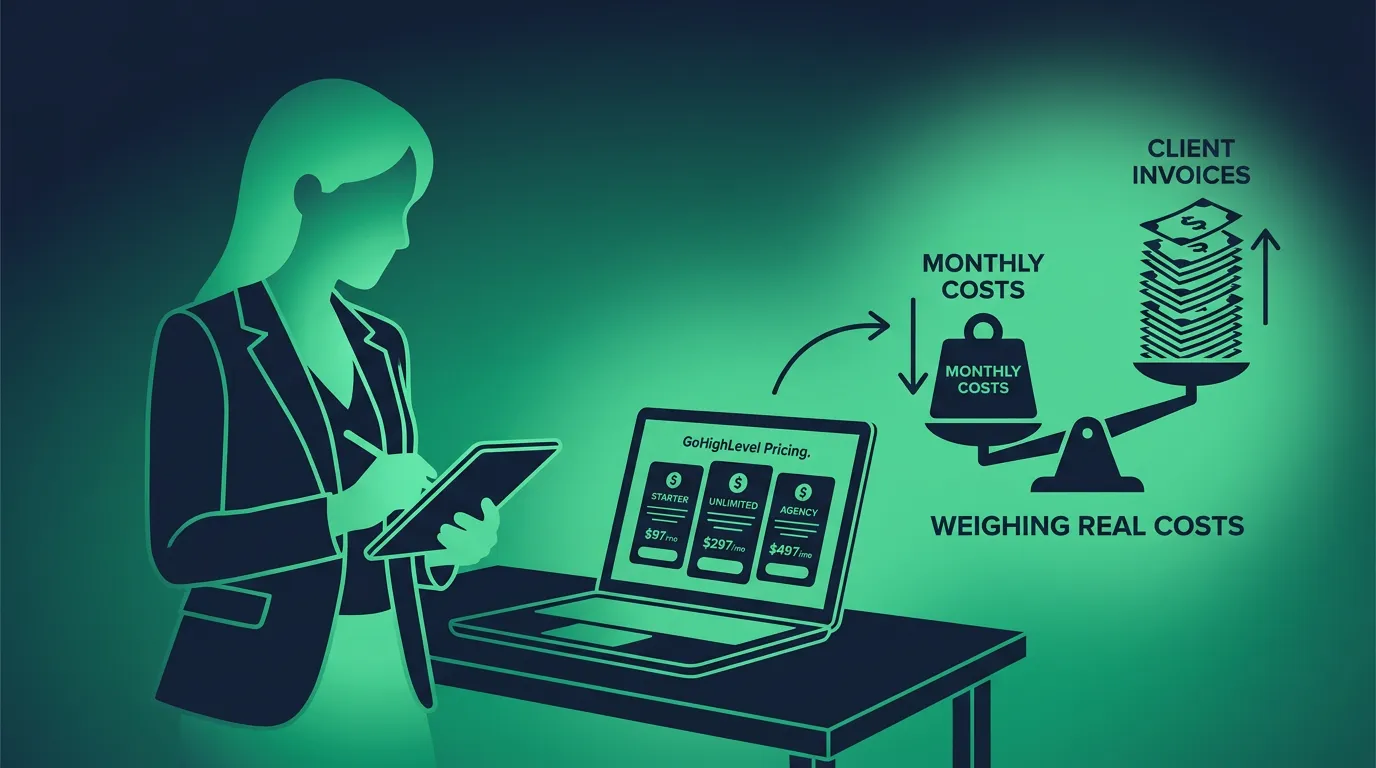
GoHighLevel’s Starter plan is $97/month ($970/year) with unlimited contacts and users and up to 3 sub-accounts. Unlimited is $297/month and suits a marketing agency serving several community banks. SMS costs $0.00747 per segment in the US and Canada plus carrier fees, and email costs $0.675 per 1,000 sends. AI features such as Voice AI and Conversation AI are billed per use unless you add an AI Employee plan ($50 or $97 per sub-account per month). Our GoHighLevel pricing breakdown has the full detail. The 14-day trial needs a card on file and charges automatically unless you cancel.
Where GoHighLevel stops
The moment a prospect becomes an applicant or account holder, GoHighLevel has nothing to contribute and real risk to add. It has no core banking integration, so balances and transactions can’t appear in it. It has no customer due diligence, beneficial ownership or OFAC screening workflow. It has no BSA/AML case management and no audit trail built for an examiner.
Vendor review is the second hurdle. Federal banking regulators issued interagency guidance on third-party relationships in June 2023, and it expects a bank to assess a vendor’s security and controls in proportion to the risk. We couldn’t find a SOC 2 report or security attestation published on HighLevel’s own site, so a bank should request one directly before approving it. A bank that can’t get comfortable with the vendor review shouldn’t use GoHighLevel at all, even for marketing.
If a bank does use it, the rules are simple. Prospects and campaign responses only. No account numbers, balances, Social Security numbers or loan application data. A documented handoff (usually an export or an integration) into the system of record once a prospect applies.
Compliance for automated outreach
Automation doesn’t change the rules a bank already follows, but it multiplies the number of messages that follow them or don’t.
The TCPA requires prior express written consent for automated marketing texts and calls to mobile numbers. Any CRM sending them, GoHighLevel included, needs consent captured at the form and stored on the contact record. Regulation B prohibits statements that would discourage prospective applicants on a prohibited basis, so loan marketing templates and audience targeting need compliance review before a workflow goes live. Customer information collected at intake is covered by the bank’s privacy obligations under the Gramm-Leach-Bliley Act.
None of that rules out automation. It means compliance signs off on templates, consent language and data fields before launch, and the bank keeps records it can produce on request.
CRM in the banking sector: retail, private and investment banking
Retail banking runs on volume: many customers, a handful of products each, and service interactions spread across branches, call centers and digital channels. Personalized service at that scale depends on a CRM that surfaces the right next product and flags a customer at risk of leaving, using data from the core.
Private banking runs on depth. A relationship manager covers a small book of high-net-worth clients across deposits, lending, trust and investments, and the CRM has to hold rich notes, household structures and service history.
Investment banking runs on deals. CRMs there track relationships with issuers, investors and counterparties across transactions lasting months, closer to enterprise B2B sales than consumer banking.
Banks use CRM differently in each segment, and GoHighLevel fits none of them as a core system. Its narrow overlap is pre-client outreach in retail and business banking: the seminar invite, the referral follow-up, the BDO’s prospect list.
Implementing CRM in banking
A banking CRM implementation is a project with a budget, an owner and a timeline. Plan for data migration from legacy CRM tools and spreadsheets, core integration, permission design, staff training and compliance review. Large rollouts commonly run for months, and a successful CRM implementation needs a named owner with authority across lending, retail, marketing and IT.
To choose the right CRM for the bank, start from the jobs your teams do:
- Map which teams need customer data from the core (relationship managers, branch staff, service) and which work only with prospects (marketing, some loan officers and BDOs).
- For core-connected work, shortlist platforms that integrate with your core, and ask each vendor for reference banks of your size on the same core.
- Run third-party risk review early, including security reports and data residency.
- Price total cost per user, including implementation, integration and add-on modules.
- For prospect outreach, decide whether the main platform covers it or whether a separate, approved marketing tool makes sense.
The benefits of CRM in banking show up when staff stop re-keying data and start acting on it: fewer missed follow-ups, faster loan pipelines, and a better customer experience because the next person who answers already knows the history. Without a CRM, that knowledge sits in individual inboxes and leaves when an employee does.
The future of CRM in the banking industry
AI is the main change in banking CRM software for the banking industry in 2026, and it shapes much of the future of banking technology. Vendors now market AI agents and assistants that draft outreach, summarize relationships and suggest next steps; nCino, for example, describes AI agents working alongside bankers on its platform. For banks, the open questions are model risk management, explainability and data controls, so AI features still go through the same review as any other vendor capability.
The split described on this page should hold. Core-connected relationship platforms keep getting deeper and more regulated, while outreach tools keep getting cheaper and faster. Banks that keep the boundary clear can use both.
Choosing the right banking CRM system by institution
Regional and larger banks: a financial-services CRM platform integrated with the core, with lending on nCino or similar. Adding GoHighLevel usually creates a second system to reconcile.
Community banks and credit unions: a financial-services CRM platform (or whatever relationship tools your core provider offers) for relationship data, plus an approved marketing tool if the marketing team needs campaign automation.
Independent mortgage teams and BDO groups doing their own prospecting: GoHighLevel can run lead response and nurture cheaply, if the bank approves it and account data never enters it.
For the full picture of the platform, see our GoHighLevel review. Other regulated and service-heavy industries face similar splits; read our guides to CRM for call centers, CRM for healthcare, CRM for retail and CRM for hotels, or compare tools broadly in our best CRM software guide.