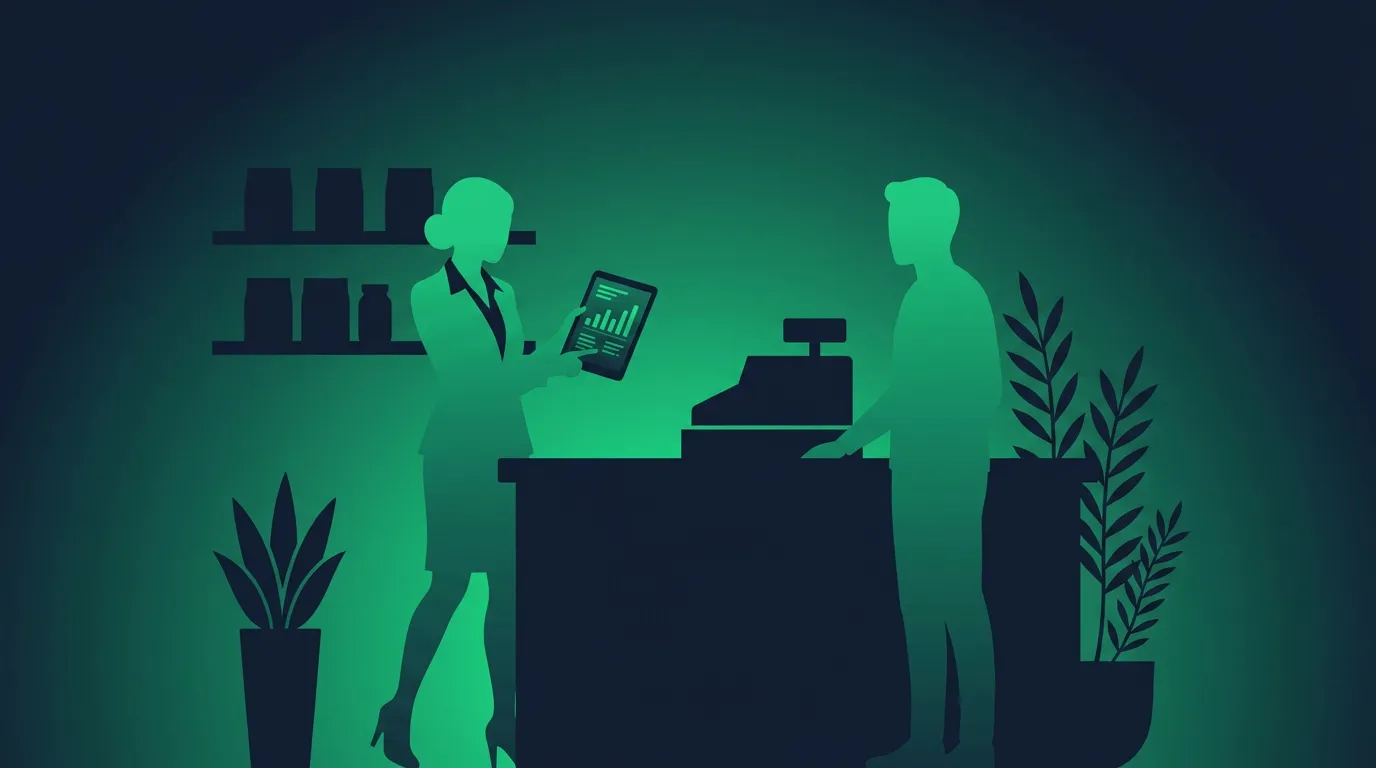
The best CRM for retail is usually the one already built into your point-of-sale system, because a retail CRM is only as good as the purchase history it can see. Shopify POS, Lightspeed Retail and Square all attach each sale to a customer profile, and Lightspeed includes a loyalty program on every plan; most stores then add a marketing tool on top to send texts and emails that bring customers back.
GoHighLevel is one of those marketing tools, not a retail management system. It’s a strong choice for local, appointment-based and multi-location retailers who want SMS, email, missed call recovery, review requests and booking for one flat price. It can’t run a register or sync stock across stores. This page covers what a retail CRM system should do, compares the retail CRM software stores actually use, and shows where GoHighLevel fits.
What is CRM in retail?
CRM stands for customer relationship management. In a retail store it means a record of every customer, what they bought, when they last visited, and how they like to be contacted, used to bring them back. Across the retail industry, the CRM can help you answer practical questions: who bought winter boots last year and hasn’t been back, which customers spend the most, and who should hear about a restock first.
Retail CRM vs a generic CRM
CRM in retail differs from a generic CRM in where the data comes from. A sales CRM like Salesforce or HubSpot is built around a sales team working a pipeline of deals. In retail there’s rarely a sales team or a pipeline. The data comes from transactions at the register and online checkout, so a retail CRM system has to integrate with the POS and e-commerce platform, or it’s guessing. That’s the main reason a purpose-built retail CRM, or the built-in CRM inside your POS, usually beats a general sales CRM for retail sales.
CRM features for retail that matter
Most retail CRM platforms list dozens of CRM capabilities, but the needs of retail businesses are narrower than the feature lists suggest. These are the ones that decide whether a retail CRM solution earns its fee:
| Feature | What it does for a retail business | GoHighLevel |
|---|---|---|
| Purchase history on the customer profile | Segments by what people bought and when | Only through the Shopify integration, its own online store or an import |
| Loyalty program | Points or visit rewards tied to sales | No native points program |
| Email and SMS marketing | Restock, flash-sale and win-back campaigns | Yes, with multi-step automation |
| Omnichannel data | One profile across in-store, online and messaging | Messaging and online store, not in-store sales |
| Inventory sync | Stops online orders overselling in-store stock | Own online store only |
| Reviews and reputation | Requests and replies to Google reviews | Yes |
| Appointment booking | Fittings, consultations, personal shopping | Yes |
The first two rows are the reason most stores start with the CRM inside their POS. The middle rows are where marketing CRMs earn their place.
Omnichannel CRM is the phrase vendors use for the fourth row. In omnichannel retail, a customer who browses online, buys in store and texts a question should land on one profile. That only works when the POS and the online store share a database, which is the strongest argument for an integrated CRM like Shopify POS for any store that sells both ways.
Leading CRM solutions for retail, by store type
Prices were checked on each vendor’s pricing page on October 2, 2026, except where noted.
| Retail CRM | Best for | Starting price |
|---|---|---|
| Shopify POS | Stores selling online and in person on Shopify | Shopify Basic $39/mo; POS Pro $89/location/mo |
| Lightspeed Retail | Multi-location stores that need loyalty and inventory | $89/mo (Basic), $149 (Core), $289 (Plus) |
| Square | Small shops that want free POS and simple marketing | Square Free $0/mo; Marketing texts 500 free, then 3¢ each |
| Klaviyo | E-commerce brands running email and SMS at scale | Free up to 250 profiles; paid plans scale with list size |
| GoHighLevel | Local and appointment-based retailers, agencies serving them | $97/mo, unlimited contacts |
| HubSpot | Retailers with a B2B or wholesale sales team | Free CRM; Starter $15/seat/mo billed annually |
| Zoho CRM | Budget-conscious retailers who want a customizable CRM | From $14/user/mo billed annually (third-party sources) |
| Salesforce | Large retailers with in-house admins | Starter Suite $25/user/mo |
POS-native CRMs: Shopify POS, Lightspeed and Square
These POS-native retail CRMs are the right choice for most stores because the customer record fills itself in at checkout. Shopify POS shares one customer profile between online and in-store orders; its POS Pro add-on ($89 per location per month) adds staff management, inventory control and customer profiles for physical stores. Lightspeed Retail includes “in-store and online loyalty” connected to customer accounts on all three plans, from $89 a month. Square’s Free plan runs the register at no monthly fee, and Square Marketing and Square Loyalty plug into the same customer directory, with marketing texts free for the first 500 and 3¢ each after.
The weakness of POS-native CRMs is marketing depth. Their campaigns are usually simple broadcasts with limited branching, which is why many stores add a dedicated marketing platform.
Email and SMS platforms: Klaviyo
Klaviyo is marketing software designed for online retail brands, most of them on Shopify. It reads order data from the store, so it can segment by product, spend and order count, and its free plan covers up to 250 profiles and 500 emails a month. Paid pricing scales with profile count, so a large list gets expensive. Klaviyo is built for e-commerce; it has no missed-call text back, booking calendar or review management for a physical store.
Generic CRMs: HubSpot, Zoho CRM and Salesforce
HubSpot CRM, Zoho CRM and Salesforce are each a general-purpose CRM platform. They make sense when a retailer also has a sales team, such as a furniture store with a commercial division, a wholesaler that also runs shops, or a brand selling to other stores. HubSpot’s Free CRM covers up to two users and Starter costs $15 per seat per month billed annually; Salesforce’s Starter Suite is $25 per user per month. Zoho sells a retail edition of its CRM, and Salesforce markets retail-specific products to large chains. All three need configuration to work for retail operations and retail workflows, and none comes with a POS.
Where GoHighLevel fits for a retail business
GoHighLevel is a marketing CRM and automation software platform. For a retail store it does the work between visits, which is where a lot of retail revenue leaks: getting a customer who bought once to come back.
SMS and email campaigns carry the most weight. A boutique can text a segment of past buyers about a restock, send a follow-up email to anyone who didn’t open, and tag whoever clicks for a second offer, all in one workflow. Email is billed at $0.675 per 1,000 sends and US texts at $0.00747 per segment plus carrier fees, so a small shop’s monthly usage cost is usually modest, but price it on your list size before you commit.
Missed Call Text Back matters more in retail than it first appears. One employee on the floor during a rush can’t answer every call about hours, stock or a special order. GoHighLevel texts the caller back automatically, which keeps that customer from calling the next shop.
Appointment-driven stores get a good fit. Bridal shops, formalwear rental, custom fittings, eyewear and furniture showrooms with design consultations all sell through a scheduled visit. Booking calendars let customers pick a slot online, and reminder texts cut no-shows.
Reviews drive local search. “Boutique near me” results depend heavily on review count and rating, and GoHighLevel can send a review request after a purchase or visit. Its Reviews AI can draft replies, billed at $0.01 per review unless the account is on an AI Employee plan ($50 or $97 per sub-account per month).
For online sales, GoHighLevel’s Shopify integration includes an abandoned-cart workflow trigger, and its built-in online store has inventory counts, SKUs and abandoned-checkout recovery. That’s enough for a small shop selling a few dozen products online. It isn’t an e-commerce platform for a large catalog.
Multi-location brands and agencies benefit from sub-accounts and snapshots. An agency running marketing for several retail clients, or a franchise with many locations, can build one campaign, review flow and booking setup and copy it into each location’s account.
Where GoHighLevel stops and POS retail software starts
Once the customer reaches the counter, GoHighLevel has little to offer. It has no in-store register, no barcode scanning, no purchase orders and no stock transfers between locations. It can’t tell you that the last size 8 sold downtown while three are still at the mall store. That’s the job of Shopify POS, Lightspeed or Square.
It also has no native loyalty points program. You can approximate one with tags and custom fields, but it breaks down once you have many products or locations. If loyalty tiers tied to spend are central to your store, put that budget into a POS with loyalty built in.
The usual setup is two systems: the POS records sales, stock and loyalty, and GoHighLevel runs the outreach. Connect them through the Shopify integration, Zapier or Make, so a new online customer starts a welcome sequence and an in-store purchase triggers a review request without anyone retyping a phone number.
How AI enhances retail CRM
An AI-powered CRM in the retail sector mostly helps with segmentation, product recommendations and writing. E-commerce tools such as Klaviyo work from order data; GoHighLevel’s AI is aimed at conversations instead. Conversation AI can answer common texts and web chats about hours, stock questions or booking, and Content AI drafts campaign copy. Every AI feature in GoHighLevel is billed per use unless you add an AI Employee plan, so test it on a small segment first. AI won’t fix a customer list with no purchase data attached, which is why the POS integration comes first.
Is it hard to implement a retail CRM?
A CRM built into your POS takes almost no setup, because customer profiles fill in as you sell. A marketing CRM takes longer. In GoHighLevel you import customers, connect your Shopify store or POS through an integration, register for A2P texting, then build your first campaigns. Most of the work is deciding what to send and to whom.
Keep the first CRM implementation small. Start with a review request after each purchase and one restock or win-back campaign, measure it for a month, and add more after that. A retail owner building it alone on evenings will take longer than one who hires an agency or buys a ready-made template.
Which retail businesses GoHighLevel fits
GoHighLevel fits retailers whose growth depends on reaching customers they already have: boutiques running SMS flash sales, gift and apparel shops with a local following, showrooms that sell through consultations, bridal and formalwear stores, and multi-location specialty chains managed by a marketing agency.
It fits poorly for high-SKU, department-style retailers and pure e-commerce brands, the two ends of modern retail that live on transaction data. A department store needs loyalty tied to every transaction and stock accuracy across locations. An online-only Shopify brand is usually better served by Klaviyo, which reads order data natively.
Other industries face versions of the same choice. The call center CRM guide covers the same speed-to-respond problem at higher inbound volume, and our pages on banking and healthcare deal with compliance rules retail doesn’t have. Nonprofits track donors much as stores track customers, which we cover in the nonprofit CRM guide.
How to choose the right CRM software for retail
Start with your POS. If you’re on Shopify, Lightspeed or Square, use its customer profiles as the system of record and don’t pay for a second CRM to duplicate them. Then decide whether its built-in marketing is enough. If you’re sending one email a month, it probably is.
Count active customers you could reach today, not lifetime buyers. A shop with a few hundred reachable customers and a busy phone line benefits from automated texts, review requests and missed-call recovery. A shop that mostly serves walk-ins and regulars may not need a marketing CRM yet; for that kind of small retail business, the CRM in the POS is enough.
Then match the marketing tool to the channel, since no single CRM solution covers every retail customer journey. Online-first brands should look at Klaviyo. Local and appointment-based stores, and agencies serving several retailers, get more from GoHighLevel’s mix of texting, calls, booking and reviews. Check the integration with your POS before you buy, and test it with a free trial: GoHighLevel offers 14 days with a card on file.
If GoHighLevel looks right for the marketing side, GoHighLevel’s pricing tiers explain which plan fits a single store versus an agency running several, and our GoHighLevel review covers the platform as a whole. For tools beyond GoHighLevel, start from our best CRM software roundup.