The best CRM for marketing in 2026 is GoHighLevel for service businesses and marketing agencies, HubSpot for B2B teams that need deep reporting, and ActiveCampaign for email-led businesses with a modest list. The right pick depends on how leads reach you, how fast your list will grow, and whether your industry needs a separate tool for compliance work after the sale.
This guide explains what CRM marketing is, which features matter, how the main CRM options compare on price, and where each industry’s needs split off. If you already lean toward GoHighLevel, the GoHighLevel pricing breakdown and the full GoHighLevel review cover the details.
What is CRM marketing?
CRM stands for customer relationship management (our explainer on what CRM stands for covers the history). A CRM system is a database of every person who has contacted your business and everything that happened next: calls, emails, form fills, appointments, quotes and payments. Customer relationship management software exists to manage customer relationships in one place instead of across a phone, an inbox and a spreadsheet.
CRM marketing, or customer relationship management in marketing, is using that customer data to run your marketing. Instead of sending the same email to everyone, the CRM knows a contact’s lead source, stage and recent customer activities, and automations send relevant marketing messages based on that. A marketing CRM adds three things to a plain sales CRM: lead capture (forms, landing pages and funnels that feed the database), automated follow-up (email and SMS sequences triggered by behavior), and segmentation (treating a hot lead differently from a cold one without someone deciding by hand).
CRM database vs marketing automation tools
Buyers often use the two terms interchangeably. A CRM database stores contacts, interactions and deal stages. Marketing automation software sends messages based on triggers and rules. A CRM with no automation is an organized address book; automation with no CRM fires blind, with no record of what a contact already did. Modern CRM systems built for marketing combine both, which is why GoHighLevel, HubSpot and ActiveCampaign all appear on the same shortlists even though they started as different kinds of products.
How CRM marketing automation works
Every automation has the same three parts. A trigger (a form submitted, a tag added, an appointment booked, an email clicked) starts it. Conditions check the CRM data (lead source, pipeline stage, last purchase, location) to decide which path a contact takes. Actions send the email or text, update the record, notify a salesperson or move the deal. Because the automation reads the CRM record, it can skip a contact who already booked, stop a sequence when someone replies, and send different marketing messages to a first-time lead and a repeat customer. That’s the difference between CRM marketing automation and a scheduled email blast.
Operational, analytical and collaborative CRM
Vendors describe three types. Operational CRM covers contact records, pipelines and follow-up workflows. Analytical CRM covers reporting, attribution and forecasting. Collaborative CRM keeps sales and marketing teams on one shared customer record. For most small businesses, the operational and collaborative parts matter most; analytical depth matters more as ad spend grows.
CRM marketing examples
A landscaping company runs Google Ads. A homeowner fills out a quote form at 9pm. The CRM tags the lead source, sends an instant text, and offers a booking link for an estimate. After the job is invoiced and paid, the same system sends a review request. One record tracks the contact from click to review.
A dental practice uses its CRM to send recall reminders six months after a cleaning, segmented by last visit date, and a reactivation campaign to patients who haven’t booked in 18 months.
A B2B software company scores leads by email clicks and pricing-page visits, routes high scores to sales, and keeps low scores in a nurture sequence. Attribution reporting then shows which marketing channels produced pipeline, which guides next quarter’s marketing investments.
Benefits of using CRM software for marketing
The main benefit of using CRM software for marketing efforts is speed. Leads that wait hours for a reply often book with whoever answered first, and a CRM responds in seconds at any hour.
The others follow from having one system. Marketing and sales teams work from a single source of truth instead of competing spreadsheets. Segmentation makes marketing campaigns more relevant, which improves the customer experience and customer retention. Reporting shows which campaigns produce revenue, so you can move budget away from the ones that don’t. Over time, the CRM data also shows customer lifetime value by lead source, which tells you how much each marketing campaign can afford to spend per lead. And automation removes repetitive marketing tasks such as reminders, follow-ups and review requests, so a small team can manage marketing for more leads without hiring.
Essential CRM features for marketing
When you compare CRM options, check these CRM features in order of impact:
- Instant lead response: automatic text or email replies to form fills, plus missed-call text back for phone leads
- Automation depth: multi-step workflows with conditional branching, not just single blast emails
- Lead capture: built-in forms, landing pages and funnels, so leads don’t pass through a Zapier connection to reach the database
- Multi-channel messaging: email and SMS from one inbox, ideally with social DMs
- Segmentation and lead scoring: ranking contacts by behavior so the right leads get attention
- Reporting: which channel and campaign produced booked appointments and revenue
- Pricing that scales: flat fee or contact-based, projected 12 months out
- Integrations: payments, calendars, ad platforms and the rest of your stack
Price tiers rarely line up with these. A cheap tool can nail instant response and skip landing pages; an expensive one can have everything and still raise your bill every time your list grows.
Best CRM for marketing: CRM pricing and options compared
Here’s how the main CRM marketing platforms compare on price and fit. Prices were checked against vendor pages on October 2, 2026; ActiveCampaign figures come from 2026 third-party pricing guides because its pricing page renders dynamically.
| CRM | Best for | Starting price | Pricing model |
|---|---|---|---|
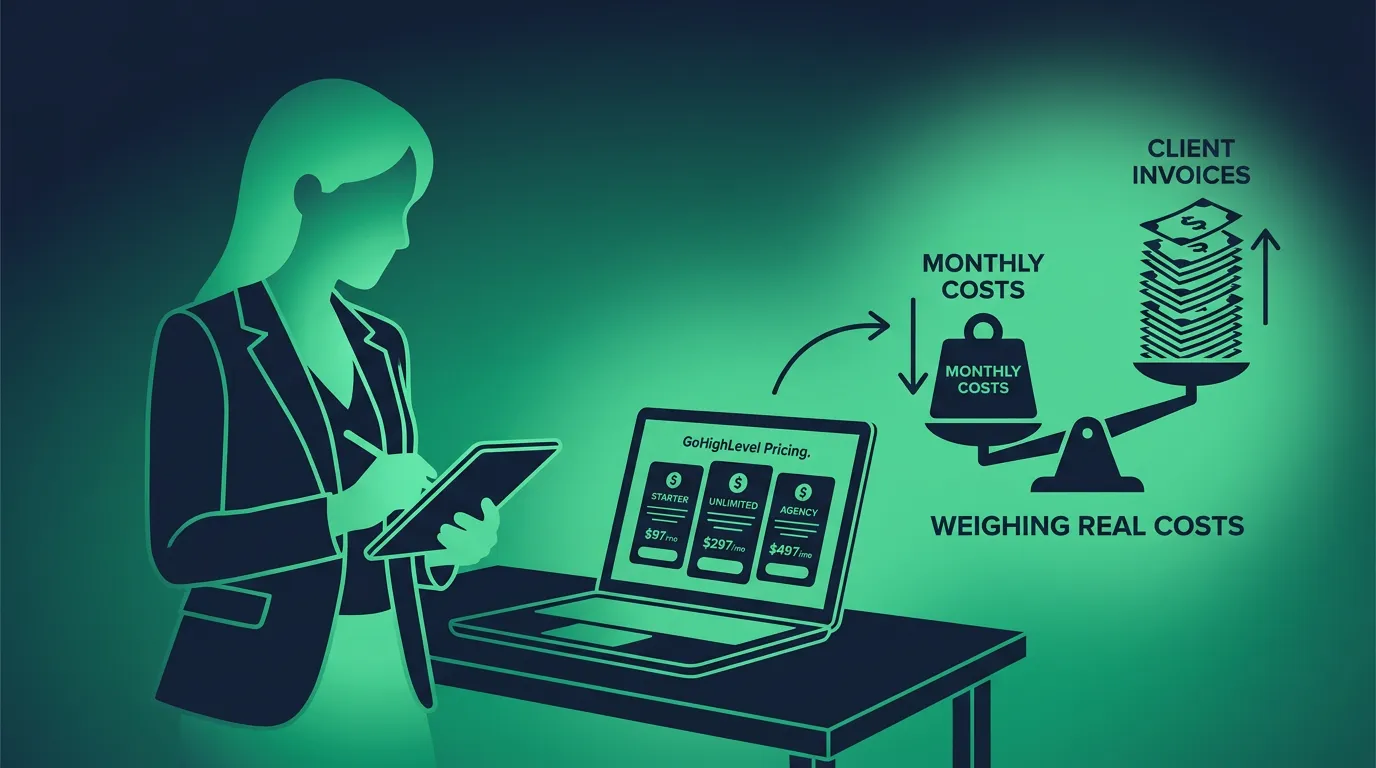
| GoHighLevel | Service businesses and marketing agencies | $97/mo (Starter) | Flat; unlimited contacts and users; usage extra |
| HubSpot | B2B teams needing deep reporting | Free CRM; Starter $20/seat/mo | Per seat, per Hub, marketing contact tiers |
| ActiveCampaign | Email-led marketing | $19/mo for 1,000 contacts | Per contact |
| Keap | Small businesses wanting guided setup | $299/mo (1,500 contacts, 2 users) | Per contact and user |
| ClickFunnels | Funnel-driven online sales | $97/mo (Launch) | Tiered by contacts and workspaces |
| Kartra | Coaches and course sellers | $59/mo (Essentials) | Tiered by contacts |
| Kajabi | Courses and communities | $179/mo (Basic) | Tiered by products and contacts |
| Vendasta | Agencies reselling to local businesses | $99/mo minimum spend | Minimum spend; 1-year contract on higher tiers |
Best CRM for marketing agencies: where GoHighLevel fits
GoHighLevel was built for marketing agencies, and its marketing tools reflect that. Every plan includes the CRM and pipelines, a funnel and website builder, email and SMS marketing, multi-step workflows, missed-call text back, booking calendars and reputation management, with unlimited contacts and users. WhatsApp is available as a $10/mo per sub-account add-on. AI tools (Conversation AI, Voice AI, Content AI and Reviews AI) are on every plan but billed per use, or flat at $50 or $97 per sub-account per month through the AI Employee plans.
Its biggest difference from other CRM platforms is the sub-account structure. Each client or brand gets its own isolated CRM, funnels and automations, and a snapshot (a template of a whole account setup) loads a working marketing pipeline into a new account quickly. That’s why GoHighLevel shows up in so many recommendations for the best CRM for agencies.
The trade-offs: users commonly report several weeks of setup, individual modules are less polished than specialists (ClickFunnels for funnels, ActiveCampaign for email), and usage is billed on top: SMS at $0.00747 per segment plus carrier fees and email at $0.675 per 1,000. Email deliverability depends on authenticating your sending domain; LC Email runs on Mailgun, and some users report inbox problems until that’s done.
GoHighLevel vs HubSpot and ActiveCampaign
HubSpot started as marketing software and built a CRM good enough to give away. The Free CRM covers up to 2 users. The tools that make it a full marketing platform (workflows, advanced landing pages, attribution reporting) are in Marketing Hub Professional at $890/mo billed monthly or $800/mo billed annually, with 3 seats and a mandatory $3,000 onboarding fee. Marketing Hub Enterprise is $3,600/mo with a $7,000 onboarding fee. HubSpot wins on reporting, more than 2,000 integrations and polish. It’s a strong fit for mid-market B2B marketing and sales teams and expensive for a single-location service business. See GoHighLevel vs HubSpot.
ActiveCampaign starts at $19/mo ($15 billed annually) for 1,000 contacts, with Plus at $59 and Pro at $89 at the same contact tier; every tier rises as your list grows. Its automation builder and segmentation are among the best for email marketing, and Pro adds predictive sending and attribution. Full sales pipelines are a paid add-on. It suits a business whose main marketing channel is email. See GoHighLevel vs ActiveCampaign.
Pick a contact- or seat-priced platform if you run complex, multi-touch B2B campaigns and need advanced CRM reporting. Pick a flat-fee all-in-one like GoHighLevel if predictable cost and fast lead response matter more.
Other all-in-one marketing CRMs
Keap sells one plan at $299/mo ($249 annually) with 1,500 contacts and 2 users, extra users at $39/mo, and guided onboarding. It suits a single small business that wants help with setup.
ClickFunnels ($97 to $297/mo, plus the annual-only Dominate tier) is funnel-first, with split testing, upsells and an affiliate center. Kartra ($59 to $549/mo) leans into checkout, memberships and a helpdesk. Kajabi ($179 to $499/mo) is a course and community platform with marketing tools around it. All three are good at what they were built for and lighter on CRM pipelines than GoHighLevel.
Vendasta is built for agencies reselling marketing products to local businesses, with $99, $499 or $999 monthly minimum spend and one-year contracts on Professional and Premium. Our GoHighLevel alternatives guide compares these in more depth.
CRM marketing channels and tools
A marketing CRM is only as useful as the channels it connects. The core set for most small businesses is email, SMS, phone calls, web forms and chat. Next come social media DMs (Facebook and Instagram), lead ads from Facebook and Google, and review sites. GoHighLevel puts email, SMS, calls, Facebook and Instagram messages and web chat in one inbox per account. HubSpot and ActiveCampaign are strongest on email and ad-platform integrations, with SMS as an add-on. Whichever CRM platform you use, connect every channel that produces leads, or your reporting will miss the campaigns that work.
CRM marketing strategies that work
The best CRM marketing strategies use the data you already have before buying more leads. A CRM strategy built on these five habits beats a bigger ad budget for most small businesses and digital marketing teams. Effective CRM marketing depends more on these habits than on which CRM solution you buy.
Respond first. Set up instant replies for every inbound channel: web forms, missed calls, Facebook lead ads and chat. This is usually the highest-return automation in any CRM.
Nurture the undecided. Most leads don’t buy on first contact. A sequence of useful emails and texts over two to six weeks keeps you in front of them without manual work.
Segment by behavior and lifecycle. Separate new leads, active customers, past customers and lost deals, and give each a different message. Past customers are often the cheapest source of repeat business.
Ask for reviews automatically. Trigger review requests when a job closes or an invoice is paid. Reviews feed every other marketing channel.
Track the source of every lead. Tag each contact with the campaign that produced it, so you can compare cost per booked appointment across marketing channels and tools.
Best CRM by industry
The marketing side looks similar across industries: get found, respond fast, nurture the undecided. What changes is the work after a lead becomes a client, and whether your industry has a requirement a marketing CRM wasn’t built for.
Accountants and bookkeepers can use a marketing CRM for intake: capturing inquiries, replying fast and booking consultations. Client document requests, tax deadlines and engagement workflows need practice management software such as TaxDome or Karbon. See CRM for accountants.
Law firms face stricter rules. Client funds must be held in trust accounts under state bar rules, and conflict checks are mandatory. No general marketing CRM, GoHighLevel included, handles trust accounting. A marketing CRM handles consultation requests, nurture and appointment reminders, and legal practice management software handles the matter after the engagement letter. See CRM for law firms.
Insurance agents compete on response speed, because a shopper often requests quotes from several agents at once. A marketing CRM’s instant response and quote follow-up fit that well. Policy management, carrier downloads and ACORD forms need an agency management system. See CRM for insurance agents.
Contractors have simple marketing needs (fast estimate response, review requests) and complex operations: job costing, crew scheduling and change orders. Most pair a marketing CRM with a construction platform such as JobNimbus or Buildertrend. See CRM for contractors.
How to choose the right CRM for marketing
Work through these in order, because the order changes the answer:
- Count monthly leads by channel. With a few referrals a month, you may not need marketing automation yet. With daily form, phone and ad leads, automated follow-up pays for itself.
- Check for industry requirements. If you need compliance or delivery tools, budget for two systems from the start.
- Project your list 12 months out. Price a flat-fee platform and a contact-based one at that size, including onboarding and usage fees.
- Decide who owns setup. All-in-one platforms need someone to spend real hours in the first month. If nobody can, buy a template, a done-for-you setup or a simpler tool.
Then run a trial with real leads. Different CRM tools look similar in a demo and very different with live data. GoHighLevel offers a 14-day free trial (card on file); HubSpot’s paid-tier trials and ActiveCampaign’s trial don’t need a card. Build one complete workflow, from form fill to booked appointment, in each tool you’re considering. If this is the first time your team will use a CRM, weight ease of use above the length of the marketing automation features list.
Is a CRM tool hard to learn?
A basic CRM with contacts and a pipeline takes days. A full marketing CRM takes longer because you’re learning automation logic, funnels, messaging and reporting at once. GoHighLevel users commonly describe several weeks of setup, and HubSpot’s mandatory onboarding fees on Professional tiers reflect the same reality. New to CRM? Whichever new CRM you choose, start with one workflow (instant response to new leads), get it working, then add nurture, reviews and reporting.