GoHighLevel beats ActiveCampaign for agencies and service businesses that want one platform for CRM, pipelines, funnels, SMS and email at a flat price. ActiveCampaign beats GoHighLevel for a single business that makes its money through email, because its automation builder, segmentation and testing tools are deeper and cheaper to start on.
That’s the short answer to “GoHighLevel vs ActiveCampaign.” The longer answer depends on how many businesses you run marketing for, how big your list is, and how much of your selling happens by phone and text instead of by email.
The core difference in one paragraph
GoHighLevel (HighLevel, or GHL to most agencies) is an all-in-one platform built for agencies. It bundles customer relationship management, sales pipelines, a funnel and website builder, calendars, SMS, calling, reviews and email automation, and it lets one agency run many client businesses as separate sub-accounts. ActiveCampaign is an email marketing and marketing automation platform for small businesses and ecommerce brands. It specializes in email: behavioral automation, segmentation, split testing and personalization, with SMS, WhatsApp and a sales CRM available as extras. GoHighLevel tries to replace six tools. ActiveCampaign tries to be the best of one.
GoHighLevel vs ActiveCampaign pricing
The two pricing models work in opposite directions, and that difference decides the comparison for a lot of buyers.
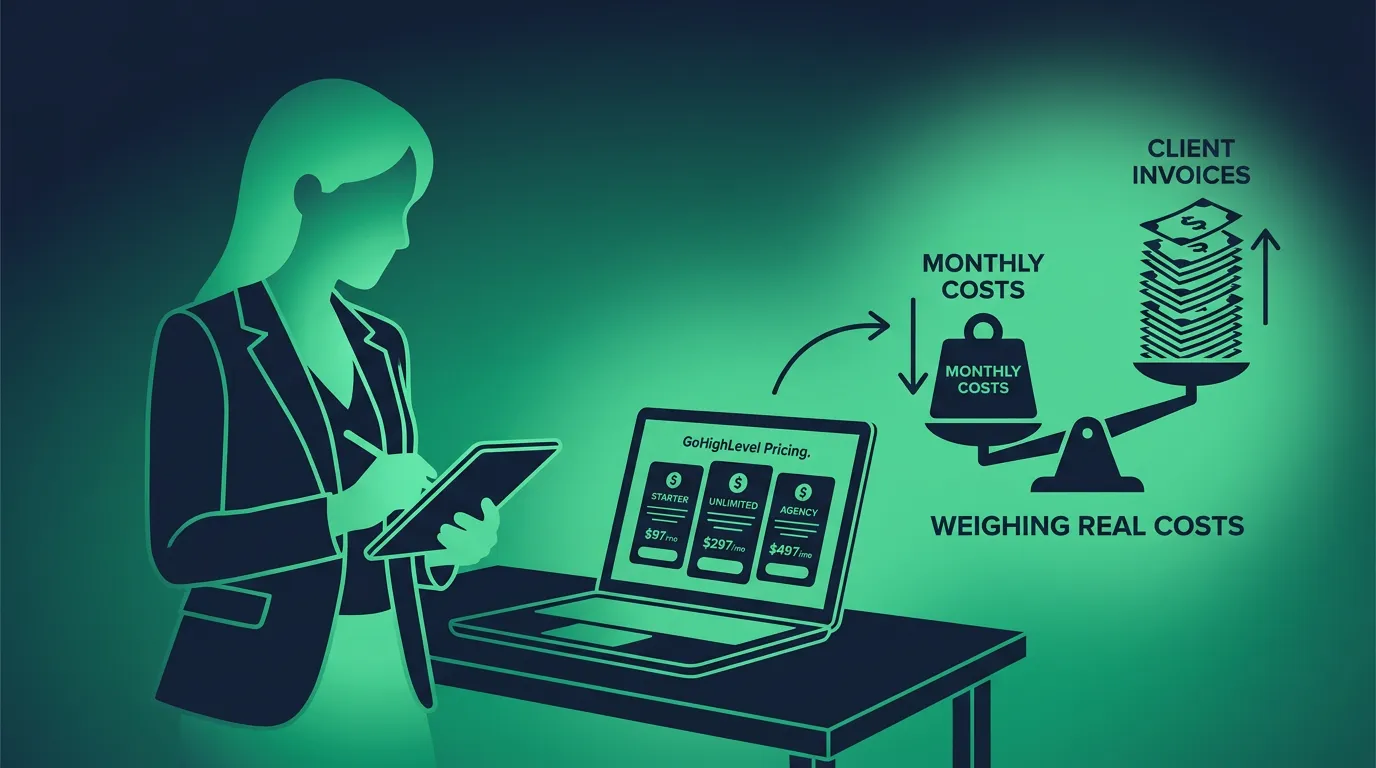
GoHighLevel charges a flat subscription. Starter is $97/mo with 3 sub-accounts and unlimited contacts and users. Unlimited is $297/mo with unlimited sub-accounts, a white-label desktop app and the ability to rebill phone and email usage at cost. Agency Pro is $497/mo and adds SaaS Mode, rebilling with markup and AI rebilling. Annual billing cuts those to $970, $2,970 and $4,970 a year. Enterprise is quoted. Contact count never changes the subscription, but usage does add to the bill: SMS runs $0.00747 per segment in the US and Canada plus carrier fees, LC Email is $0.675 per 1,000 emails, and the AI features are billed per use. Our GoHighLevel pricing breakdown covers every tier and usage fee.
ActiveCampaign prices by contact count. Third-party pricing trackers list these 2026 starting prices for 1,000 contacts (the vendor page renders prices dynamically, so check the live number for your list size):
| ActiveCampaign plan | Monthly billing | Billed annually | What it adds |
|---|---|---|---|
| Starter | $19/mo | $15/mo | Email marketing and basic automation, 1 user, no landing pages |
| Plus | $59/mo | $49/mo | Landing pages, lead scoring, unlimited automation actions |
| Pro | $89/mo | $79/mo | Predictive sending, conditional content, attribution |
| Enterprise | from $159/mo | from $145/mo | SSO, custom objects, dedicated onboarding (largely quote-based) |
ActiveCampaign is cheaper for one business with a small list. On the Plus plan, a business with 1,000 contacts pays around $49 to $59 a month, roughly half of GoHighLevel Starter. The math changes in two situations. The first is list growth, because every tier steps up as your contact count rises, and since November 3, 2025 new accounts are billed for all contacts, including unsubscribed and bounced ones. The second is client work. An agency running ten clients on ActiveCampaign pays for ten separate accounts, each priced on that client’s list, while GoHighLevel’s $297 Unlimited plan covers all ten.
CRM and sales pipeline
GoHighLevel includes a full CRM on every plan: contact records, custom fields, tags, multiple pipelines with drag-and-drop deal stages, opportunity values, tasks, and a shared inbox that pulls in SMS, email, Facebook and Instagram messages and calls. For a sales process that runs through phone calls and booked appointments, that’s most of what a small team needs.
ActiveCampaign includes a marketing CRM on every plan, meaning contact records, site and event tracking, and lead scoring. A real sales pipeline for deals is a paid add-on (Pipelines for B2C deal tracking or Sales Engagement for B2B) available on Plus, Pro and Enterprise. Pro and higher also connect to Salesforce, Microsoft Dynamics and Pipedrive if you’d rather keep a dedicated CRM. A business that wants deep email automation and a working sales pipeline ends up paying for both inside ActiveCampaign, where GoHighLevel bundles them.
CRM features go to GoHighLevel, unless your sales team already lives in Salesforce.
Automation and email marketing
ActiveCampaign’s automation builder is the reason people pay for it. The drag-and-drop canvas has conditional logic (if a contact opens but doesn’t click, send them down one path; if they click a pricing link, tag them and notify sales), goals that pull contacts forward when they convert, and more than 950 prebuilt automation recipes for welcome series, abandoned carts, re-engagement and post-purchase sequences. Its split action can divide contacts across 2 to 10 paths and pick a winning path automatically, and email campaigns support A/B split testing on subject lines, sender and content. On Pro and above you get predictive sending, which times each email to a contact’s past open behavior, plus conditional content, win-probability scoring and conversion attribution. ActiveCampaign excels at turning behavior into highly targeted marketing, and nothing in GoHighLevel matches that on email.
GoHighLevel’s workflow builder covers the automation most service businesses need: form and booking triggers, wait steps, if/else branches, tags, pipeline moves, internal notifications, and email, SMS and voicemail actions in the same workflow. That cross-channel reach is its edge. One workflow can text a lead within seconds, send an email, book the call and move the deal. Its email builder, template library and email reporting are thinner than ActiveCampaign’s, and per-recipient send-time optimization isn’t part of it.
Marketers who mainly run email marketing campaigns should use ActiveCampaign. Teams that sell by phone and text should use GoHighLevel.
Email deliverability
Neither vendor publishes inbox-placement numbers, so treat any “deliverability score” you see online with suspicion. What can be said is how each one sends.
GoHighLevel’s LC Email runs on Mailgun, according to HighLevel’s own help docs. Users commonly report better inbox placement once they set up a dedicated sending domain with proper authentication and warm it up, and some report problems on shared sending before that. A dedicated IP is available as a $59/mo add-on. ActiveCampaign has spent two decades as an email platform (it was founded in 2003) and handles authentication and sending infrastructure as a core part of the product. For a list-heavy business, ActiveCampaign is the safer default. For either platform, domain authentication matters more than the logo on the invoice.
SMS, WhatsApp and calling
GoHighLevel was built around SMS. Two-way texting, phone numbers, call tracking, call recording, voicemail drops and Missed Call Text Back (an automatic text when a call goes unanswered) all run natively inside the CRM. A contractor, clinic or med spa that converts leads by phone gets real value from that. WhatsApp has been available since 2024 as a $10/mo per sub-account add-on plus Meta’s message fees.
ActiveCampaign has added messaging channels more recently. A two-way SMS inbox launched in September 2025 as an add-on, and WhatsApp messaging came through the 2025 Hilos acquisition, sold as standalone WhatsApp plans or Email+WhatsApp bundles. WhatsApp pricing is quote-based and credits expire monthly. Those channels work for marketing across multiple channels, but they sit beside the email product instead of running the business.
AI features
ActiveCampaign rolled its Active Intelligence AI out to every plan in October 2025. It includes a Segments Agent that builds audiences from a plain-language description and an automation agent that can draft multi-path A/B tests, and ActiveCampaign also offers a Claude connector and ChatGPT integration.
GoHighLevel’s AI is broader and aimed at conversations: Conversation AI answers chats and texts, Voice AI answers and qualifies phone calls, Content AI writes copy and images, and Reviews AI drafts review replies. All of it is on every plan but billed per use, or covered by AI Employee Growth ($50/mo per sub-account) or AI Employee Unlimited ($97/mo per sub-account, fair use). No agency tier bundles AI for free. For email marketers, ActiveCampaign’s AI is more useful day to day. For a business that wants an AI receptionist answering leads at night, GoHighLevel has the tool, at an extra cost.
Funnels, landing pages and integrations
GoHighLevel includes a funnel and website builder, forms, surveys, calendars, payments through Stripe, courses and memberships, and split testing on funnel pages. You can create landing pages, take a payment and start a follow-up workflow without leaving the platform. ActiveCampaign’s landing page builder is on Plus and above and is fine for lead capture, but it isn’t a full website or checkout tool.
Integrations run the other way. ActiveCampaign lists 1,000+ native integrations across ecommerce, CRM and marketing tools, which makes it easy to slot into an existing stack. GoHighLevel has native connections to Stripe, Google, Facebook, Instagram, Shopify and Zoom, plus Zapier and Make for the rest, because its pitch is that you need fewer outside tools to begin with.
Ease of use
ActiveCampaign is easier to learn. It does fewer things, and its interface is organized around campaigns, contacts and automations. Its 14-day trial needs no credit card, though it’s capped at 100 contacts.
GoHighLevel’s ease of use is its weakest point. A new account opens on a long sidebar of tools, and community consensus is that it takes several weeks of setup before the platform runs smoothly and a couple of months before a team is fluent. Snapshots (cloneable sub-account templates) help agencies avoid rebuilding the same setup for every client. GoHighLevel’s 14-day trial requires a card on file and auto-charges when it ends.
Who should choose GoHighLevel
Choose GoHighLevel if you run a digital marketing agency or manage marketing for multiple clients. Sub-accounts, snapshots, rebilling and SaaS Mode on Agency Pro let you sell GoHighLevel to clients as your own product, and ActiveCampaign has no equivalent. It’s also the right call for local service businesses where leads arrive by phone, text and form, and where booking, reviews and fast follow-up matter as much as email. See our GoHighLevel review for the full picture, including where it falls short.
Who should choose ActiveCampaign
Choose ActiveCampaign if email is your main revenue channel: an ecommerce store running cart recovery and post-purchase flows, a content or info business nurturing a list toward launches, or a B2B company scoring leads on engagement. You get a better email platform, more advanced segmentation and testing, and a lower bill while your list is small. Add the Sales CRM add-on later if you need deal tracking.
Some agencies run both: GoHighLevel for CRM, booking, SMS and client management, and ActiveCampaign for one client’s high-volume email program. That costs more, but it gives each job to the stronger tool.
Switching from ActiveCampaign to GoHighLevel
There is no one-click migration. Export contacts, tags and custom fields to CSV and import them into GoHighLevel, then rebuild each automation by hand as a GoHighLevel workflow. Plan to authenticate and warm a new sending domain before you mail the full list, and keep the ActiveCampaign account running until every rebuilt workflow has fired correctly at least once.
If neither platform fits, compare GoHighLevel vs Keap for a small-business CRM with email, or GoHighLevel vs Kajabi and GoHighLevel vs ClickFunnels if you sell courses or run funnels. Our list of GoHighLevel alternatives covers the rest of the field.