GoHighLevel SaaS mode lets an agency sell HighLevel to clients as its own branded software, at its own prices, with billing and account creation handled automatically. It’s part of the Agency Pro plan at $497 a month ($4,970 billed yearly), and it’s the main thing that plan adds over the $297 Unlimited tier.
Most of what decides whether it makes money happens outside the feature itself: your niche, your pricing, and whether rebilling is set up properly from the first client. This guide covers how SaaS mode works, what it costs to run, how to price it, the mistakes that eat margin, and when you’re better off staying on Unlimited or picking a different white-label platform.
What is GoHighLevel SaaS mode?
On Starter and Unlimited, a sub-account is something you create by hand for a client you’ve already signed. SaaS mode turns that into a self-serve product. A prospect lands on your pricing page or a 2-step order form in one of your funnels, picks a plan, pays through Stripe, and HighLevel creates their sub-account from the plan’s settings without anyone on your team touching it.
The control panel for all of this is the SaaS Configurator in the agency dashboard. Inside it you create pricing plans, decide which features each plan unlocks, attach a snapshot so new accounts arrive pre-built, and set the markup on usage. The client sees your logo, your domain and your support email. Do clients know it’s HighLevel underneath? Not from the login screen or the desktop app if you’ve set up the white-label domain, though the mobile app is a different story unless you pay for the branded version (more on that below).
That’s the honest framing of “Is GoHighLevel SaaS mode the same as building my own software?” You own the brand, the pricing and the customer relationship. You don’t own the product roadmap. When HighLevel ships a feature, changes a rate or has an outage, your customers feel it under your name.
What the SaaS plan includes beyond Unlimited
The Agency Pro plan carries everything in Unlimited (unlimited sub-accounts, the full CRM, funnel builder, workflow automation, calendars, white-label desktop app, custom domains) and adds:
- SaaS mode and the SaaS Configurator for your own pricing plans
- Automated sub-account creation when a client signs up and pays
- Rebilling of phone, email and AI usage with your markup (Unlimited can only rebill phone and email at cost, and can’t rebill AI)
- Advanced API access and user/agent reporting
One thing it doesn’t include is the white-label mobile app. That’s a separate add-on at $497/month or $1,491/quarter, bundled only with Enterprise. Several older guides still list it as part of the $497 plan, which is wrong, and it changes the math if you were planning to sell “your own app” to clients.
What it costs to run SaaS mode
The platform fee is the easy part: $497/month, or $414.17/month if you pay $4,970 for the year. HighLevel offers a 14-day trial on direct signup with a card on file, and it charges automatically when the trial ends unless you cancel. That’s enough time to click through the configurator and build a test plan, but not to launch a real offer.
The costs that catch agencies out are per-use. HighLevel charges your agency for everything your sub-accounts consume, whether or not you pass it on:
| Usage | HighLevel’s rate (US/Canada) |
|---|---|
| SMS | $0.00747 per segment, in and out, plus carrier fees |
| Voice calls | $0.0166/min outbound, $0.01165/min inbound |
| Phone numbers | $1.15/month local, $2.15/month toll-free |
| LC Email | $0.675 per 1,000 emails |
| AI Employee | $50/month (Growth) or $97/month (Unlimited) per sub-account |
| $10/month per sub-account, plus Meta’s message fees |
Without an AI Employee plan, AI features bill per use. Voice AI, for example, runs $0.045/min for the voice engine plus text-to-speech from $0.015/min, plus model tokens and the phone minutes themselves. Our GoHighLevel SMS pricing breakdown goes through the carrier fees in detail.
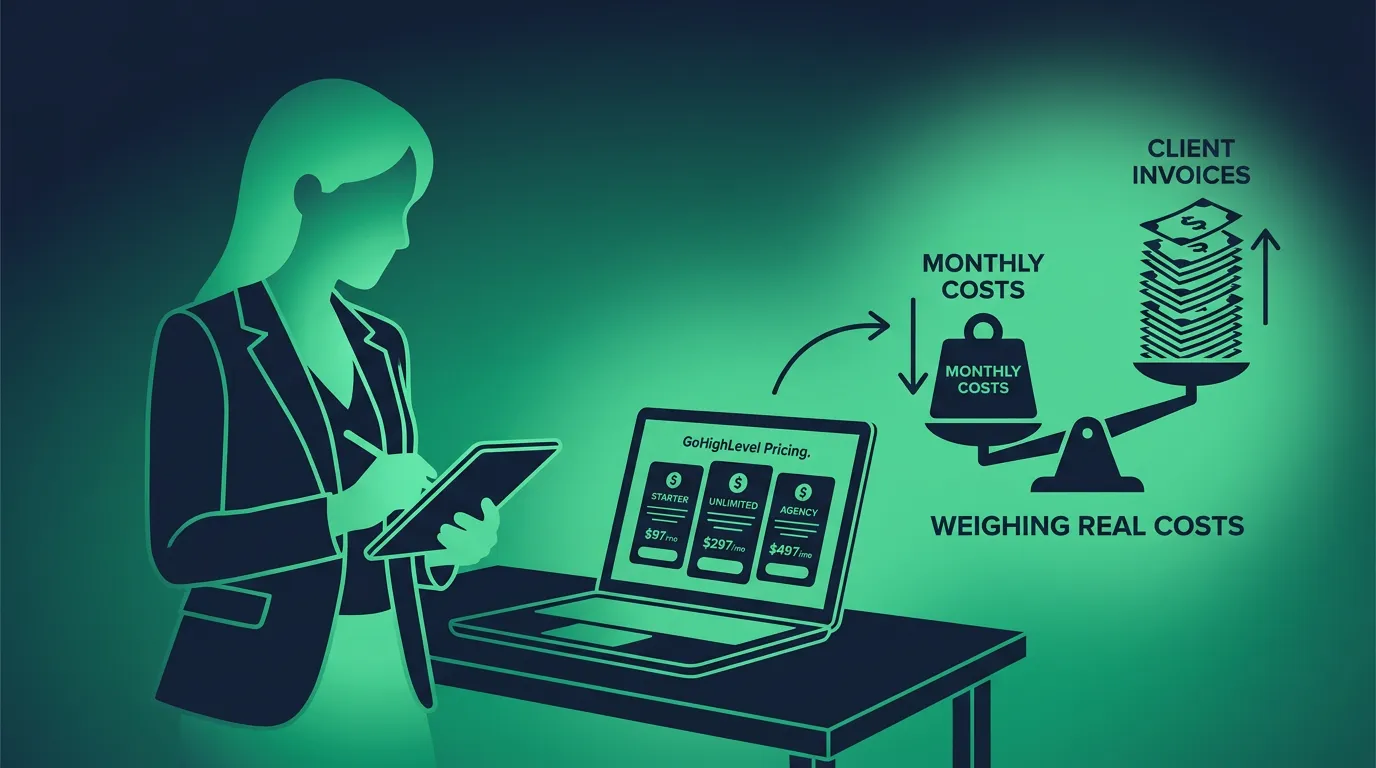
Here’s what that means for a single client. A sub-account that sends 3,000 SMS segments a month costs you about $22 at $0.00747 per segment, plus roughly $10 to $15 in carrier fees, plus $1.15 for the number. That’s $35 or so before any email, calls or AI. On a $97 plan with rebilling switched off, a third of the revenue from that client is gone before you count your share of the platform fee. For how the agency tiers compare overall, read GoHighLevel’s pricing tiers and our page on GoHighLevel white-label pricing.
How rebilling and markup work
Rebilling is how usage costs leave your margin and land on the client’s card. HighLevel always charges your agency wallet first. With rebilling on, the sub-account is then charged for the same usage, and with markup on, it’s charged your multiplied rate, so the difference is profit.
HighLevel’s help docs spell out the tiers: rebilling at cost is available on the $297 and $497 plans, and rebilling with markup only on the $497 plan. Services you can rebill include phone, email, AI and WhatsApp conversations. New sub-accounts created through SaaS mode get rebilling with markup turned on by default, and there’s a bulk tool with a global slider if you want one multiplier across every service and every client.
HighLevel doesn’t publish a recommended markup, and there’s no single right number. Price it so that your heaviest realistic user still leaves you a margin, and say clearly on your pricing page that messaging and AI usage are billed on top of the plan. Clients accept usage billing far more easily at signup than as a surprise in month three.
Is GoHighLevel SaaS mode still profitable in 2026?
It can be, and the math is simple enough to check before you commit. The platform price hasn’t changed: $97, $297 and $497 a month, confirmed on HighLevel’s pricing page in October 2026. AI features are not bundled into any agency tier, despite what some 2025 guides claimed. They’re available on every plan but billed per use unless the sub-account is on an AI Employee plan, so treat AI as a cost you resell.
Take a hypothetical book of ten clients on a $147/month plan. That’s $1,470 in subscription revenue against a $497 platform fee, leaving $973 before usage. If rebilling with markup is on, usage pays for itself and adds a margin. If it’s off, ten clients each costing $35 to $50 in messaging takes $350 to $500 back out. The difference between a viable SaaS business and a thin one is often that one setting.
What makes the recurring revenue sticky is that a client who runs their bookings, pipeline and follow-up inside your branded CRM every day has real switching costs. A retainer client can cancel a service contract fairly easily. Moving a whole CRM, phone number and automation setup is a project, which tends to keep subscribers longer. That only holds if the account is useful from day one, which is where snapshots come in. It also makes the revenue stream scalable in a way service work isn’t: the tenth subscriber on the same snapshot costs you far less setup time than the first, so ROI improves as the base grows.
A pricing strategy that keeps the SaaS business high-margin
Work backward from cost. Divide the $497 platform fee across the clients you realistically expect in year one, add the per-client usage you estimated above, and add the support time each client takes. That number is your floor. Most agencies settle on two or three plans: an entry plan close to cost-plus, a middle plan where most clients land, and a top plan with AI and higher usage included.
Pricing models vary. Some agencies sell software only. Others bundle the SaaS plan with a done-for-you service, so the software fee rides along with a retainer. You can sell SaaS and services together; the configurator handles the software subscription, and you invoice services separately or as a higher plan. Can you change pricing later? Yes, plans in the configurator are editable. HighLevel’s docs warn that changing a plan’s category or level affects which upgrade and downgrade paths customers see, so settle your plan structure before you have many subscribers. Existing clients who already have a sub-account can be moved onto a SaaS plan through the manual subscription flow, without going through checkout.
Snapshots make the product feel finished
SaaS mode decides who pays and how the account gets created. A GoHighLevel snapshot decides what’s inside it. Attach a snapshot to each plan and a new signup lands in a sub-account with your pipeline, calendar, funnel, forms and follow-up workflows already built for their niche.
Skip this and every new subscriber opens an empty dashboard and becomes a support ticket. A dentist, a roofer or a med spa owner doesn’t want to build automation. They want missed-call text-back, review requests and appointment reminders running on the first day. Build and test the snapshot before you put a SaaS offer in front of anyone.
Common mistakes and disadvantages
The most expensive mistake is leaving usage unbilled. SaaS mode turns markup on by default for accounts it creates, but older sub-accounts you created before switching SaaS mode on, or plans where someone set the multiplier to 1x, quietly pass every text and email back to you. Check rebilling settings on every account after launch.
Next is skipping the custom domain. A client who logs in at a HighLevel URL starts asking why they pay you instead of HighLevel, and it’s a fair question.
Then there’s the failed-payment toggle. Automatic suspension of sub-accounts with failed SaaS subscriptions is off by default. Leave it off and a client whose card has lapsed keeps using the platform, and keeps running up usage on your wallet, until someone notices.
The bigger disadvantage is that reselling HighLevel means reselling its rough edges. The learning curve is steep; community consensus is four to six weeks of setup and a couple of months to real proficiency. Users report deliverability trouble on LC Email until a dedicated sending domain is configured and warmed. The workflow engine is built for inbound leads more than outbound cold sales. All of that becomes your support queue once the client is on your brand.
Is GoHighLevel SaaS mode beginner-friendly? The configurator itself isn’t hard: plans, Stripe, a domain and markup settings take an afternoon. Building a niche snapshot worth paying for, plus the sales and onboarding process around it, is the real work, and that part takes weeks.
Who the GoHighLevel SaaS plan suits
The best fit is an agency that has already onboarded a dozen or so business owners in one niche with roughly the same setup: the same pipeline stages, the same booking calendar, the same follow-up sequences. That agency already knows what the snapshot should contain and what clients will pay. A new SaaS offering mostly packages work it has already done.
It’s a poor fit for an agency still working out who it serves. SaaS mode adds billing, churn and customer support on top of a service business, and none of that helps you find clients. Freelancers managing one or two accounts are better off on Starter or Unlimited.
Customization, integrations and support
Can you customize HighLevel on the SaaS plan? You control branding, the login domain, which features each plan unlocks, and every workflow, funnel, landing page and form inside the sub-accounts. You can’t change how the core product works. Integrations carry over from the standard platform: native connections for Stripe, Google, Facebook and Instagram, Shopify and Zoom, Zapier and Make for the rest, and the REST API v2 for custom work. Phone and SMS run through LC Phone, HighLevel’s built-in phone system on Twilio infrastructure, which is why the rates above come from HighLevel rather than a separate Twilio account.
Support is the part agencies underestimate. In a white-label setup your clients come to you, so you need a help desk, onboarding videos and someone who answers live chat. HighLevel supports your agency (24/7 support is listed on every plan, and a Premium Support add-on runs $500/month), but your subscribers see your brand and expect your team.
SaaS mode vs. staying on Unlimited
If your business is service delivery (ads, content, campaign management) and HighLevel is the tool you use to do the work, Unlimited at $297 covers unlimited sub-accounts and white-label branding. You save $200 a month and skip Stripe plan design, churn management and subscription customer support. Both plans include the same CRM, marketing automation tools and sales funnels; the difference is entirely in how clients are billed.
Agency Pro earns its extra $200 when clients pay you directly for software access, or when your clients’ usage is heavy enough that marking it up covers the difference. A clean way to test demand is to stay on Unlimited, offer a software-only plan to a few existing clients by invoice, and see who pays. If they do, upgrading is a plan change in the same account. If SaaS revenue doesn’t take off, you can downgrade again.
Alternatives to GoHighLevel SaaS mode
HighLevel isn’t the only white-label path. Vendasta is built specifically for resale, with a marketplace of products you bundle, and it uses $0 subscriptions with monthly minimum spend (Professional and Premium start at $499 and $999 minimums) rather than a flat platform fee. It suits agencies that want to assemble a stack of point products. HighLevel suits agencies that want one all-in-one CRM as the thing they sell. Our white-label marketing software guide covers the category, and the white-label software overview compares margin and support load across platforms.
If you’d rather sell a narrower product, white-label reputation management tools are a simpler entry point, and HighLevel’s review requests already make reputation an easy feature to demo inside a SaaS plan. If you’re still deciding which CRM to run the agency on at all, see our pick of the best CRMs for agencies.
Picking a niche worth reselling into
SaaS mode sells best to buyers who already pay monthly for industry software and understand what a CRM with funnels and automation does for them. Real estate is a common example: agents and brokers expect lead follow-up, pipelines and drip campaigns, so a branded real estate SaaS offer is an easier pitch than a generic one. Our guide to real estate marketing software covers what agents expect before you build a snapshot and pricing page for them.
Pick one niche, build one snapshot, price two or three plans, and launch to a small group. The agencies that do well with SaaS mode usually started with a service they’d already delivered a dozen times. For a wider view of where HighLevel holds up against dedicated tools, read our GoHighLevel review.