White label reputation management is review generation, review monitoring and review response sold under your agency’s brand instead of the software vendor’s. For most agencies the best white label reputation management option is the one already inside the CRM they resell: GoHighLevel includes it on every plan and brands it as yours from the $297 Unlimited plan, while review-only tools like Grade.us and reseller marketplaces like Vendasta fit agencies with different business models.
The choice comes down to whether reputation is the whole service you sell or one deliverable inside a bigger retainer for the local business clients you already serve. Get that wrong and you end up paying for two logins to do one job.
What white label reputation management means
Strip away the sales pages and it’s three jobs done under your brand: asking customers for reviews at the right moment, watching where those online reviews land, and responding fast enough that it looks like someone’s paying attention. White labeling means the client sees your dashboard, your domain and your logo on the review request email, so you deliver reputation management under your own brand and the vendor’s name doesn’t appear. Done well, the client’s experience is fully white labeled from the first login to the monthly report.
Agencies searching for this usually want one of two things. Some want a branded tool to show clients as proof of active management inside an existing retainer. Others want to sell reputation management as its own product with its own price and billing. GoHighLevel, Grade.us and Vendasta can all support either path, but the costs and setup differ.
It also helps to separate software from service. White label reputation management software gives you the platform and your team does the work. A white label fulfillment partner, which some reputation management providers offer, does the monitoring and replies for you. Most agencies start with software, because review requests and monitoring are mostly automated once configured.
Benefits of white label reputation management for marketing agencies
For digital marketing agencies, reputation is one of the easier white label services to add. It produces recurring revenue, it’s visible (the client can watch their Google reviews and rating move), and it gives you a reason to talk to the client every month. Because the platform carries your brand, the client relationship and the data stay with your agency, which makes it easier to offer reputation management alongside SEO, ads or a CRM resale. It also helps businesses that don’t have time to manage their online reputation themselves.
Features of white label reputation management software
Whatever platform you pick, a reputation management service worth billing for covers five things.
Review generation
Review requests have to fire automatically from an event (a completed job, a paid invoice, a closed deal), by SMS and email, with a reminder if the customer doesn’t respond. Manual batches don’t scale past a handful of clients and are the first thing that slips when the agency gets busy. Review generation campaigns for past customers can also restart a client whose review count has stalled. Good review collection is the part of a reputation management strategy that compounds, because every new review adds to the total.
Review monitoring
Every new review should land in one dashboard with an alert, so you can monitor reviews in one place and a negative one gets a reply the same day. Coverage matters by vertical. Google and Facebook cover most local businesses, while restaurants care about Yelp and contractors care about industry directories. Sentiment tracking (positive reviews vs negative reviews over time, by location) turns customer feedback into something an account manager can act on, so a problem location shows up early.
Review response
Response speed is the part clients notice, and it’s how a business protects its brand’s reputation when something goes wrong. The goal is to respond to reviews, good and bad, within a day. AI-drafted replies let an agency clear a backlog in minutes, but someone should still read each one before it posts, because AI drafts can misread sarcasm or miss a complaint buried in a mostly positive review.
Reporting and the white label dashboard
A client paying for reputation management wants a report with your logo showing review count, average rating and response time trending the right way. Without it, the service looks like nothing is happening, and that’s how retainers get cancelled.
White label customization
Your logo, colors and custom domain on the client dashboard, your sending domain on white label emails, and reports with your branding. Ask for a live demo of a fully rebranded account before you sign anything.
Top white label reputation management software compared
Here’s how the three most common options compare at published October 2026 prices.
| Platform and tier | Monthly cost | White-label | AI replies | Resale billing |
|---|---|---|---|---|
| GoHighLevel Starter | $97 | No white-label app or custom domains | Pay-per-use ($0.01/review) | No rebilling |
| GoHighLevel Unlimited | $297 | White-label desktop app + custom domains | Pay-per-use, agency absorbs it | Rebill phone and email at cost |
| GoHighLevel Agency Pro | $497 | Same as Unlimited; mobile app is a $497/mo add-on | Pay-per-use, can rebill with markup | SaaS Mode, markup on usage |
| Grade.us Small Business | $99 (1 location) | White Label Basic included | Not listed on pricing page | Agency bills clients itself |
| Grade.us Agency | from $400 | White Label Basic and Premium | Not listed on pricing page | Agency bills clients itself |
| Vendasta Starter / Professional | $99 / $499 minimum spend | Co-branded on Starter; white-label client portal on Professional | Varies by marketplace product | Built for resale; 1-year contract on Professional |
GoHighLevel
GoHighLevel’s reputation management sits inside the same sub-account you already run for each client. Its feature page lists automatic review requests by text and email after every appointment or sale, a centralized review dashboard pulling in Google Business Profile, Facebook and other major platforms, AI help drafting replies, sentiment and rating tracking over time, instant flags on negative feedback, and flagging and disputing fraudulent reviews.
Two cost details matter. Reviews AI is billed at $0.01 per review on a pay-per-use basis, or unlimited if the sub-account is on AI Employee Growth ($50/mo) or AI Employee Unlimited ($97/mo). And review requests use texts and email, billed at $0.00747 per SMS segment in the US and Canada plus carrier fees and $0.675 per 1,000 emails.
Branding starts on Unlimited ($297/mo), which adds the white-label desktop app and custom domains. Unlimited can rebill phone and email at cost but can’t mark them up or rebill AI. GoHighLevel’s SaaS Mode on Agency Pro ($497/mo) adds automated sub-account creation, your own pricing tiers and markup on usage, including AI. The white-label mobile app isn’t part of Agency Pro; it’s a separate $497/mo add-on. Our GoHighLevel pricing breakdown covers every tier.
Grade.us
Grade.us is a review platform built for agencies, one of the reputation management tools sold mainly through them. Small Business costs $99/mo for one location, Multi Location is $60 per location per month, and the Agency plan starts at $400/mo for 10+ seats. Every plan includes White Label Basic (your look, your logo, your own domain); White Label Premium, which adds dashboard logos, is included on the Agency plan or $440 a year on Multi Location. It’s a good fit for an agency that sells reviews and nothing else, but it isn’t a CRM, so pipelines, funnels and broader automation live somewhere else.
Vendasta
Vendasta is a reseller marketplace with reputation management as one of its 250+ products, alongside listings management and other white label marketing tools. It charges a $0 subscription with a monthly minimum spend: $99 on Starter, $499 on Professional and $999 on Premium. Starter is co-branded, Professional adds a white-label client portal, and Professional and Premium require a one-year contract. The minimum-spend model pays off when reputation is one of several products you resell per client. It’s poor value if reviews are the only thing you need.
What your agency needs from a white label reputation management partner
Start with what you already run. If your agency resells GoHighLevel, the reputation tools are already in every client’s sub-account, and adding Grade.us or Vendasta means a second login, a second data source and a second bill. If you don’t run a CRM and only want to sell reviews, Grade.us is simpler. If you resell many services to local businesses and want one white label solution for all of them, look at Vendasta.
Then check five things in a demo: automatic review requests triggered by a CRM or POS event, coverage of the review sites your clients’ customers actually use, response tools with a human approval step, a fully white-labeled dashboard and reports, and how client billing works. A partner that can’t show a fully rebranded account on the spot is a warning sign.
Watch the limitations too. No platform can delete legitimate reviews. Review request rules on some sites restrict incentives and selective asking (Google’s policy bans selectively soliciting positive reviews and offering incentives for reviews), so configure requests to go to every customer. And email requests depend on deliverability: GoHighLevel’s LC Email runs on Mailgun, and users report spam-folder problems when a sending domain isn’t set up and warmed before the first campaign.
How to package and sell reputation management
Reputation management is one of the easier services to sell, because the client can see the result in their own Google listing and in their customer reviews.
Agencies usually package it one of two ways. As a standalone offer, it’s a low-commitment entry point for a business worried about a slipping star rating, and it opens the door to bigger work. Folded into a local SEO or marketing retainer, it becomes one deliverable among several, which tends to make it stickier since cancelling means renegotiating the whole retainer.
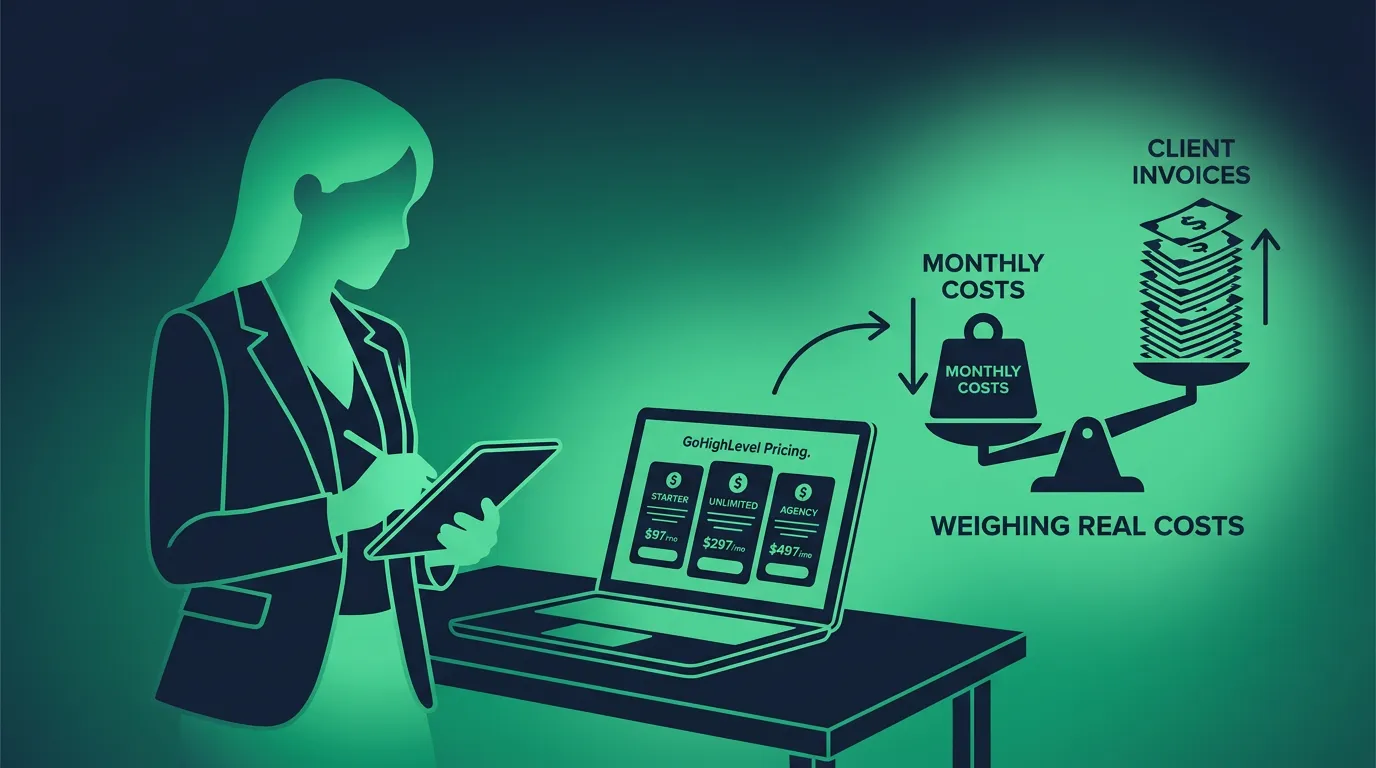
There’s no official rate card, since this is your resale price. Price it from your costs: the platform share per client, review-request texts and emails, AI replies, and the human time to approve responses and write the monthly report. That human time is where agencies underprice. Automated requests are nearly free to run, but a client with forty reviews a week needs someone reading forty replies.
The platform math is simple at small scale. On GoHighLevel Agency Pro ($497/mo), two clients paying $250 a month each cover the subscription, and every client after that adds margin minus usage. On Grade.us, the $99 Small Business plan covers one client location, so the per-client cost is fixed and easy to price against.
Reputation management, local SEO and digital marketing
Reputation and local visibility are linked. Google’s own Business Profile help says more reviews and positive ratings can help a business’s local ranking, because review volume and ratings feed prominence, alongside relevance and distance. A client whose review velocity stalls has less working for them in the local pack. Responding to reviews also shows prospects that the business is paying attention.
That overlap is why reputation management sits naturally next to white label SEO and Google Business Profile management in an agency’s offer. Ratings and review snippets also show up in search results and maps, so a company’s online reputation is often the first thing a prospect sees.
Trends in white label reputation management
Three things shape how agencies run this in 2026. AI-drafted replies are now a standard feature; GoHighLevel’s reputation page lists AI help drafting on-brand responses, and the real work has shifted to reviewing drafts rather than writing them. SMS review requests sit next to email, because a text after a completed job is easier to act on. And platform rules matter: Google’s policy bans offering incentives for reviews and selectively soliciting positive ones, so white-label review workflows that filter unhappy customers away from Google put the client at risk. Ask every customer, and handle complaints in the reply.
Implementing white label reputation management for clients
The tools help businesses most when the setup is consistent from client to client.
Build once and copy. In GoHighLevel, a snapshot (a clonable template of a sub-account’s workflows, templates and settings) lets you build a niche-specific reputation setup for dental practices or HVAC contractors once and load it into each new client. That cuts onboarding time, which is where much of the margin on this service goes.
A clean rollout follows the same order every time: connect the client’s Google Business Profile and Facebook page, verify and warm the sending domain, set up review requests on the trigger the client already has (appointment completed, invoice paid), set response rules and an approval step, then schedule the monthly report. Multi-location and multi-agent businesses need extra care. A brokerage with thirty agents wants review requests tied to the agent who closed the deal and reporting broken out by agent; our real estate marketing software guide covers that side of the workflow.
Where this fits in a white label stack
Reputation management is one of several white label services most agencies sell, and its business reputation reporting fits next to SEO and ads reports. If you’re building a full white-label stack (CRM, funnels, reputation, social media management) under one brand, the white-label marketing software hub covers the category, and our best CRM for agencies comparison is worth reading before reputation management alone drives your platform choice.
Common mistakes agencies make reselling it
The first is treating bundled as branded. A $97 Starter account has the reputation tools but not the white-label app or custom domains, and a client who spots someone else’s logo mid-contract will ask what they’re paying you for.
The second is underpricing because the software does the work. Monitoring and response drafting still need a person, and AI replies cost money per review unless you’re on an AI Employee plan.
The third is skipping the report. A client can’t see review requests firing in the background. They can see a monthly report with their rating and review count going up, and that report is often why the line item survives the next budget review.
GoHighLevel’s 14-day trial (card on file required) includes the reputation tools, which is enough to run one real review-request cycle before deciding whether to sell this as an add-on or its own product. Our GoHighLevel review covers the rest of the platform.