To use GoHighLevel, set up one sub-account and build a single working loop in this order: business basics, phone and email setup, one pipeline, one follow-up workflow, a calendar and a short lead-capture funnel. Everything else in HighLevel, from AI agents to SaaS mode, sits on top of that loop and is easier to learn once it runs.
This GoHighLevel tutorial for beginners is a step-by-step guide to that order on the 2026 interface. Most video tutorials tour every menu; this one covers what to build first, plus the costs and compliance steps those walkthroughs skip. No code is needed for any of it.
What GoHighLevel is and who it’s for
GoHighLevel, HighLevel and GHL are the same product. HighLevel is the name the company uses in its own product and help docs, and gohighlevel.com is where you sign up. It’s an all-in-one CRM with a funnel and website builder, email marketing, SMS, calendars, automation, reputation management, memberships and payments in one login. Most users are marketing agencies managing multiple clients, plus small businesses that want to replace six or eight separate tools.
Is GoHighLevel a CRM? Yes, at its core: contacts, conversations, pipelines and opportunities sit at the center, and every other feature reads from them. Is it suitable for a small business? It can be, but the plans are built for agencies, and a single business owner on Starter will see agency tools they never use. Does it replace ClickFunnels? For most lead-generation funnels, yes. HighLevel even has a guide for importing ClickFunnels funnels. The trade-off is polish, covered further down.
Getting started with a plan and the free trial
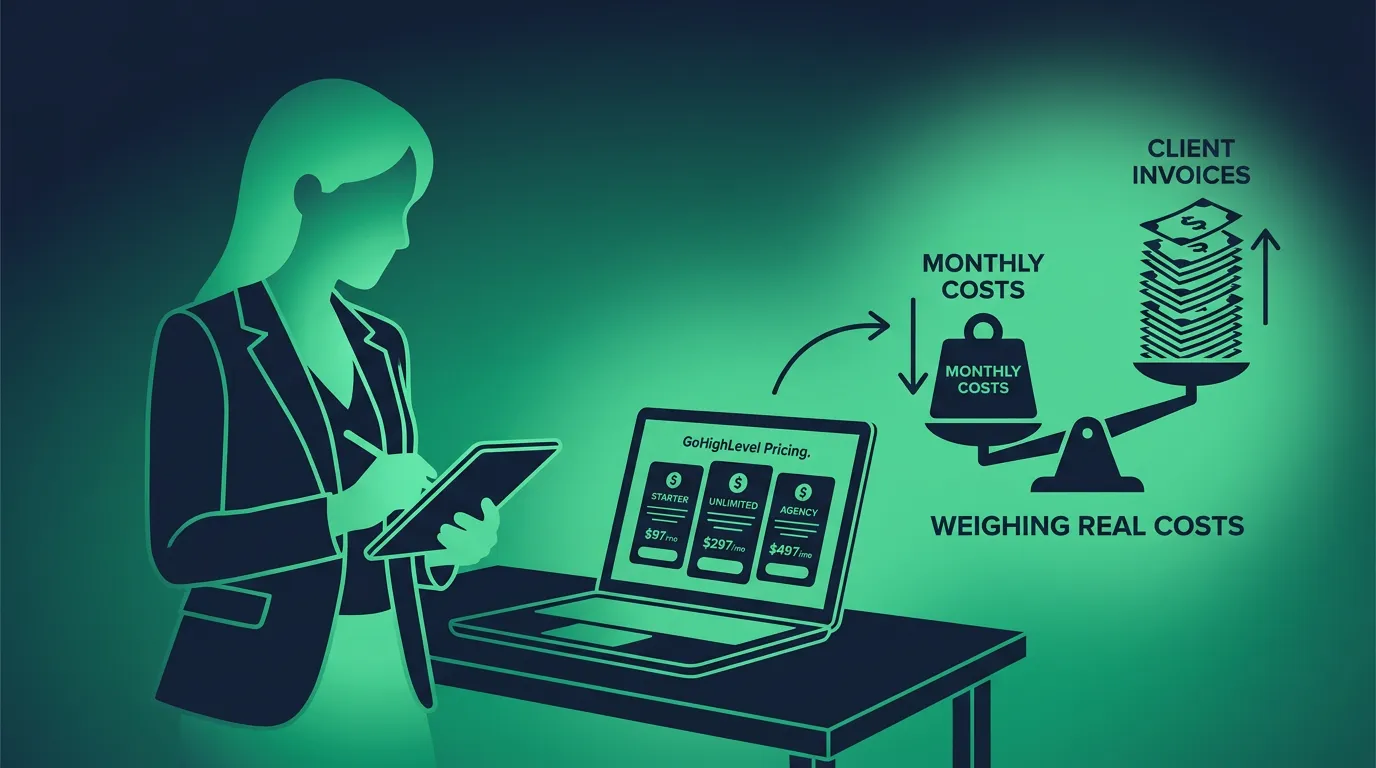
HighLevel’s pricing plans are Starter at $97/month (three sub-accounts), Unlimited at $297/month (unlimited sub-accounts, white-label desktop app, rebilling at cost) and Agency Pro at $497/month (adds SaaS mode and rebilling with markup). Annual billing cuts those to $970, $2,970 and $4,970 a year. Every plan includes unlimited contacts and users.
The direct signup comes with a 14-day free trial, and it needs a card on file that’s charged when the trial ends unless you cancel. Some HighLevel-hosted partner pages offer a 30-day trial, also card-on-file. Usage is billed on top of the subscription on every plan, so texts, calls, emails and AI all cost extra. Our breakdown of GoHighLevel’s pricing plans covers each tier and the add-ons in detail.
Agency view vs sub-account
HighLevel has two levels, and mixing them up wastes your first hour. Agency view is the admin shell: billing, sub-account management, snapshots, white-label settings and the switcher for jumping between clients. A sub-account is the working CRM for one business, with its own contacts, pipelines, calendars, funnels, phone numbers and workflows.
If you’re an agency, each client gets a separate sub-account and nothing crosses between them by default. A workflow built for a dental client won’t fire in a roofing client’s account. If you run HighLevel for your own business, you’ll live in one sub-account and rarely open agency view after setup.
Set the business basics
Before you touch a pipeline, fill in the boring settings in the sub-account: business name, address, logo and time zone. Time zone matters most, because calendar slots, scheduled workflow steps and reporting all read from it. A wrong one sends a reminder text at 3am.
Then add users. Give yourself admin rights and give everyone else the narrowest role that works. HighLevel’s permissions are granular enough to let an assistant work the conversations inbox without seeing billing or deleting contacts.
Set up the phone system and email
This is the step beginners skip, and it’s the reason so many first workflows “don’t work.”
HighLevel’s built-in phone system, LC Phone, handles calls and texts at $0.00747 per SMS segment in the US and Canada plus carrier fees, $1.15 a month for a local number, and $0.0166 a minute for outbound calls. It runs on Twilio infrastructure. Some older accounts still use their own Twilio account, and HighLevel’s help center covers migrating them to LC Phone. For a new account, LC Phone is the simpler choice because billing stays inside HighLevel.
Before you text anyone in the US from a local number, register for A2P 10DLC. HighLevel’s help center calls it “the messaging standard required for sending SMS/MMS messages to U.S. mobile numbers using local business phone numbers.” The fees are passed through from The Campaign Registry, Twilio and carriers with no HighLevel markup: $22.50 one-time for a sole proprietor or low-volume standard registration, $64 for high-volume, then $2 a month for a sole-proprietor campaign or $10 a month for a standard one. Approval takes time, so start it on day one. A text workflow built before registration clears will fail or get filtered, which looks like a broken automation when it’s an unfinished compliance step.
Email goes out through LC Email, HighLevel’s built-in sending service on Mailgun, at $0.675 per 1,000 emails. Set up a dedicated sending domain (a subdomain like mail.yourbusiness.com) and warm it up gradually. Users commonly report deliverability problems on accounts that skip this.
Build one pipeline
A pipeline maps how a lead moves from first contact to a closed deal, and in HighLevel it lives under Opportunities. Build stages that describe your real process. New Lead, Contacted, Booked, Won and Lost works for most service businesses; a longer sales cycle might need Proposal Sent. Every prospect becomes a card on the board, and dragging cards (or letting automation move them) shows where deals stall. The sub-account dashboard then pulls pipeline value and conversion analytics from those stages, so clean stages mean useful reports.
One pipeline, used daily, teaches you more than five half-built ones. Add the second when the first is a habit.
Automate the follow-up
Workflows are the reason most people move to HighLevel. Go to Automation, create a workflow, and pick a trigger you understand: a form submission, a missed call, or a tag added to a contact. Keep the first one simple. Send a text within a minute, wait an hour, check for a reply, then either move the opportunity to Contacted or send a second nudge. Personalize the text with the lead’s first name and what they asked about, since a generic message reads like a bot.
Test it with your own phone number before real leads arrive. Watch it run cleanly for a few days, then adjust timing based on actual replies before you build a second workflow. Missed-call text-back, appointment reminders, a welcome email for new contacts and a review request after a completed job are what most beginners automate next. Our guide to GoHighLevel automation covers trigger types, branching and the workflow patterns worth copying.
Connect a calendar
Under Calendars, create a calendar, set real weekly availability, and connect Google or Outlook so HighLevel can’t book a slot that’s taken elsewhere. Pick a meeting length that matches the offer, from a 15-minute qualifying call to an hour-long consultation, and copy the booking link.
Then wire it into the workflow. A lead who books should move to Booked in the pipeline automatically and get a confirmation text. Setting that up now saves a manual step on every booking afterward.
Build a simple funnel or website
Under Sites, start a funnel from the template library or describe the offer to Funnel & Website AI, which can generate pages from a prompt, a URL or an image and is currently available without extra AI usage charges, subject to limits. A first funnel needs two or three pages: a landing page with the offer and a short form, a thank-you page with the booking link, and optionally a page with a testimonial. Keep the form to a name, a phone number and one qualifying question.
Can you build a website with GoHighLevel? Yes. The website builder uses the same drag-and-drop editor for multi-page sites with navigation and a blog. Start with the funnel, though, because it plugs straight into the loop. Our roundup of GoHighLevel templates covers what’s in the built-in library and when paid templates earn their price.
Connect the form submission to your workflow. That completes the loop: the funnel captures the lead, the workflow follows up, the pipeline tracks the deal and the calendar books the call.
Using AI agents and the AI Employee plans
AI is everywhere in the 2026 interface, and it’s the area beginners most often misjudge on cost. Every AI feature is available on every plan, but it’s billed per use unless the sub-account is on an AI Employee plan:
| AI feature | What it does | Pay-per-use price |
|---|---|---|
| Conversation AI | Answers texts, chat and social DMs, books appointments | Token-based (e.g. $1.25 per 1M input tokens) |
| Voice AI | Answers and qualifies inbound calls | $0.045/min engine + TTS from $0.015/min + tokens + phone minutes |
| Reviews AI | Drafts replies to reviews | $0.01 per review |
| Content AI | Writes copy and images | $0.0945 per 1,000 words, $0.063 per image |
| AI Employee Growth | 1,000 Conversation AI replies, 100 Voice AI minutes, unlimited Reviews and Content AI | $50/month per sub-account |
| AI Employee Unlimited | Unlimited use of the above under fair use (Agent Studio still pay-per-use, phone charges extra) | $97/month per sub-account |
The sensible order for a beginner is to get the manual loop working, then add Conversation AI to answer after-hours texts, then consider Voice AI once you’ve seen how leads actually talk. AI agents are only as good as the knowledge and instructions you give them, so test each one against your own questions before it talks to customers.
Reputation management, memberships and the client portal
GoHighLevel’s built-in tools go well past the core loop. Reputation management sends review requests and pulls reviews into one dashboard. Memberships and courses host paid or free content. Payments run through Stripe for invoices, order forms and subscriptions. The client portal gives customers a login for courses, communities and documents, and a branded client portal app is a $49/month add-on per sub-account. The HighLevel mobile app lets you work conversations, contacts, opportunities and appointments from a phone; a white-label version under your own brand is a separate $497/month add-on (or $1,491/quarter) unless you’re on Enterprise.
None of these belong in your first afternoon. Add them one at a time once the loop runs.
Save your first account as a snapshot
A snapshot is a saved copy of a sub-account’s setup (pipelines, workflows, calendars, funnels, custom fields and more) that loads into another sub-account. It doesn’t carry contacts or conversations. Once your first account works, create a snapshot in Agency View, Account Snapshots, and load it into the next client’s account instead of rebuilding. Our guide to GoHighLevel snapshots covers creating, loading, updating and sharing them.
You can also start from someone else’s. HighLevel provides industry snapshots for niches such as real estate, dentists and gyms, and agencies sell niche builds on HighLevel’s App Marketplace and independent sites. Review what’s inside before you load one into a live client account.
Troubleshooting the problems beginners hit
Text workflows that never send are most often an A2P problem: the number isn’t registered yet, or isn’t linked to the approved campaign. HighLevel’s help center has a specific article on error 30034, which covers linking a number to an approved A2P campaign.
Emails landing in spam usually mean no dedicated sending domain or a domain that wasn’t warmed up. Calendar bookings at the wrong time point to a time zone mismatch between the sub-account, the calendar and the user.
Building five workflows and three pipelines before testing any of them is the other classic. A workflow that’s never been run against a real lead has an untested bug in it somewhere. Test each piece before adding the next.
Choosing the wrong plan is the last beginner mistake. A small business owner who wants a simple CRM can end up paying for agency features they’ll never touch. If you only run one business, Starter covers it.
How long it takes to learn GoHighLevel
Each step in this guide is simple on its own. Stacking them into a system that runs without you checking every trigger is what takes time. Community consensus puts setup at four to six weeks for a full account and 60-90 days before HighLevel feels like a tool you know, and that learning curve is a common reason people cancel during the trial.
That’s the cost of putting six or eight tools in one login. A single-purpose scheduler or email platform is quicker to learn because it does one thing. Whether the trade is worth it depends on how many tools you’re paying for and stitching together today.
Where GoHighLevel falls short
Be honest with yourself (and clients) about the gaps. The funnel builder is less refined than ClickFunnels, the CRM is less intuitive than Pipedrive for pure sales teams, and the email editor is more basic than ActiveCampaign’s. Usage costs for SMS, calls, email and AI sit on top of the subscription and surprise anyone who doesn’t model them. And HighLevel is built for inbound leads; teams doing heavy cold outbound usually add a dedicated prospecting tool. Our full GoHighLevel review weighs those trade-offs against what the platform does well.
What to learn next
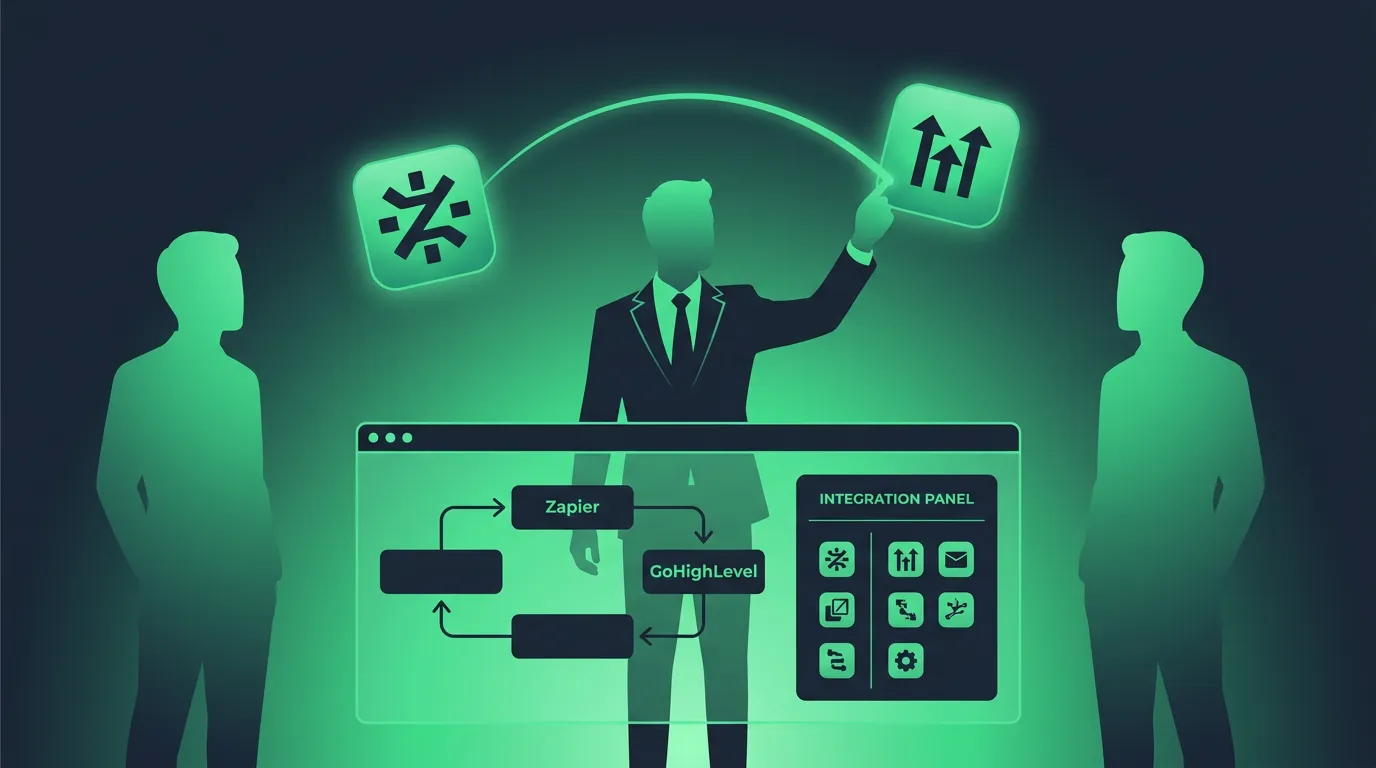
Once the loop runs, pick the direction that fits your business. GoHighLevel integrations covers the native connections, the API and where Zapier or Make fill gaps. Agencies managing multiple clients should look at the HighLevel certification program to learn the platform properly, and at SaaS mode if they want to resell HighLevel under their own brand. If referring others is part of your plan, the GoHighLevel affiliate program pays 40% recurring on referred subscriptions once an account stays in good standing for 45 days.
Use the 14-day trial to build the loop in this guide once, end to end. If it runs and you can see yourself living in it, the deeper features are worth learning.