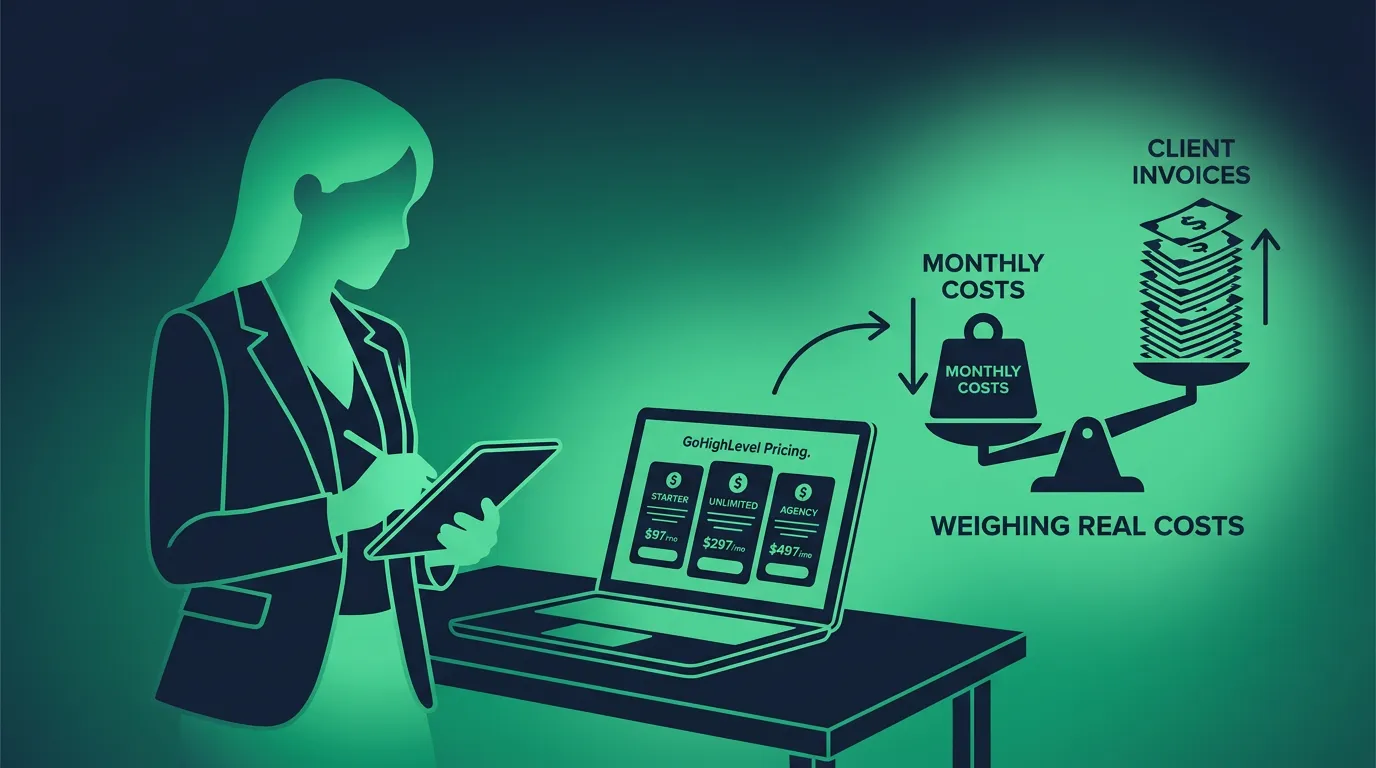
The right CRM for a consultant is the one that matches how your work arrives. If leads come from webinars, ads, LinkedIn content or speaking, GoHighLevel automates the follow-up, booking, proposal and retainer billing in one account for $97/month. If nearly everything comes through referrals and you see a handful of warm introductions a month, a lighter pipeline tool like Pipedrive or Copper will serve you better at a lower cost.
Most “crm for consultants” roundups are written for software sales teams. Consulting doesn’t move like that. A discovery call turns into a scoping conversation, scoping stalls for three weeks while the prospect finds budget, and the six-week project that finally closes becomes a 12-month retainer nobody planned for at intake. A CRM for consulting has to handle that loop, plus the follow-up after delivery that leads to the next engagement.
What a CRM system does for a consulting business
A CRM (customer relationship management) system is where every prospect, client and referral source lives, along with the history of each conversation and where each deal sits. For a consulting firm it also becomes the memory of the practice: who introduced whom, which engagements ended when, and who is due for a check-in. Consultants and consulting firms use a CRM to automate the follow-up they would otherwise forget, which is where many consulting practices quietly lose work.
Why consultants need a CRM built around relationships
Referrals drive most consulting revenue. A past client mentions you to a peer, an old colleague sends an introduction, a newsletter reader finally gets in touch after six months. A CRM that only records “lead source: website” misses how consulting work is actually won, and a consultant who can’t answer “who sent me this client?” can’t close the loop with a thank-you, which is often what keeps the introductions coming.
The sales process also loops instead of running in a straight line. Discovery uncovers a different problem than the one in the inquiry email, scope gets revised twice, and a project inquiry turns into a retainer conversation. Forcing that into a rigid four-stage sales pipeline produces data nobody trusts. The right CRM lets you customize pipeline stages per engagement type (a strategy audit moves differently from an ongoing advisory retainer) and keeps the client relationship history in one place.
Then there’s follow-up, the stage where consulting deals are usually won or lost. Before the sale, it’s the prospect who went quiet after a strong discovery call. After it, it’s the client whose project ended six months ago and is ready for a follow-on engagement. A good CRM makes both automatic.
Features of CRM software for consultants
Consultants have unique CRM needs that a generic sales team tool doesn’t cover. Here’s what separates a useful consulting CRM platform from the rest:
- Flexible pipelines with stages like discovery call, proposal sent, scoping and signed, and a separate pipeline for active engagements.
- Referral and relationship fields so you can see who introduced each client and what else they’ve sent you.
- Booking calendars that let prospects pick a discovery-call slot and get automatic reminders.
- Workflow automation for nurture sequences, post-call follow-up and “it’s been six months” check-ins.
- Proposals, e-signature and invoicing, either built in or through a clean integration.
- Integration with Gmail or Outlook, Google Calendar, Zoom and your payment processor, so you centralize contacts and communication instead of updating three tools.
- A dashboard showing open opportunities and active engagements together.
Light project management helps too, because a signed deal turns into a delivery timeline with milestones. Few CRMs do this well. Consultants with heavy delivery work often pair the CRM with a project management tool or a professional services automation (PSA) platform that handles time tracking and resourcing.
The best CRMs for consultants compared
Four products cover most independent consultants and small consulting companies. Prices below were checked in October 2026.
| CRM | Starting price | Pricing model | Best fit for consultants |
|---|---|---|---|
| GoHighLevel | $97/mo (Starter) | Flat, unlimited users and contacts | Inbound lead gen, automated nurture, proposals and retainers in one system |
| Pipedrive | ~$14/seat/mo billed annually (Lite) | Per seat | Visual sales pipeline for a referral-driven practice |
| HubSpot | Free CRM; Starter $20/seat/mo ($15 annual) | Per seat, steep jumps at Professional | Firms that want content marketing and CRM together and can grow into Professional |
| Copper | $23/seat/mo annual, $29 monthly (Basic) | Per seat | Consultants who live in Gmail and Google Workspace |
GoHighLevel: best for consultants with inbound lead flow
GoHighLevel earns its spot by solving the automated follow-up problem, which is where most consulting practices leak revenue. Someone downloads a framework PDF at 9pm and doesn’t book a call? A workflow follows up by email and text over the next week. A prospect goes quiet after a strong discovery call? A tagged sequence checks back in on a schedule instead of relying on a sticky note. Missed Call Text Back replies by SMS when you’re on a client call and can’t pick up.
The money side is more complete than older reviews suggest. Documents & Contracts (under Payments) sends proposals, estimates and contracts with legally binding e-signatures, tracks when they’re viewed and signed, and can trigger a workflow or generate an invoice the moment a client signs. Recurring invoices bill a monthly retainer on a schedule, and auto-pay charges a saved card when each invoice falls due. That covers a typical consulting engagement from first inquiry to the third retainer payment.
The gaps: there’s no native time tracking for hourly work billed against a cap, referral tracking runs on tags and custom fields, and the platform takes real time to learn. HighLevel also bills SMS, phone, email and AI per use on top of the subscription. Our GoHighLevel pricing breakdown covers those usage costs and which tier fits a solo consultant versus a firm with associates.
Pipedrive
Pipedrive is a pipeline-first CRM tool and the easiest of the four to learn. Its visual deal board suits a consultant who wants to see every open proposal at a glance and get nudged when one stalls. It starts around $14 per seat per month on the Lite plan billed annually, with Growth at about $39 per seat, according to 2026 third-party pricing reviews. It has far less marketing automation than GoHighLevel, so it fits referral-heavy practices better than funnel-driven ones.
HubSpot
HubSpot’s Free CRM is a reasonable starting point for up to two users, and Starter costs $20 per seat per month ($15 billed annually). It’s strong for consultants who publish content and want email marketing, forms and CRM in one place. The catch is the jump to Professional: Sales Hub Professional is $100 per seat per month, and Marketing Hub Professional is $890 a month billed monthly. A small consulting team can outgrow Starter fast.
Copper
Copper is built around Google Workspace, with Gmail, Calendar, Contacts and Drive sync plus a Chrome extension. Basic costs $23 per seat per month billed annually ($29 monthly), Professional $59, Business $99. For an independent consultant whose whole working day happens in Gmail, Copper keeps client relationship data where the conversations already are, with little setup.
Is GoHighLevel the right CRM for your consulting practice?
Run the lead-volume test. Count every inquiry from the last month across your website form, referral introductions, LinkedIn messages, conference follow-ups and newsletter replies. Then check how long each one waited for a real response.
A boutique strategy consultant closing four engagements a year from a tight network can track everything in a spreadsheet and never drop a relationship. A consultant running a webinar funnel or paid LinkedIn ads with 20 to 30 inquiries a month is in a different position: a lead that doesn’t get a same-day answer is already talking to someone else, and no amount of discipline scales past a certain number of simultaneous conversations.
GoHighLevel fits best for fractional executives, marketing consultants, coaches with a consulting arm and consulting-adjacent agencies, because they’re actively building and converting a list. It fits worst for specialized advisory practices that win work through formal RFPs, and for solo consultants who don’t want to spend a month on CRM implementation.
How to choose a CRM for your consulting firm
Separate the two jobs before you select a CRM. Before the signature, you need capture, fast response, nurture, booking and follow-up. After it, you need proposals, contracts, invoicing and delivery. GoHighLevel covers both in one account, except time tracking. Pipedrive and Copper cover the pipeline well but lean on integrations for marketing automation and billing.
Next, compare total cost rather than the sticker price. A three-person firm on HubSpot Sales Hub Professional pays $300 a month in seats before any marketing tools. The same team on GoHighLevel Starter pays $97 plus usage. A solo consultant on Pipedrive Lite pays about $14 a month and may never need more.
Then test with real data. Most CRM options include a free trial (GoHighLevel’s is 14 days with a card on file). Route two weeks of actual inquiries through your shortlist and see which one gets you replying faster. Choose the CRM that closes your specific gap over the one with the longest feature list.
CRM implementation best practices for a small consulting business
A new CRM system only pays off if it gets used, and that depends on keeping it simple. Keep the pipeline to five or six stages. Make “referred by” a required field. Set one automated check-in for every client 90 days after an engagement ends. Import your existing contacts on day one so the CRM data starts complete, and connect your calendar and email before anything else. Consultants who skip that step end up keeping a spreadsheet alongside the new CRM, and the CRM initiative quietly dies.
How a CRM helps consultants win more clients
A good CRM lets you spend less time chasing and more time on consulting services you can bill. The gains come from three places. Response time drops, because the CRM replies or alerts you the moment someone inquires. Fewer prospects slip away, because a stalled proposal triggers a reminder instead of being forgotten. And past clients come back, because a scheduled check-in reaches them before a competitor does.
For a consulting business with steady inbound demand, those three are usually worth more than any reporting dashboard. Our full GoHighLevel review goes deeper on the automation builder and the platform’s weak spots.
Related CRM guides
Consultants share most of their needs with accountants, attorneys and other advisory firms, covered in our guide to CRM for professional services. Businesses with a different sales cycle can compare the CRM for plumbers, CRM for real estate investors and CRM for manufacturing pages, or start from our roundup of the best CRM software for a wider comparison.