The best CRM for most nonprofits is a dedicated donor management platform, because the job is recording gifts, pledges and tax receipts, and general marketing CRMs don’t do that. GoHighLevel is a reasonable second system for organizations with heavy event, volunteer or phone traffic, but it shouldn’t hold your donor records.
That split matters because “CRM for nonprofits” covers two different purchases. One is donor management software: the database your development director, your bookkeeper and your auditor all rely on. The other is outreach software that sends texts, runs event registration and follows up with volunteers. Buy them in that order.
Key nonprofit CRM features a sales CRM doesn’t have
In the nonprofit sector, CRM often stands for constituent relationship management instead of customer relationship management. A donor isn’t a customer, and the software reflects that. A good nonprofit CRM gives you a single view of donor history: every gift, every pledge payment, event attendance, volunteer hours and how they prefer to be contacted.
Nonprofit organizations call it nonprofit constituent relationship management for a reason. These are the capabilities that separate a fundraising CRM built for nonprofits from general CRM tools and management tools sold to sales teams:
- Gift and pledge tracking, including soft credits, tributes and multi-year pledge schedules
- Tax-deductible receipts with the acknowledgment language donors need at tax time
- Lapsed-donor reporting such as LYBUNT (gave last year but not this year) and SYBUNT (gave some year but not this year)
- Fund and campaign coding so restricted gifts stay attributed to the right program
- Donor segmentation by gift size, frequency, recency and program interest
- Moves management for major-gift officers working a prospect list
A sales CRM like GoHighLevel or HubSpot has pipelines, email marketing and automation, but none of the donor math. You can build a “donation” pipeline in GoHighLevel. You can’t get a year-end giving statement out of it.
Donor data quality is the other difference. Fundraising teams live on donor behavior over time: who upgraded, who lapsed, who gives every December. That history is what lets you segment your donors, time an upgrade ask and build stronger donor relationships year over year, and it’s what nonprofit CRM software built for the sector stores by default. A sales CRM system can hold the contact information. It won’t hold the giving record that explains why a donor matters.
The best nonprofit CRMs by budget
Prices below were checked on each vendor’s pricing page in October 2026. Most nonprofit CRM solutions price by record count or by revenue, so treat these as entry points rather than a final quote.
| CRM | Starting price | Pricing model | Best for |
|---|---|---|---|
| Givebutter | Free (Plus from $29/mo) | Free tier funded by optional donor tips | Small organizations that want online giving and a donor database at $0 |
| Little Green Light | $45/mo | By constituent records (up to 2,500 at $45) | Small to midsize organizations with a lean fundraising team |
| Neon CRM | $99/mo | By revenue; unlimited records and users | Growing nonprofits that want memberships, events and volunteers as add-on modules |
| DonorPerfect | $99/mo (Core) | Plus and Pro quoted on request | Established development teams that need moves management and QuickBooks sync on higher tiers |
| Bloomerang CRM | $125/mo, billed annually | By records; unlimited users | Donor retention focus with predictive insights |
| Salesforce Nonprofit Cloud | 10 free licenses, then from $70/user/mo | Per user, annual | Larger organizations with budget for an implementation partner |
| HubSpot | Free CRM for 2 users; 40% nonprofit discount on Pro/Enterprise | Per seat and tier | Marketing-heavy organizations that want strong email marketing and content tools |
| GoHighLevel | $97/mo | Flat per agency account, plus usage | The outreach layer: events, volunteers, texting, follow-up automation |
Little Green Light is the value pick for smaller nonprofits. It starts at $45/month for up to 2,500 records, steps up $15 for each tier, and offers 10% off for annual prepayment, with a 30-day free trial and no credit card. Online donation processing runs through the payment processor with no extra fee to LGL.
Neon CRM prices on revenue instead of records, which suits organizations with large supporter lists and modest budgets. It starts at $99/month with unlimited records and users. Memberships and volunteers each add 10% to the subscription, and events add 20%.
DonorPerfect’s Core plan starts at $99/month and includes donation forms, a donor portal, payment processing and Constant Contact for email. The Plus and Pro tiers add QuickBooks integration, auctions, crowdfunding and moves management, but they’re quote-only.
Bloomerang sells its CRM from $125/month billed annually, its volunteer product from $119/month, and a bundled Giving Platform from $242/month. Every plan includes unlimited users, and pricing scales with the number of records you track.
Is Salesforce for nonprofits really free?
Partly. Salesforce offers eligible organizations 10 Nonprofit Cloud Core licenses at no cost through its Power of Us program, and additional licenses are discounted from a $70 per user per month list price (Sales & Service Core, billed annually). The licenses are free. The setup usually isn’t. It’s the most comprehensive CRM on this list and the closest thing to an all-in-one nonprofit CRM, covering fundraising, program management and grants, but most organizations hire a consultant to configure it, and that work can cost more than years of a simpler tool. It’s a powerful CRM platform, and the right CRM for a nonprofit with an admin on staff. If you don’t have an admin or a budget for one, Little Green Light or Neon CRM will get a small team running faster.
Is there a free CRM for nonprofits?
Givebutter is the strongest free option. Its free tier includes unlimited users, contacts and email blasts plus a donor management system, and it’s funded by optional tips donors add at checkout. Turn tips off and Givebutter charges a 3% platform fee plus card processing (2.9% + 30 cents). HubSpot’s Free CRM is free forever for up to two users, but it has no gift tracking or receipting, so it works as a contact list and nothing more. GoHighLevel has no free plan; the closest thing is a 14-day trial that needs a card on file and charges automatically when it ends.
Where GoHighLevel fits for outreach and automation
GoHighLevel is an all-in-one marketing platform built for agencies and small businesses, and its CRM capabilities lean toward speed: texting, calendars, funnels and automation. As a CRM solution it can help nonprofits most in the places where fast follow-up matters more than donor accounting, which covers a surprising share of nonprofit operations.
Phone-heavy organizations see the clearest payoff. Missed Call Text Back sends an automatic SMS when a call goes unanswered, so a donor asking about a gift or a family calling a helpline gets a reply within seconds instead of a voicemail nobody checks until tomorrow. Two-way texting then runs from the same inbox as email, so staff can automate the first reply and personalize the second.
Workflows for events and volunteers
Events are the second fit. A gala, a 5K or a donor appreciation night needs a registration page, confirmation email, reminder text the day before and a thank-you afterwards. GoHighLevel’s funnel builder, calendars and customizable workflows automate that sequence, and the same workflow can be cloned for the next event, which matters for fundraising efforts that repeat every year.
Volunteer intake works the same way. A form submission can trigger a welcome email, a background-check reminder, a shift booking link and a check-in text, with a dashboard showing which volunteers are stuck at which stage. Messages can be personalized with the volunteer’s name, shift or program, and the builder is user-friendly enough that a coordinator can personalize templates without touching the automation logic.
Donation forms and recurring gifts
It can also take money. GoHighLevel’s form payment element collects suggested or custom donation amounts and recurring donations on a weekly, monthly or yearly schedule through Stripe, Authorize.net or NMI. That’s useful for a text-to-give link or an event ticket page. Treat it as a payment collector. The donor record, the receipt and the giving history still belong in your donor database.
AI is available but billed on usage. Conversation AI and Voice AI can answer common questions by text or phone, but they’re pay-per-use unless the sub-account is on an AI Employee plan ($50 or $97 per month per sub-account). Budget for it before turning it on.
Where GoHighLevel falls short as a fundraising CRM
The gaps sit exactly where fundraising teams spend most of their time, and they’re the fundraising tools a team uses daily to manage donors. GoHighLevel has no tax-receipt template, no pledge schedule, no soft credits and no fund coding for restricted gifts. It has no LYBUNT or SYBUNT report, so a year-end lapsed-donor campaign has to be built from data exported from somewhere else. It has no grant management, which rules it out as a core tool for organizations funded mostly by foundations or government contracts. Fundraising strategies that depend on upgrade asks or monthly-giver retention need those reports, so a GoHighLevel-only setup leaves the development team guessing.
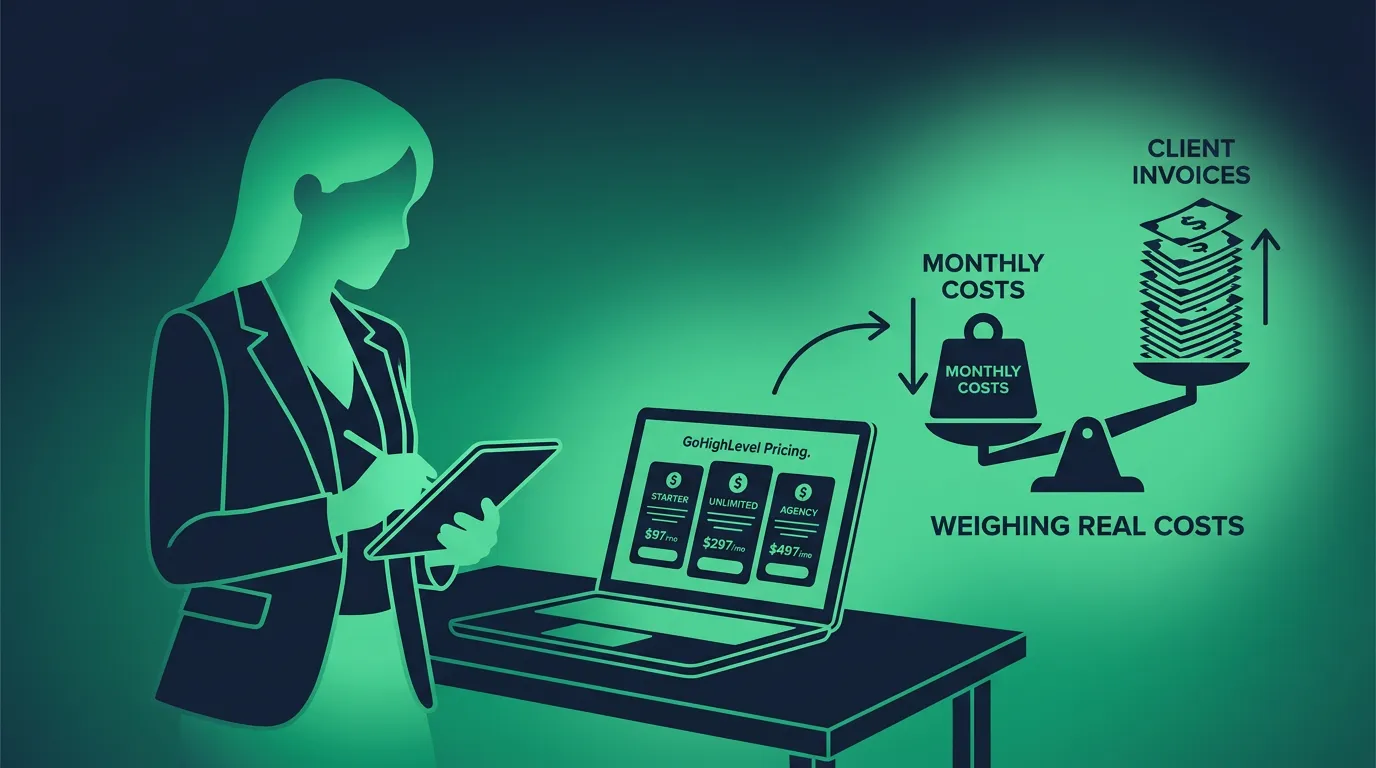
Cost is the other issue. A nonprofit pays the same $97/month as any agency, and SMS ($0.00747 per segment in the US and Canada plus carrier fees), email ($0.675 per 1,000) and AI all bill on top. For a small nonprofit, $97/month is more than Little Green Light’s entry tier and roughly what Neon CRM or DonorPerfect costs for an actual donor database.
There’s also the learning curve. GoHighLevel’s workflow builder is flexible, and community consensus is that it takes weeks of setup before it runs smoothly. A volunteer-run organization without a technical staff member will struggle.
Running a donor management system and GoHighLevel together
Organizations that use both settle on the same division of labor. The donor platform is the fundraising platform and system of record for every gift, pledge and receipt and every report the board or auditor asks for. GoHighLevel handles outreach: texting, missed calls, event funnels, volunteer sequences and nurture campaigns to supporters who haven’t given yet.
The cost of that setup is data sync. Donor information and each donor segment you mail to have to move between the two systems, usually through Zapier, Make or GoHighLevel’s API, and someone has to own that integration when it breaks. If your donor platform already includes email marketing (DonorPerfect bundles Constant Contact, and Bloomerang includes marketing automation), a second system may not be worth the overhead. GoHighLevel earns its place when manual follow-up on calls, events and volunteers is costing more staff hours than the sync does.
How to choose CRM software for nonprofits
Start with the donor records. If gifts live in a spreadsheet or QuickBooks and you can’t produce a receipt or a giving report in a few clicks, buy a donor management system first. Small nonprofits should look at Givebutter or Little Green Light, growing teams at Neon CRM, DonorPerfect or Bloomerang, and larger organizations with an admin at Salesforce Nonprofit Cloud. Any CRM provider on that list will let you manage donor relationships properly; the differences are price, setup time and how much donor management and fundraising you want under one login.
Then count the outreach load. How many inbound calls, event registrations and volunteer applications does staff process by hand each month? If the answer is a handful, your donor platform’s built-in tools are enough. If someone spends hours a week chasing RSVPs and returning calls, test GoHighLevel on one real campaign during the trial.
Finally, ask who will maintain it. Every CRM decays without an owner. Pick the tool your team will keep clean, because a simple system with accurate donor data beats a powerful one nobody updates. That’s the closest thing to best practices that holds for organizations of all sizes.
Do small nonprofits need a CRM?
Once you have more than a few hundred donors, yes. A spreadsheet can track gifts, but it can’t send receipts, flag lapsed donors or show a dashboard of how this year’s appeal compares with last year’s. Small to midsize nonprofits get the most from a data-driven donor tool because a two-person development team can’t hold all its relationships with donors in memory, and donor engagement drops fast when thank-yous go out late. If your donor base is tiny and your volunteer list is longer, Givebutter’s free tier covers the basics while you grow.
For the full plan breakdown, including when a multi-chapter nonprofit needs Unlimited instead of Starter, see GoHighLevel’s pricing tiers, and the full GoHighLevel review covers the platform beyond fundraising. Organizations dealing with sensitive client data can compare the CRM for healthcare breakdown, and nonprofits with a retail arm such as a thrift store can read the CRM for retail guide. The best CRM software hub compares GoHighLevel against wider alternatives.