GoHighLevel is the better pick for agencies and local service businesses, because it puts CRM, SMS, funnels, calendars and reviews into one flat-fee platform from $97 a month and lets you run every client in its own sub-account. HubSpot is the better pick for B2B companies with a sales team, since its CRM, reporting and integrations go deeper, and its Free CRM costs nothing to start.
The two products answer different questions. GoHighLevel is built for agencies managing multiple clients and for small businesses that want to replace a tech stack of five or six tools. HubSpot is built for one company running its own marketing, sales and service, starting free and adding paid Hubs as the team grows.
The main differences between GoHighLevel and HubSpot
GoHighLevel (HighLevel, or GHL) launched in 2018 for marketing agencies. GoHighLevel is an all-in-one marketing and CRM platform: contacts and pipelines, a funnel and website builder, calendars, email and SMS marketing, calling, reputation management, courses and workflow automation, all in one dashboard. Agencies give each client a sub-account, clone setups with snapshots, and on the Agency Pro plan resell the platform under their own brand.
HubSpot, founded in 2006, sells separate Hubs (Marketing, Sales, Service and Content) on top of a shared CRM, plus a bundle called the Customer Platform. HubSpot offers a genuinely free CRM, then charges per seat and per Hub as you add features. It’s the standard choice for B2B companies that want strong CRM data, sales tools and reporting in one place.
GoHighLevel vs HubSpot pricing
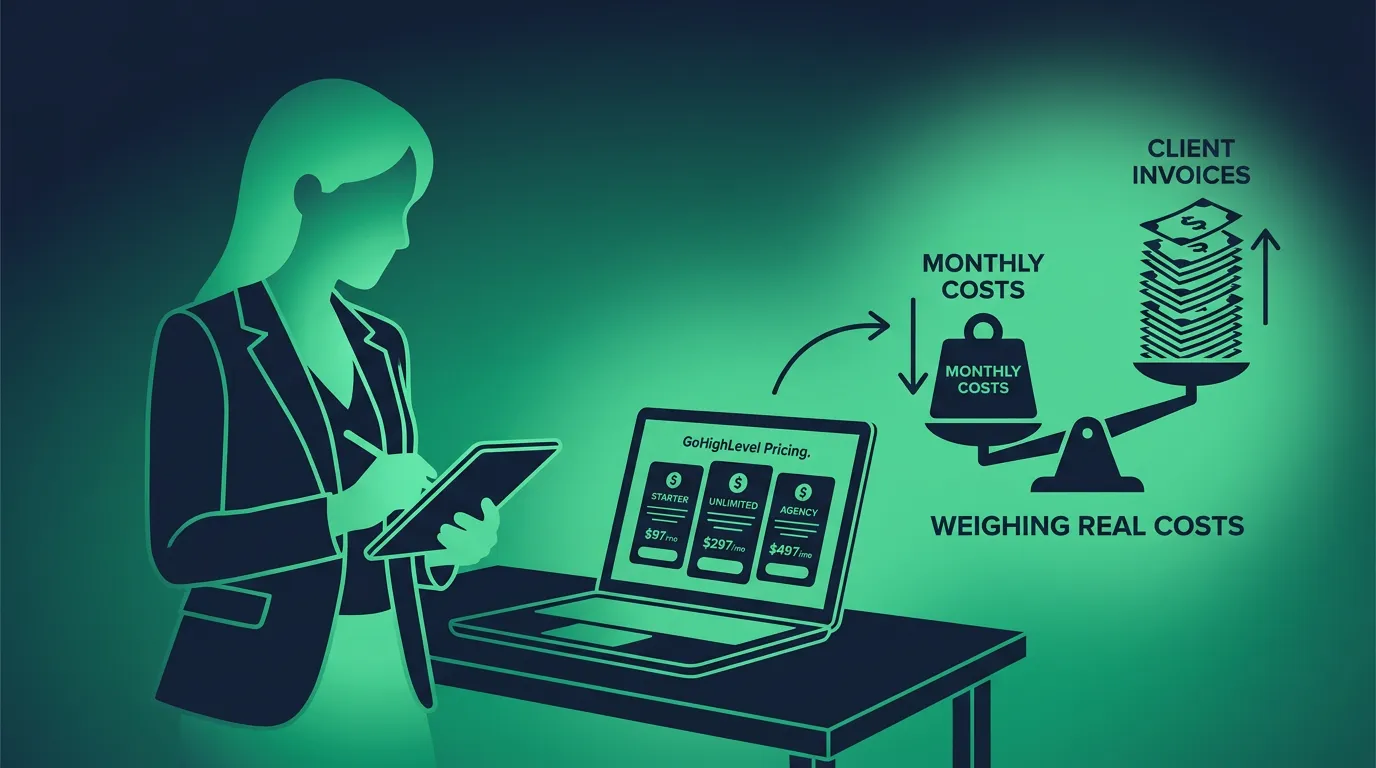
GoHighLevel’s pricing is flat-rate. Starter is $97/mo (3 sub-accounts, unlimited contacts and users). Unlimited is $297/mo (unlimited sub-accounts, white-label desktop app and custom domains, rebilling of phone and email usage at cost). Agency Pro is $497/mo (adds SaaS Mode, rebilling with markup and AI rebilling). Annual billing is $970, $2,970 or $4,970 a year, and Enterprise is quoted. There’s no onboarding fee. The extra cost is usage: SMS at $0.00747 per segment in the US and Canada plus carrier fees, LC Email at $0.675 per 1,000 emails, and AI billed per use. Our GoHighLevel pricing guide covers each tier in detail.
HubSpot’s pricing tiers depend on which Hub you buy:
| HubSpot plan | Price | Key limits |
|---|---|---|
| Free CRM | $0 | Up to 2 users, 1 deal pipeline, HubSpot branding |
| Starter (Customer Platform) | $20/seat/mo, $15 billed annually | 1,000 marketing contacts |
| Sales or Service Hub Professional | $100/seat/mo, $90 billed annually | 15 pipelines, 300 workflows; $1,500 onboarding |
| Marketing Hub Professional | $890/mo, $800 billed annually | 3 seats, 2,000 marketing contacts; $3,000 onboarding |
| Marketing Hub Enterprise | $3,600/mo | 5 seats, 10,000 marketing contacts; $7,000 onboarding |
| Customer Platform Professional | $1,300/mo | 6 seats, all Hubs |
| Customer Platform Enterprise | $4,700/mo | 8 seats, all Hubs |
The free tier is a real advantage for small teams that only need a basic CRM. The jump to Professional is where costs add up. A small business that wants marketing automation on HubSpot pays at least $9,600 in the first year for Marketing Hub Professional on annual billing, plus $3,000 onboarding, before extra seats or contacts. The same business on GoHighLevel Starter pays $970 for the year plus usage. Professional and Enterprise contracts also typically run 12 months.
For agencies, the gap is wider. HubSpot licenses per company, so serving ten clients means ten portals or working inside each client’s account. GoHighLevel’s $297 Unlimited plan covers all ten.
CRM depth and reporting
HubSpot is better here, and the gap matters for B2B sales. Sales Hub Professional gives you up to 15 deal pipelines, 300 workflows, 30 dashboards, sequences, quotes, forecasting and 12,000 calling minutes. Enterprise raises that to 100 pipelines and 1,000 workflows, with custom objects and advanced permissions. HubSpot wins on reporting depth because its dashboards and forecasts were built for multi-stakeholder deals with long cycles.
GoHighLevel’s CRM covers the needs of most small businesses: contacts, custom fields, tags, smart lists, multiple pipelines, opportunity values, tasks and a unified inbox for SMS, email, social DMs and calls. Its reporting covers attribution, calls, appointments and pipeline value, but forecasting and custom reporting are lighter. A team with a six-month sales cycle and five decision-makers per deal will outgrow it. A roofer or dental clinic won’t notice.
Marketing automation and workflows
Both platforms automate email and lead follow-up through visual workflow builders. GoHighLevel includes workflows on every plan, and a single workflow can text, email, leave a voicemail drop, assign a task, move a pipeline stage and request a review. Missed Call Text Back sends an automatic text when a call goes unanswered.
HubSpot gates most of its useful automation features (workflows, A/B testing, sequences and custom reporting) behind Professional and Enterprise. In return you get stronger attribution, SEO and content tools, a native CMS for your website and campaign analytics built for B2B demand generation. If your marketing runs on content and email, HubSpot’s toolset is deeper. If it runs on texting leads within a minute and booking appointments, GoHighLevel automates more for less money.
SMS, calling and reputation management
GoHighLevel treats SMS and calling as core channels: phone numbers, two-way texting, call tracking and recording, voicemail drops, missed-call text back, automated review requests and review replies. WhatsApp is a $10/mo per sub-account add-on plus Meta fees. Local service businesses rely on this set.
HubSpot’s strengths are email, chat and calling minutes inside Sales Hub. Texting and review management aren’t where it puts its weight, so check which Hub and tier covers SMS before you assume it does. Many local businesses using HubSpot add third-party tools for texting and reviews.
AI features
HubSpot includes Breeze Assistant, its in-app AI copilot, on every tier, including Free, for drafting content and summarizing CRM records. Heavier AI use draws on HubSpot Credits, which are included in set amounts per plan.
GoHighLevel offers Conversation AI, Voice AI, Content AI and Reviews AI on every plan, billed per use unless a sub-account is on AI Employee Growth ($50/mo) or AI Employee Unlimited ($97/mo). No GoHighLevel agency plan bundles AI for free.
Ease of use, onboarding and support
HubSpot is easier to start with. The Free CRM takes minutes to set up, the interface is consistent across Hubs, and HubSpot Academy offers free courses. The complexity arrives later: many teams report needing a dedicated HubSpot admin once several Hubs are active, and the mandatory onboarding for Professional plans exists for that reason.
GoHighLevel’s setup is harder up front. A new account opens on a long menu of tools, and community consensus is that it takes several weeks before everything runs smoothly. Agencies accept that because they build a snapshot once and reuse it for every client.
Trials differ too. HubSpot’s 14-day Professional trial needs no credit card and reverts to your previous plan when it ends. GoHighLevel’s 14-day trial needs a card on file and auto-charges unless you cancel.
Integrations and app marketplace
HubSpot connects to more than 2,000 apps through its marketplace, including Gmail, Outlook, Slack, Zoom and Teams. That makes it easy to add to an existing stack. GoHighLevel has native integrations with Stripe, Google, Facebook, Instagram, Shopify and Zoom, plus a REST API and Zapier and Make for anything else, because its pitch is that you need fewer outside tools.
Which is better for agencies and small businesses?
GoHighLevel is better for agencies, and it’s not close. Sub-accounts, snapshots, rebilling and white label branding let you run dozens of clients from one login, and SaaS Mode on Agency Pro turns the platform into a product you sell. HubSpot has no multi-client equivalent. Our GoHighLevel review covers how that works day to day, including the rough edges.
For small businesses, it depends on how you sell. Local service businesses that book appointments by phone and text get more from GoHighLevel. Small B2B teams that want a strong CRM and can live on the Free or Starter tier for a while get more from HubSpot, and HubSpot is the safer choice if you expect to grow into a larger sales organization.
Is there anything better than GoHighLevel or HubSpot?
For some businesses, yes. Salesforce is HubSpot’s main rival at the enterprise end, and Pipedrive or Zoho CRM suit small sales teams that want a simpler, cheaper pipeline tool. If you’re comparing all-in-one marketing tools instead, see GoHighLevel vs Keap for small-business automation, GoHighLevel vs ActiveCampaign for email-first marketing, or GoHighLevel vs ClickFunnels and GoHighLevel vs Kajabi if you sell funnels or courses. Our full list of GoHighLevel alternatives covers the rest.
Moving from HubSpot to GoHighLevel
Export contacts, companies and deals from HubSpot as CSV files and import them into GoHighLevel, then rebuild pipelines and workflows by hand. Custom properties, email history and call recordings usually don’t carry over cleanly. Some agencies keep HubSpot’s Free CRM for their own sales pipeline and use GoHighLevel for client work, which works until keeping two systems up to date becomes a chore.