The best CRM for manufacturing depends on where your sales process breaks. If RFQs sit unanswered and trade-show leads go cold, a marketing CRM like GoHighLevel ($97/month) fixes that cheaply. If your quotes depend on bills of materials, inventory, costs and production lead times, you need manufacturing CRM software that connects to your ERP, and GoHighLevel can’t do that.
Both kinds of product get sold under the same label, which is why advice about the best CRM for manufacturing businesses seems to contradict itself. This page separates them, prices the main options and says plainly where GoHighLevel stops.
What a manufacturing CRM system does
A CRM (customer relationship management system) keeps track of your customer relationships, meaning the people and companies you sell to: buyers, engineers, purchasing managers, distributors and reps. In the manufacturing industry that means lead management for every RFQ, logging every quote and follow-up, and showing the sales pipeline so you know which jobs are likely to land and when.
A manufacturing CRM adds features a general-purpose CRM lacks. The common ones are account-based forecasting (how much will this customer order next quarter), sales agreements or run-rate contracts, channel and distributor management, and quoting that reads product, price and inventory data from the ERP. Salesforce describes its Manufacturing Cloud as connecting customer, product and asset data from ERP, PLM and IoT systems, with tools for commercial operations, channel partners and warranty.
The ERP sits next to it. ERP and MRP systems run order management, inventory management, purchasing, production scheduling, supply chain management and accounting. Some go further into the shop floor with a manufacturing execution system. The CRM and ERP split is simple in principle: the CRM owns the relationship and the deal, the ERP owns the order and the product. Problems start when quotes need data that only the ERP has.
Why manufacturing companies need more than a generic CRM
Generic CRM roundups assume short, simple deals with one buyer. Manufacturing sales are different in four ways.
Long sales cycles with many people. The sales cycle for a new part number can run for months: RFQ, engineering questions, samples, first-article inspection, approval, then a blanket order. The CRM has to track several contacts at one account and many open quotes at once.
Quotes depend on data the CRM doesn’t own. Material cost, machine time, minimum order quantities and lead times live in the ERP or estimating software. A quote built without them is a guess.
Repeat business matters more than new logos. For many manufacturers, most revenue comes from reorders and run-rate programs. Forecasting by account and spotting a customer whose orders are slipping is worth more than a flashy lead form.
Channels. Many manufacturers sell through distributors and independent reps. Recruiting, onboarding and supporting those partners is its own pipeline.
A small job shop selling one-off work from website and trade-show leads feels the first two less and lead response much more. That’s where the decision splits.
Benefits of a CRM for manufacturing
The benefits of CRM in a plant come down to visibility and speed. Sales managers see every open quote and its stage instead of asking around. Estimators get complete RFQs with drawings attached instead of forwarded emails. Account managers spot a run-rate customer whose orders are slipping before the customer has gone. And a cloud-based CRM lets reps and distributors update deals from the road, so the CRM data reflects reality rather than last month’s meeting.
For small manufacturing companies the main win is simpler: nothing falls through the cracks between the trade show, the quote and the first order. Larger manufacturers get more from forecasting and from connecting CRM data to manufacturing operations, so sales promises match what the plant can build.
Manufacturing CRM features to look for
Choosing the right CRM starts with the features that match how you sell:
- RFQ capture and fast response: web forms that accept drawings, automatic acknowledgement and routing to the right estimator.
- Pipeline management with stages that match your process: RFQ received, quoted, engineering review, sample, approved, ordered.
- CRM and ERP integration so quotes use real pricing, inventory and lead times, and so sales can see order status and invoice history.
- CPQ (configure, price, quote) for configurable products with option rules and BOM-driven pricing.
- Account forecasting and sales agreements for run-rate customers.
- Distributor and rep management, including partner portals and territory reporting.
- Automation for follow-up on quotes, reorder reminders and customer experience touchpoints like order-shipped updates.
The first two and the automation are where GoHighLevel is strong. The middle four are where it has nothing to offer.
Where GoHighLevel fits for a manufacturing business
As a CRM platform, GoHighLevel can help manufacturers whose bottleneck is the front of the sales process: custom fabricators, machine shops, job shops, small contract manufacturers and product companies recruiting distributors.
Missed Call Text Back is the clearest example. A sales team of two, or a front office that also handles shipping, will miss calls. When a buyer calls about a quote and gets voicemail, GoHighLevel texts them back within seconds so the conversation stays open. The same goes for RFQ forms: an automatic reply confirms you received the drawings and tells the buyer when to expect a quote.
After the first touch, workflow automation does the follow-up that slips when everyone is busy on the floor. A sequence can check in three days after a quote goes out, again after a week, and create a task for a salesperson if the buyer still hasn’t replied. Trade-show leads can go straight into a nurture sequence instead of sitting in a spreadsheet until the next show. Booking calendars let a buyer or prospective distributor schedule a plant tour or call online.
For distributor and rep recruitment, GoHighLevel’s funnels, email and SMS campaigns, and pipelines work as a small marketing department. You can build a landing page for prospective distributors, run an application form, and push qualified partners into an onboarding pipeline. Sub-accounts let a rep agency or a manufacturer with several plants run separate pipelines per territory or product line.
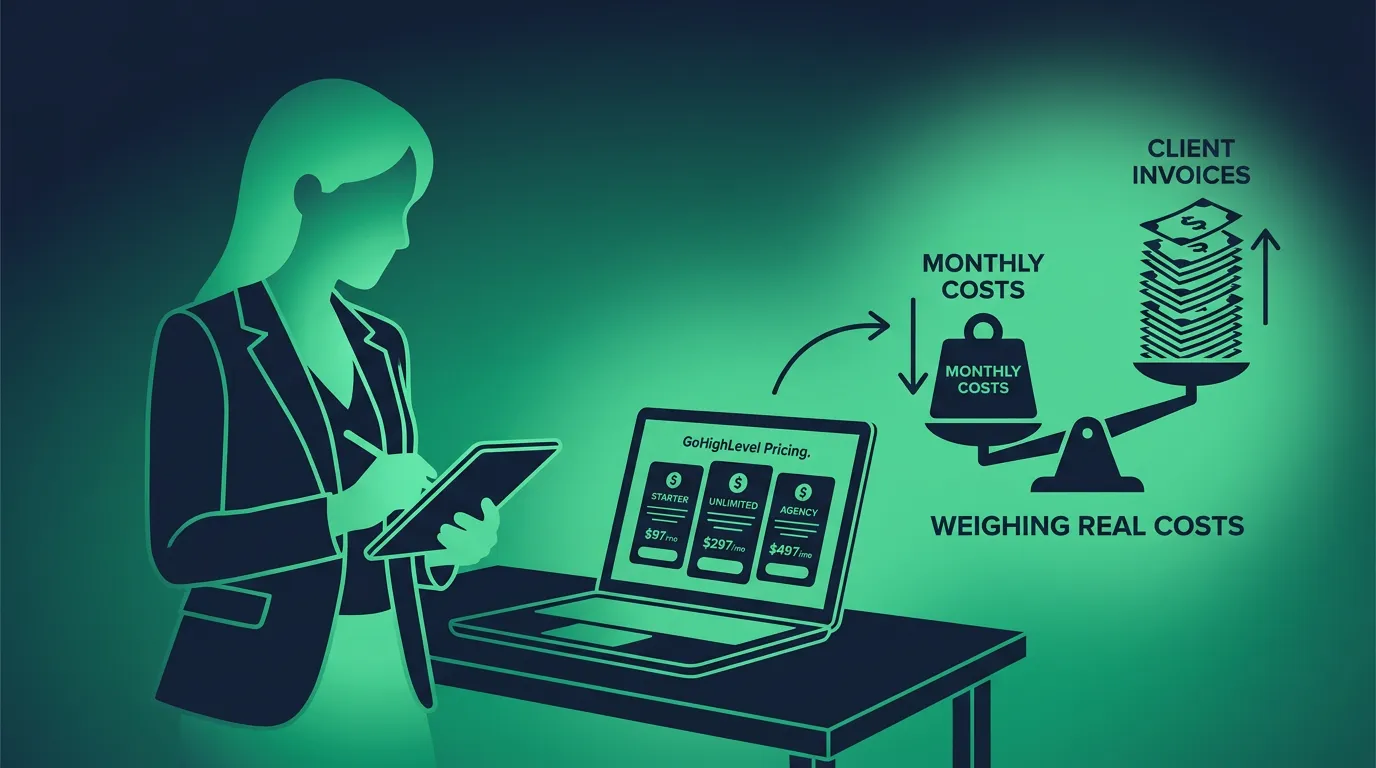
Cost is the other reason. Starter is $97/month with unlimited contacts and users. A per-seat CRM gets expensive once estimators, inside sales and customer service all need logins. Usage (SMS at $0.00747 per segment plus carrier fees, email, and AI billed per use unless you buy an AI Employee plan at $50 or $97 per sub-account per month) comes on top.
Where GoHighLevel stops
The limits are hard ones for any manufacturer whose quotes depend on operational data.
GoHighLevel has no CPQ and no bill-of-materials quoting. It can’t price a configured product or roll up material and labor costs. It has no native ERP integration, so it can’t see inventory, production capacity, lead times, open orders or invoice history. HighLevel’s native integrations cover tools like Stripe, Google, Facebook, Shopify and Zoom, with Zapier and Make for the rest, and a custom ERP connection through the API is a development project, not a setting.
It also has no RFQ workflow built for engineering: no drawing revision control, no routing to an engineer for a manufacturability check, no audit trail on technical changes. And it has no account forecasting or sales agreement tracking for run-rate customers.
So a manufacturer that uses GoHighLevel usually keeps quoting in an estimating tool or the ERP, and uses GoHighLevel only for lead capture, follow-up and marketing. That works for a job shop. It breaks down for an OEM supplier whose sales team lives inside forecasts and order data.
Best manufacturing CRM platforms compared
Prices below were checked on vendor sites in October 2026 unless noted.
| Option | Type | Pricing | Best for |
|---|---|---|---|
| GoHighLevel | Marketing CRM with SMS, email, funnels and automation | $97/mo Starter, $297/mo Unlimited; usage extra; unlimited users | Job shops and fabricators fixing RFQ response and trade-show follow-up |
| MRPeasy | MRP/ERP for small manufacturers with CRM built in | Starter $49, Professional $69, Enterprise $99, Unlimited $149 per user/mo; CRM on all plans | Small manufacturers wanting CRM, inventory and production planning in one tool |
| Microsoft Dynamics 365 Sales | CRM in Microsoft’s business apps family | Professional $65, Enterprise $105, Premium $150 per user/mo, annual commitment | Manufacturers on Microsoft 365 or Microsoft’s ERP products |
| Salesforce Manufacturing Cloud | Industry CRM on the Salesforce platform | No price on Salesforce’s manufacturing page; 30-day free trial; sales quote | Mid-size and large manufacturers with channel partners and forecasting needs |
| Salesforce Sales Cloud | General enterprise CRM | Starter Suite $25/user/mo; Pro Suite $100; Core to Max $195-$550, billed annually | Manufacturers that want Salesforce without the industry cloud |
| HubSpot | General CRM | Free CRM (2 users); Starter $20/seat/mo ($15 annual) | Manufacturers focused on inbound marketing who want HubSpot CRM’s free tier |
| Zoho CRM | General CRM | Free for up to 3 users; paid editions per user | Budget-conscious shops willing to configure their own workflows |
| Pipedrive | Pipeline-focused sales CRM | About $14 to $79 per seat/mo billed annually (third-party listings) | Small sales teams that want simple pipeline management |
General CRMs are cheap to start and expensive to connect, while ERP-connected and industry CRMs cost more per user but bring the data your quotes need. Ask every vendor for the integration cost with your specific ERP, in writing, because that number often decides the deal.
How CRM and ERP should work together
The cleanest setup sends data both ways. Customers and contacts are created in the CRM and pushed to the ERP when they place a first order. Products, prices and inventory come from the ERP into the CRM so quotes are accurate. Orders, shipments and invoices flow back into the CRM so sales can see an account’s full history without logging into the ERP.
How much of that you need depends on size. A small manufacturer can get by with an MRP system’s built-in CRM, or with GoHighLevel for marketing and the ERP for everything after the order. A manufacturer with ten salespeople, distributors and forecasting needs a CRM that integrates natively with the ERP, which narrows the shortlist to CRMs with a proven connector for your ERP.
Choosing the right manufacturing CRM for your sales process
Start by counting RFQs and inbound inquiries per month, and how they arrive. A fabricator with two or three long-term OEM customers and few new inquiries doesn’t need a marketing CRM. A shop running a website, paid search and trade shows that fields 20 or more RFQs a month does, because an RFQ answered two days late often goes to a faster shop.
Next, look at how quotes get built. If an estimator builds them in a spreadsheet from drawings, GoHighLevel plus that spreadsheet is a reasonable setup. If quotes need live costs, inventory and capacity, prioritize ERP integration over marketing features.
Then check who needs access. Per-user pricing at $65 to $150 a seat adds up fast across sales, estimating and customer service. A flat-rate tool covers everyone for the same price but won’t do the ERP-connected work.
Finally, test your own response. Submit an RFQ through your website at 4pm on a Friday and call the main line at lunch. If neither gets a reply until Monday afternoon, start there.
If GoHighLevel looks like the right fit for lead response and distributor recruitment, GoHighLevel’s pricing tiers show which plan fits one plant versus several, and the full GoHighLevel review covers the platform beyond manufacturing. The 14-day trial needs a card on file and bills when it ends unless you cancel, so route a few weeks of real RFQs through it before deciding.
Related B2B sales models share many of these trade-offs. See our pages on CRMs for distributors, CRMs for the automotive industry, CRMs for professional services firms and CRMs for consultants, or compare tools across industries in our best CRM software roundup.