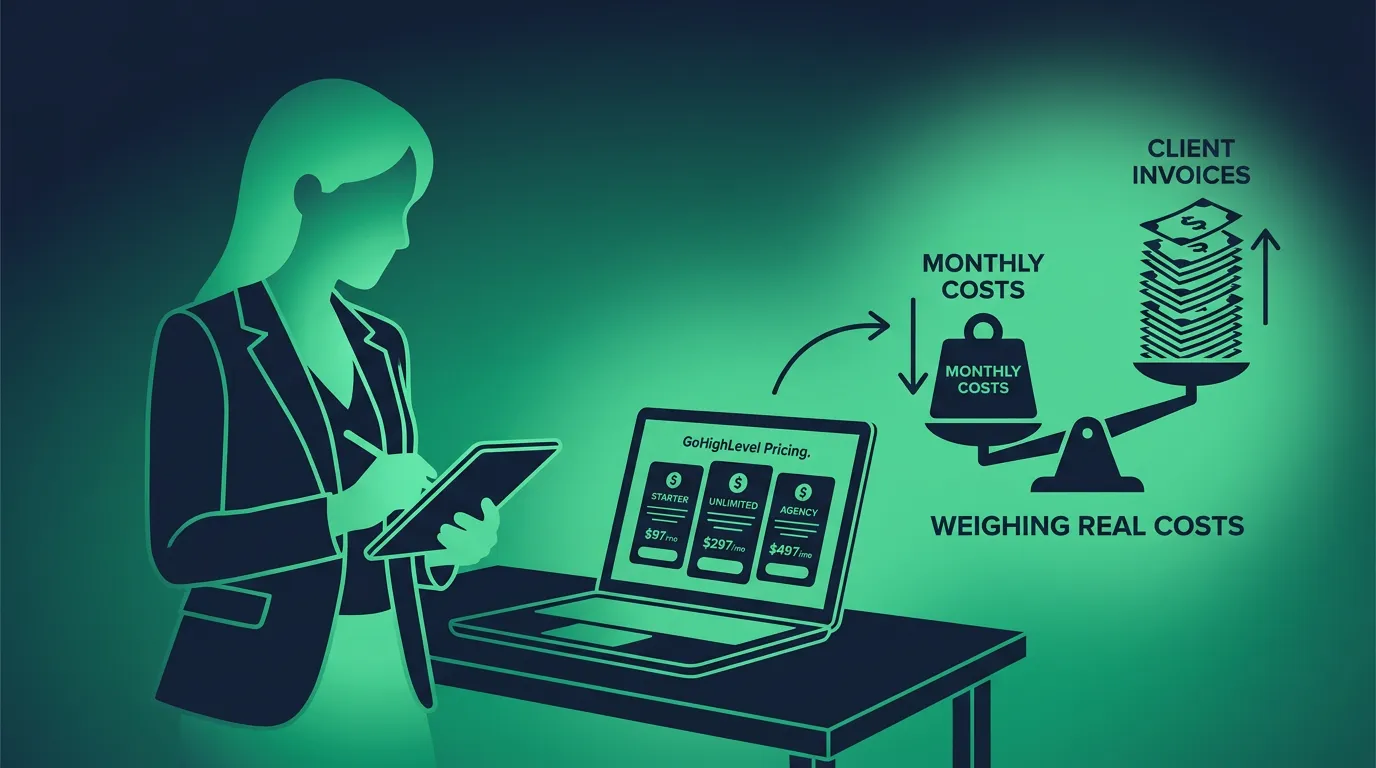
GoHighLevel SMS pricing is usage-based: you pay $0.00747 per message segment in the US and Canada, inbound and outbound, plus a carrier fee on each outbound segment. None of it is included in the $97 Starter, $297 Unlimited or $497 Agency Pro subscription, so texting is a second bill that grows with your clients’ volume.
That second bill matters more on GoHighLevel than on most CRMs. Missed Call Text Back, appointment reminders, review requests and most of the workflows agencies sell all send SMS by default. If you price a client at the subscription cost alone, you’ve left out a line item that scales with every booking. HighLevel’s public pricing page focuses on the plans, so the per-message rates you actually pay live in the HighLevel support portal and in each account’s billing dashboard.
How GHL SMS pricing works on the LC Phone system
Texts and calls run through LC Phone, the native phone system GoHighLevel uses for every sub-account, built on Twilio. SMS pricing is based on segments, not messages, and each send is metered and charged to the sub-account’s wallet. HighLevel’s LC Phone system pricing guide, updated on 29 September 2026, sets the US and Canada rates this way.
US and Canada rates for SMS, MMS and phone numbers
| Charge | Price (US/Canada) |
|---|---|
| SMS, outbound or inbound | $0.00747 per segment |
| MMS, outbound | $0.0220 per segment |
| MMS, inbound | $0.0165 (local) / $0.0200 (toll-free) |
| Local phone number | $1.15/mo |
| Toll-free number | $2.15/mo |
| Outbound voice | $0.0166/min |
| Inbound voice | $0.01165/min |
The SMS figure is HighLevel’s $0.0083 list rate with a 10% discount applied. That discount covers US and Canada SMS, phone numbers and voice calls. You’ll still see $0.0083 in older help articles and third-party guides, along with $0.0079 and a vague “$0.0075 to $0.0083” range. The current pricing guide says $0.00747, so check the date on any source you use, because pricing changes do happen and old figures linger online.
Carrier fees on outbound SMS
Carriers charge their own A2P fee per segment, and HighLevel passes it through. For outbound SMS the pricing guide lists:
| Carrier | Outbound SMS fee | Outbound MMS fee |
|---|---|---|
| AT&T | $0.0035 | $0.0090 |
| T-Mobile | $0.0045 | $0.0100 |
| Verizon | $0.0050 | $0.0070 |
| US Cellular and others | up to $0.0050 | $0.0100 |
Carrier fees are charged per segment, so a message that splits into three segments pays the carrier fee three times. Some carriers also bill inbound messages (T-Mobile lists $0.0025 per inbound SMS, for example).
So the real cost per text is the segment rate plus the carrier fee. Sending a single SMS of one segment to a Verizon customer costs $0.00747 + $0.0050 = $0.01247. To an AT&T customer, $0.01097. HighLevel’s own SMS and MMS cost calculator article uses the same formula: segments × per-segment cost, plus segments × carrier fee.
MMS pricing
Whether a send bills as SMS or MMS depends on attachments. Attach an image or GIF and the message bills as MMS: $0.0220 per outbound segment plus the MMS carrier fee, so roughly 3 cents a send to most US numbers. That puts the MMS cost compared to standard SMS at about two and a half times. MMS earns its cost for a before-and-after photo or a coupon image. For a reminder or a “reply YES to confirm,” send it as SMS.
What counts as an SMS segment
Message length decides the segment count, and the character set decides the length limit:
- GSM-7 (plain text): 160 characters fit in one segment. Longer messages are split into multiple segments of 153 characters each, because part of each segment is reserved for the header that stitches them back together.
- UCS-2 (Unicode): any emoji, curly quote or non-Latin character switches the entire message to Unicode. The limit drops to 70 characters for a single segment and 67 per segment after that.
A 150-character reminder fits in one segment. Add one smiley face and the same message becomes three UCS-2 segments, increasing the cost threefold. Small formatting choices impact the cost more than the per-segment rate does. Hidden characters pasted in from Word or Google Docs do the same thing. HighLevel suggests pasting templates as plain text and using a messaging segment calculator to check each template before you turn on a workflow.
Extra fees on top of the cost per segment
Phone numbers and A2P 10DLC registration
Any US sub-account texting from a local 10-digit number has to register a brand and campaign under A2P 10DLC, the carriers’ system for business texting. Registration is per sub-account, so a 20-client agency runs 20 registrations. HighLevel’s pricing guide lists these fees:
| A2P brand type | One-time fee | Monthly campaign fee |
|---|---|---|
| Sole proprietor | $22.50 | up to $2.10 |
| Low volume | $22.50 | $1.50-$10.50 |
| High volume | $64.00 | $10.50 |
Toll-free numbers skip A2P 10DLC and go through a separate toll-free verification instead. The number costs $2.15/mo against $1.15 for a local one, but there’s no 10DLC campaign fee to pay each month.
The fixed 5% markup
HighLevel adds a fixed 5% to carrier fees and A2P registration fees at the sub-account level, but only when rebilling is enabled. Some older guides say the 5% applies “regardless of rebilling.” HighLevel’s current pricing guide says otherwise. The 5% doesn’t touch the $0.00747 segment rate itself.
Carrier lookup and failed messages
The first time you text a contact, HighLevel runs a carrier lookup to check the number can receive SMS. That fee shows up on invoices as carrier lookup fees and is charged once per contact, not per message. It’s there to stop you paying full rates to texts sent to dead or fake numbers.
Undelivered messages are the other surprise. If a send fails inside HighLevel before it reaches the carrier, you’re not charged. Once it’s handed off to the phone carrier, the charge stands even if the delivery attempt fails, including texts that can’t be delivered due to country restrictions, and HighLevel doesn’t refund undelivered SMS. A list full of disconnected numbers costs real money.
SMS pricing options by plan: who can rebill
The per-segment cost is identical on every plan, so the pricing structure for SMS messages doesn’t reward upgrading by itself. What changes is whether you can pass that cost to clients, and whether you can make money on it.
| Plan | Monthly price | Rebill SMS to clients? | Markup allowed? |
|---|---|---|---|
| Starter | $97 | No | No |
| Unlimited | $297 | Yes, at cost | No |
| Agency Pro | $497 | Yes | Yes, you set it |
On Starter, the agency pays every text. That’s fine for a single business running its own account and painful for an agency with three clients. Unlimited lets each client’s wallet pay its own usage at cost, so the texting bill leaves your P&L but earns nothing. Agency Pro, through SaaS Mode, lets you set a markup on SMS, calls and LC Email ($0.675 per 1,000 emails) and is the only tier that can rebill AI usage. The GoHighLevel white-label pricing breakdown covers what else separates Unlimited from Agency Pro, and our GoHighLevel pricing guide walks through all four plans and their add-ons.
Estimating a client’s SMS bill
Three numbers get you close: monthly conversations, segments per conversation, and the carrier mix. Two-way appointment confirmations (reminder, reply, confirmation) usually run three or four segments per booking, and remember inbound replies are billed too.
Take a hypothetical HVAC client with 150 booked appointments a month at 3.5 segments each, plus 400 missed-call text-back replies at one segment each. That’s 925 segments. At an all-in rate of about $0.0125 per segment (the segment rate plus the highest outbound carrier fee), usage comes to roughly $11.50 a month. Add $1.15 for the local number and a low-volume A2P campaign fee of $1.50 to $10.50, and the client’s texting runs somewhere between $14 and $24 a month.
That’s small per client and real across a roster. Thirty clients at that level is $420 to $720 a month in texting alone, which either comes out of your margin (Starter), passes through at cost (Unlimited) or becomes a revenue line (Agency Pro). Add a buffer of 15 to 20% for months when a review-request campaign or a seasonal rush pushes volume up.
How to reduce your GoHighLevel SMS costs
SMS costs in GoHighLevel are mostly a segment problem, so most of the savings come from segment discipline. Strip emoji and smart quotes from automated templates, keep reminders under 160 characters, and paste copy as plain text. Then cut the sends you don’t need: trim follow-up steps in long nurture sequences, and clean lists so you aren’t paying for texts to numbers that will never reply.
Channel choice helps too. WhatsApp has been available in GoHighLevel since 2024 as an add-on billed at $10 monthly per sub-account, with Meta’s own message fees on top. Those messages don’t use US carrier routes, so there’s no A2P 10DLC fee or per-segment carrier charge. It suits clients with international customers or a customer base that already uses WhatsApp, and it’s a poor fit for a US plumber whose customers expect a normal text. Email at $0.675 per 1,000 sends (plus $2.50 per 1,000 if you use email validation) is the cheapest channel of all for anything that doesn’t need an instant read. Rates for international texts vary based on the destination country, so route overseas contacts to WhatsApp or email where you can.
If you’re still deciding whether the platform is worth this usage model, you can see the live billing dashboard and wallet charges during the GoHighLevel free trial, and our GoHighLevel review covers the CRM and automation side the texting sits on.