White label software is a product one company builds and hosts, and another company rebrands and sells as its own. The reseller puts its own name, logo and domain on the login screen, sets the price, and owns the customer relationship, while the vendor runs the servers and ships the updates.
For marketing agencies, the practical question is which kind of white label product to buy, because the term covers everything from a branded PDF report to a full SaaS platform you resell at your own prices. This page sorts the types, compares what each costs, and names the platforms that are actually built for agency resale. If you already know you want a full CRM and marketing stack under your brand, our white label marketing software hub goes deeper on that decision.
How white-label SaaS works
The mechanics are the same in every category. A vendor builds a software product once, usually as software as a service (SaaS), then licenses it to many resellers. Each reseller can customize the look and feel (logo, colors, domain, sometimes the app name and email sender), sells access to its own customers, and pays the vendor a wholesale fee or subscription.
The customer logs into app.youragency.com, sees your brand name, and pays your invoice. The vendor stays invisible. That’s what separates a white label product from an affiliate deal, where you send the customer to the vendor’s own signup page and collect a commission.
Why would a software company let other businesses take the credit? Distribution. A vendor like HighLevel gets a large network of agencies selling its platform to local businesses it would never reach through its own marketing, and each agency pays a monthly fee whether or not its clients ever hear the vendor’s name.
White label vs private label vs reseller
People mix up white label and private label constantly, and vendors use “reseller” loosely in sales pitches.
A white label product is built once and licensed to many resellers at the same time, all selling the identical software under different brands. A private label product is built or customized for one company, which gets exclusivity over that version. A reseller sells someone else’s product, sometimes at a discount, often with the vendor’s brand still visible somewhere in the experience.
GoHighLevel and Vendasta are white label in the first sense. Many agencies resell the same platform, each wrapped in its own branding. The difference between white-label and reseller matters most when you read a vendor’s partner page: “reseller program” can mean anything from a referral discount to full rebranding, so check what the client actually sees.
Is white labeling legal?
Yes. White labeling is a standard licensing arrangement, and the reseller or partner agreement governs it. That contract spells out what you can rebrand, whether you can set your own prices, how billing works, and who handles customer support. Trouble starts only when someone rebrands software without a license, or breaks the terms of the agreement they signed.
The four types of white-label software
The search term pulls in at least four different kinds of products. They don’t compete with each other on price or features.
White label SEO tools and analytics reports
Tools like AgencyAnalytics and DashThis let an SEO or PPC agency put its own logo on client-facing analytics dashboards and reports while the vendor collects the data. These are the cheapest white label tools and the narrowest. They make one deliverable look like yours and leave the rest of your stack untouched.
Single-purpose white label tools
White label website builders and CMS platforms, white label social media management tools, help desks and client portals all fall here. Each solves one job for clients under your brand: a site editor, a social scheduler, a ticketing portal. Useful, but you’re stitching several of them together if you want to offer a full service.
Full white-label SaaS platforms for CRM and marketing automation
This is what most agencies mean when they search for the best white label tools: a white-label platform is built from the ground up to be rebranded and resold as your own SaaS product. You customize everything the client sees, set your own subscription pricing, automate client provisioning, and rebill usage like SMS and email. GoHighLevel and Vendasta compete here.
Reseller programs on a single marketing tool
Some well-known marketing tools offer partial rebranding through an agency program. ActiveCampaign’s Agency Partner Program, for example, lets partners apply their own logo, custom domain and app name to resold accounts. You’re still reselling one tool (email marketing and marketing automation), and you’re priced by contact count per client account.
Across the four types you’ll find white label SEO tools (rank trackers, site audits), white label PPC reporting, white-label social media schedulers, white label CMS and website builders, and email marketing software. Project management software rarely shows up on white label vendor lists. Most of it was built for internal teams and was never designed to be handed to end clients under someone else’s brand.
The best white label SaaS platforms for agency resale
Once you’ve decided you want a full platform to resell under your own brand, the list gets short.
GoHighLevel
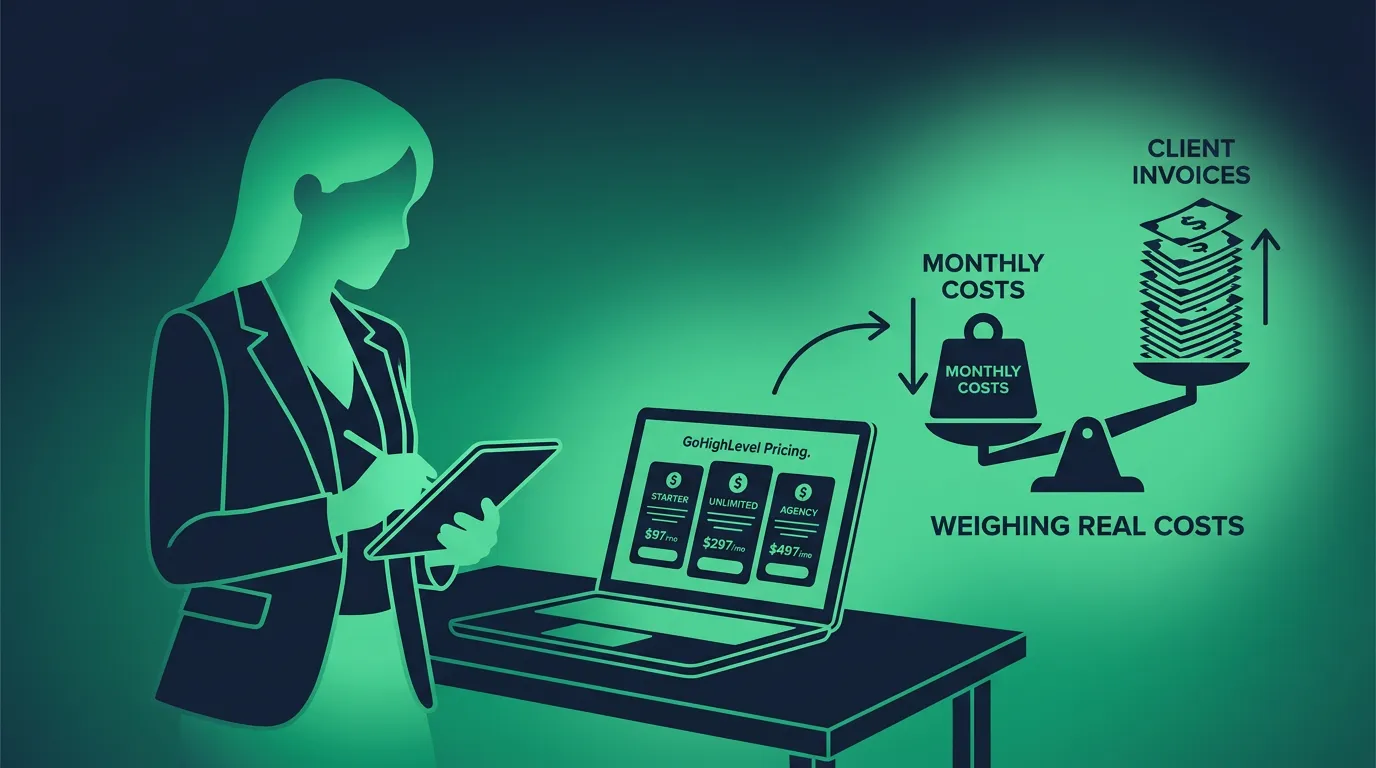
GoHighLevel splits white labeling across two plans. On Unlimited ($297/mo) you get unlimited client sub-accounts, a white-labeled desktop web app and custom domains, so clients log into your branded CRM, funnel and landing page builder, email marketing, SMS and calendar tools. You can also rebill phone and email usage to clients at cost.
On Agency Pro ($497/mo) you add SaaS Mode: you set your own subscription prices, sub-accounts are created automatically when a client pays through Stripe, and you can rebill phone, email and AI usage with a markup. This is the plan where an agency stops being a branded user of GoHighLevel and starts running its own software business. Our breakdown of GoHighLevel’s SaaS Mode walks through the setup and the margin math.
The branded mobile app is the line item that trips people up. It’s a separate add-on at $497/mo or $1,491/quarter on any agency plan, and only Enterprise includes it. Without it, your clients use the free LeadConnector app under LeadConnector’s name.
AI features (Conversation AI, Voice AI, Content AI, Reviews AI) are available on every plan but billed per use, or through AI Employee plans at $50 or $97 per sub-account per month. If you’re reselling AI to clients, only Agency Pro can rebill it.
Vendasta
Vendasta takes a different shape. There’s no flat subscription. Instead, each plan is a $0 subscription with a monthly minimum spend that your marketplace purchases count against. Starter has a $99/mo minimum and is co-branded rather than fully white-label. Professional, at a $499/mo minimum, adds a white label client portal but requires a one-year contract. Premium is a $999/mo minimum with multi-location portals and API access.
Vendasta’s strength is breadth. It’s a marketplace of white label products and services (reputation management, SEO services, social media, websites) that an agency resells to local businesses, plus its own CRM. That suits an agency selling a menu of marketing services. It suits an agency that wants one unified platform less well, and reviewers frequently describe the interface as complex. We compare the two head to head in GoHighLevel vs Vendasta.
Tools that won’t let you resell software under your brand
HubSpot’s Solutions Partner Program is a services and referral program. Clients still log into HubSpot, and you can’t rebrand it as your own software. Kartra says plainly on its own site that you can’t rebrand Kartra and sell it as your own software, although Kartra Agency lets you manage client accounts. ActiveCampaign sits in between, as described above: rebranded accounts, but a single tool priced per client contact list.
White-label platforms compared
| Platform | Branding unlocks at | Full resale with your own pricing | Branded mobile app | Contract |
|---|---|---|---|---|
| GoHighLevel | $297/mo (Unlimited) | $497/mo (Agency Pro, SaaS Mode) | $497/mo add-on; included on Enterprise | Month to month |
| Vendasta | $99/mo min. spend (co-branded only) | $499/mo min. spend (white-label portal) | Not covered here | 1 year on Professional and Premium |
| ActiveCampaign | Agency Partner Program (rebranded accounts) | You set retail price on resold accounts | No | Per account |
| HubSpot | Not offered | No | No | n/a |
| Kartra | Not offered (custom domains only) | No | No | n/a |
The table makes the real decision obvious. If you want to resell a whole marketing platform, CRM included, as your own SaaS product, you’re choosing between GoHighLevel and Vendasta. Everything else is either a single tool or not resellable at all.
Advantages of white label SaaS products for agencies
The main advantage is speed. Building your own CRM or SaaS company from scratch means hiring developers, paying for infrastructure, and waiting a year or more for a product clients will pay for. A white label SaaS solution gives you a finished software product on day one, and the vendor keeps shipping updates you never had to build.
The second is recurring revenue. Digital marketing agencies usually sell projects and retainers that end. Putting clients on your own branded platform adds a monthly subscription line that stays as long as the client does, and it makes switching agencies harder because their contacts, pipelines and automations live in your account.
The third is brand control. Every login, email and report carries your brand name, which builds trust in your agency rather than in a vendor the client could sign up with directly. For lead generation agencies this matters a lot: the landing pages, forms, SMS follow-up and booking calendars that capture leads all run under your domain.
The trade-offs are real. You depend on the vendor’s uptime, roadmap and pricing changes, you take on first-line customer support, and you can’t change the underlying code. If the vendor raises prices, your margin shrinks until you pass it on.
How much white label software costs (and what it earns)
The subscription is the easy part to budget. Branded reporting tools sit at the low end. Full platforms run $297 to $497 a month on GoHighLevel, or a $499 minimum spend on Vendasta’s white-label tier.
Three costs sit outside that number and catch new resellers off guard.
Usage. On a platform built for resale, SMS, calls, email sends and AI meter separately. On GoHighLevel, SMS runs $0.00747 per segment in the US and Canada plus carrier fees, and email is $0.675 per 1,000 sends. If you don’t rebill or price that into the client’s plan, it comes out of your margin. Our GoHighLevel pricing guide lists every usage rate and add-on.
Support. When your brand is on the login screen, clients contact you, not the vendor. On a stable, well-documented platform that’s manageable. On a confusing one it eats hours.
Setup. Building a client-ready template (a snapshot, in GoHighLevel’s terms), testing the branded experience end to end, and writing onboarding material all take time before the first invoice. None of it needs a developer or custom software development. It does need someone to do it.
Is reselling white label products profitable?
It can be, and the math is simple. Your margin is what clients pay minus the platform fee, usage you don’t rebill, and support time. GoHighLevel’s Unlimited plan costs the same $297/mo whether you serve 3 clients or 30, so the platform cost per client falls fast as you add accounts: about $99 each at 3 clients, about $30 at 10. Agencies that price usage and support into the client rate from day one tend to cover the platform fee within the first few clients. Agencies that charge a flat low fee and absorb SMS costs often find the margin gone by the end of the first busy month.
How to choose a white label SaaS platform
Match the category to what you sell today.
If you sell one deliverable, such as SEO reports, PPC reporting or reputation monitoring, a cheap white label SEO tool or reporting dashboard is the right buy. Paying for a full platform’s resale tier to brand one report wastes money.
If you run CRM, funnels, email, SMS and booking for several clients, a consolidated platform pays for itself. You’re already managing pipelines and automations for clients, so adding your brand and your own pricing on top costs little more than the tools you’d otherwise pay for separately. A niche makes this easier. An agency focused on home services marketing software can build one template with job booking and review requests and deploy it to every HVAC or plumbing client. The same goes for real estate marketing software, where buyer and seller pipelines repeat from client to client.
If your clients are very small businesses that just need something better than a spreadsheet, read our guide to marketing software for small business first. Some of them are better served by a direct subscription than by a resold platform.
Before you sign, check four features: full removal of the vendor’s brand from login pages and outgoing emails, custom domains, automated client provisioning and billing, and the ability to rebill usage with a markup. A platform missing the last two works for branding but not for running a software business.
Where to start
Most agencies on this search are really choosing between a cheap tool that brands one deliverable and a full platform they can resell as their own product. For the second, GoHighLevel is the most complete option for CRM and marketing automation, and its 14-day free trial (card on file, charged at the end unless you cancel) is enough time to build one branded sub-account and see how much setup work you’re signing up for.
If GoHighLevel itself is still the open question, our full GoHighLevel review covers the CRM, funnel builder and automation tools apart from the resale angle.