The best home services marketing software for most HVAC, plumbing and roofing companies is a pairing: a field service platform such as Jobber, Housecall Pro or ServiceTitan to run the jobs, and a marketing platform such as GoHighLevel to catch, follow up and review every lead. Which one you buy first depends on whether your bottleneck is running crews or answering the phone.
That second problem is bigger than most owners think. A homeowner whose AC quit at 7 p.m. doesn’t wait for callbacks. They call or text three or four contractors in the same ten minutes, and the first one to respond usually gets the job. Nearly everything worth evaluating in this category comes back to speed, reviews and follow-up, which is why home service marketing looks different from marketing for e-commerce or professional services.
What home services marketing software does
Home services marketing software is the set of tools a home service business uses to turn calls, form fills and past customers into booked jobs. At minimum it covers four jobs.
The first is lead capture and response. Missed call text back, an automatic SMS the instant a call goes unanswered, has become close to table stakes, because a tech on a roof can’t pick up and a text keeps the caller from dialing the next company on Google. Call tracking adds the other half: a unique number per ad, listing or mailer, so every inbound call is tied to the marketing channel that produced it.
The second is customer relationship management. Plain CRM software logs who called, what they asked for, the quote they got and whether anyone followed up. Without it, leads slip between an office manager’s shifts and nobody can tell which marketing campaigns are paying for themselves.
The third is reputation management. Review count and recency feed both local pack rankings and the homeowner’s gut call between three similar quotes, so the tools built for this industry send a review request automatically when a job closes. Your Google Business Profile matters as much as the reviews: an accurate service area, hours and recent job photos all help. Good online reputation tools also route negative reviews to the owner fast, so you can respond, or fix the problem, while the customer is still reachable.
The fourth is follow-up and retention. Email marketing and SMS sequences remind past customers about seasonal maintenance, chase open estimates and bring in repeat business. Service history matters here: a furnace installed eight years ago is a better lead than a cold list, and software that keeps customer data attached to the address can target it.
Two kinds of platforms
The category splits into two approaches, and most buying mistakes come from comparing them as if they were the same product.
Field service management platforms (ServiceTitan, Jobber, Housecall Pro) build the operational core first: scheduling, dispatch, quoting, invoicing, payments and a technician mobile app. Marketing comes as an add-on or a lighter module. Their advantage is that marketing runs on real job data. A review request can fire the moment a tech marks the job complete, and a maintenance reminder can use the actual install date.
General marketing platforms (GoHighLevel, HubSpot) build the CRM and marketing engine first and leave dispatch and job costing to someone else. Their advantage is depth on the lead side: multi-step automation with branching, funnels and landing pages, booking calendars, a shared customer communication inbox, and the ability to run a plumber’s pipeline and a dentist’s recall campaign on the same marketing platform.
Neither approach is wrong. A two-truck operation drowning in missed calls and a twelve-truck shop fighting over dispatch need different software solutions.
The main options compared
Here’s how the options people actually shortlist compare on price and marketing depth. Prices are list prices as published in October 2026.
| Platform | Type | Starting price | Marketing tools |
|---|---|---|---|
| GoHighLevel | Marketing + CRM | $97/mo Starter (3 sub-accounts) | Missed call text back, review requests, email/SMS workflows, funnels, calendars, call tracking |
| Jobber | Field service | $49/mo Core ($29/mo prepaid annually) | Marketing Suite add-on: review requests, email campaigns, referrals, Google and social posting |
| Housecall Pro | Field service | $79/mo Basic ($59/mo annually) | Review management on all plans; Campaigns and CSR AI as add-ons |
| ServiceTitan | Field service (larger shops) | Not published; quote only | Marketing Pro add-on |
| HubSpot | Marketing + CRM | Free CRM; Starter $20/seat/mo | Email marketing, forms, light automation; no native trades features |
ServiceTitan
ServiceTitan is what larger operations run once they’ve outgrown lighter tools, typically shops with dedicated dispatchers and office staff. It sells three packages (Starter, Essentials and The Works) and publishes no prices; every plan says “Request Pricing.” Its marketing tools live in Marketing Pro, one of several paid “Pro” add-ons alongside its AI Virtual Agent and Contact Center Pro. The upside is depth: marketing, dispatch, pricebook and reporting share the same job data. The downside is a sales-led buying process and an implementation that small crews rarely need. That’s why most of the market sits underneath it.
Jobber
Jobber is built for solo operators and small crews who want quoting, scheduling and invoicing in one clean interface. Core starts at $49 a month (no commitment) or $29 a month prepaid annually, Connect at $139 and Grow at $199 a month. Two-way texting arrives on Grow, and the AI Receptionist on Plus at $499 a month. The marketing tools (automatic review requests after every job, email campaigns to past customers, referral tracking, Google and social posting) come in the separately priced Marketing Suite add-on. Every plan includes a Jobber website and Google Business Profile optimization.
Housecall Pro
Housecall Pro takes marketing a little more seriously out of the box. Review management is on every plan, including Basic at $79 a month for one user. Essentials ($189, five users) and Max ($329, eight users) add more operational depth, and Housecall Pro sells call answering (CSR AI), Pipeline and Campaigns as add-ons. When owners weigh Jobber or Housecall Pro, the question is usually how much marketing they want inside the scheduling tool and how much they’d rather run in a separate platform.
GoHighLevel and HubSpot
GoHighLevel and HubSpot come at the problem from the other side. Neither has dispatch, job costing or a technician app, and neither claims to. HubSpot’s Free CRM is a reasonable no-cost contact database for up to two users, but it has no trades-specific features and its paid marketing tiers climb fast (Marketing Hub Professional is $800 a month billed annually plus a $3,000 onboarding fee). GoHighLevel is the one built for this kind of buyer and the agencies that serve them, so it gets its own section.
Where GoHighLevel fits for home services
For a single home service business, the appeal is consolidation. On the $97 Starter plan you get the CRM, pipelines, missed-call text back, booking calendars, review requests, email and SMS automation with conditional branching, and funnels and websites. A typical setup texts every missed caller within seconds, books the job from a calendar link, sends confirmation and reminder texts, asks for a Google review after the job, and drops the customer into a seasonal maintenance sequence. A conditional branch can separate an emergency repair from a routine tune-up so each gets a different follow-up.
Two costs matter that the sticker price hides. Usage is billed on top: SMS at $0.00747 per segment in the US and Canada plus carrier fees, LC Email at $0.675 per 1,000, and calls by the minute. And the AI tools (Conversation AI, Voice AI, Reviews AI, Content AI) are on every plan but billed per use, unless a sub-account is on AI Employee Growth ($50 a month) or AI Employee Unlimited ($97 a month, fair-use, excluding Agent Studio and phone charges). An AI that answers after-hours calls is useful for a plumber, but it isn’t free on any agency plan. Our GoHighLevel pricing breakdown walks through those rates.
The other honest limitation is setup. GoHighLevel is a blank toolkit, and users regularly report a learning curve of several weeks before automations run cleanly. The fastest routes are a home services snapshot (a prebuilt template of workflows, pipelines and funnels) or an agency that sets it up for you.
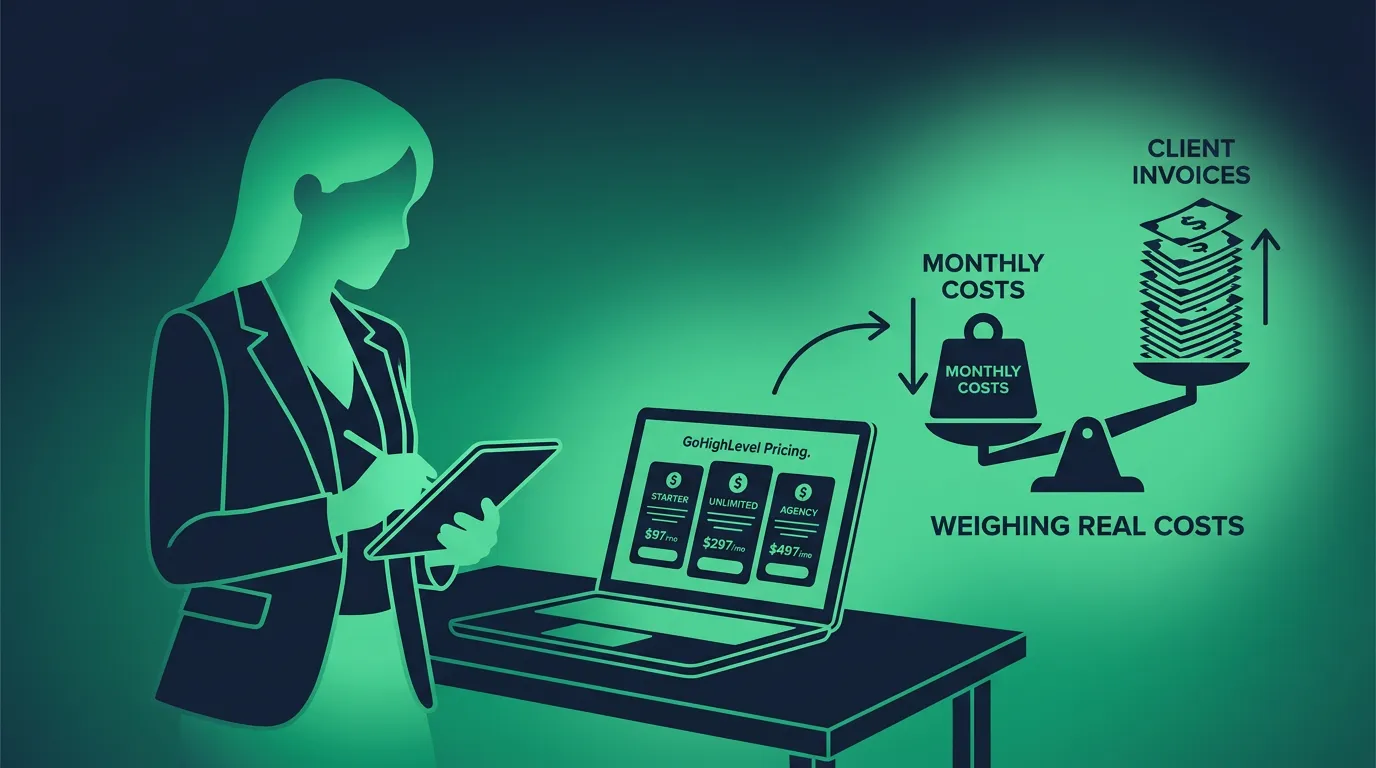
For an agency, the case gets much stronger. The Unlimited plan at $297 a month adds unlimited sub-accounts, so each HVAC, roofing or plumbing client runs in its own workspace under one agency login, plus a white-label desktop app and custom domains. A home services snapshot built once can be loaded into every new client. Agency Pro at $497 a month adds SaaS Mode, which lets the agency sell the platform as its own branded product with its own pricing and rebill usage with a markup. Our GoHighLevel SaaS Mode guide explains how that works, and the white-label software overview covers the broader resale model. The white-label mobile app is a separate $497-a-month add-on, so don’t assume Agency Pro includes it.
Where field service platforms still win
GoHighLevel doesn’t replace a field service management system, and treating it as one is where evaluations go wrong. Job costing, dispatch boards, technician GPS, pricebooks, estimates with good-better-best options and route optimization are whole product categories it doesn’t attempt. Field service software also ties marketing to real job data more naturally: Jobber’s review request fires off a completed job and Housecall Pro’s reviews sit next to the invoice.
If your crews are double-booked, your techs are driving across town twice a day or you can’t tell which jobs make money, buy FSM software first. Better marketing just adds more work to a broken schedule.
How to choose the right marketing tools by business size
Solo operators and two-to-three-person crews. Pick based on your bottleneck. If quoting and invoicing eat your evenings, start with Jobber Core or Housecall Pro Basic. If the phone rings while you’re under a sink and those callers never come back, GoHighLevel Starter fixes that faster. Few service professionals at this size need both on day one.
Growing shops with four to ten technicians. This is where most service businesses that want to scale end up running two tools: Jobber or Housecall Pro for scheduling and invoicing, and GoHighLevel or a comparable marketing tool for missed-call recovery, review automation and nurture sequences. That’s two subscriptions, but usually cheaper than moving to an enterprise platform built for triple the crew size. Connect them through the field service platform’s integrations or Zapier so job status can trigger marketing.
Ten-plus technicians with real dispatch complexity. ServiceTitan for operations, with marketing either in Marketing Pro or a connected platform, depending on how much control your marketing team or outside marketing expert wants over funnels and follow-up.
Agencies serving home service contractors. This is closer to choosing the best CRM for an agency than choosing a contractor’s software. Standardizing one stack across local service providers (HVAC companies, roofers, plumbers, electricians, pest control and lawn care operators) works because their marketing needs are nearly identical: answer fast, follow up, get the review, bring them back next season. That’s where GoHighLevel’s sub-accounts and SaaS Mode earn their price. The same logic drives our real estate marketing software guide for a different vertical, and our marketing software for small businesses guide covers the decision outside the trades.
Digital marketing strategies that work for home services
Software only pays off if it runs a strategy. The digital marketing strategies with the most leverage for local home services are consistent across trades.
Respond in minutes, around the clock. Automate the missed-call text, an after-hours reply and a booking link, so every caller gets an answer even when nobody is at the desk.
Ask every customer for a review. Automate the request at job completion and follow up once. Respond to every review, especially negative reviews, quickly and specifically.
Keep your Google Business Profile current. Photos from recent jobs, correct service area and hours, and regular posts all help in the local pack, where most home service searches end.
Market to past customers. Seasonal reminders (AC tune-ups in spring, furnace checks in fall, gutter cleaning after leaf drop) to your existing customer base cost far less than new leads. Seasonal service businesses should let automation absorb the swing in call volume instead of staffing the office for August all year.
Track marketing ROI by booked job. Cost per lead is easy to see and misleading. Count cost per booked job and revenue per channel, using call tracking and CRM data, and cut the channels that don’t book. A simple monthly marketing scorecard covering leads, booked jobs, revenue and spend per channel is enough for most owners.
Our verdict
There’s no single winner, because a solo plumber and a twelve-truck HVAC shop have different problems. Field service platforms win when dispatch, quoting and job costing are the bottleneck, and Housecall Pro has the most marketing built in. GoHighLevel wins when missed calls, thin follow-up and too few reviews are what’s losing jobs, and it’s the only one of these an agency can white-label and resell.
If you’re an agency or a contractor in that second group, the 14-day GoHighLevel trial (card on file required) is long enough to load a home services snapshot and test missed-call text back and a review sequence on real calls. Our GoHighLevel review covers the CRM, automation and white-label tools in more depth, and the white-label marketing software hub compares the platforms agencies resell.