The best digital marketing software for a small business is usually one core platform that catches and follows up on leads, plus a handful of free tools around it. For most businesses that core is either an all-in-one CRM like GoHighLevel ($97 a month), a free CRM like HubSpot’s, or an email marketing platform like ActiveCampaign (from $19 a month), depending on how much of the marketing you need to run on autopilot.
Owners who search for this are rarely short on options. They have leads going cold in a spreadsheet, an email list split across three apps and a missed call from yesterday nobody returned. They need to know which one or two tools fix that and what they’ll cost after usage fees.
What digital marketing software needs to do for a small business
Strip away the feature pages and the job of a marketing solution for running a small business is short. Leads arrive from a website form, a phone call, a Google Business Profile message or a Facebook ad, and someone has to catch them before they go cold. Emails and texts need to go out on schedule without anyone sending them by hand. A calendar should let a prospect book a slot without six messages back and forth. And somebody needs to see which marketing channels produce customers and which only produce noise.
None of that needs enterprise software. A five-person landscaping company and a two-person bookkeeping firm need roughly the same functions, sized for a team where one person wears five hats. Small businesses that miss the right marketing setup usually do it in one of two ways: buying software built for a ten-person marketing team, or stringing together four free tools that don’t share data and losing more in missed leads than a $97 subscription would cost.
The labels vary (CRM, marketing automation, email marketing platform), but the core is the same across the category: catch the lead, follow up on time and keep a record so nothing falls through twice. Shop with that list of what your small business needs in hand and you’ll end up with the right-sized tool. Shop from a feature comparison chart and you’ll usually overbuy.
Marketing tools for small business owners, by type
The four main types of digital marketing a small business runs are search (SEO and Google Business Profile), social media, email and SMS, and paid ads. Each needs some software, but only one or two of those tools need to be paid.
CRM and marketing automation
The paid core. It holds contacts and deals, sends automated emails and texts, books appointments and reports on what’s working. This is the category the rest of this page compares.
Email marketing tools
Newsletters, drip campaigns and list segmentation. Built into all-in-one platforms, or bought separately when email is your main channel.
Social media marketing
GoHighLevel and HubSpot both include basic social posting and scheduling. If you’re posting a real content calendar across multiple platforms, a dedicated scheduler usually works better.
Content and design
Canva’s free tier covers social graphics and simple flyers. AI tools such as ChatGPT or Gemini can draft posts and emails, but someone still has to edit them and know the customer.
SEO tools and analytics
Free tools like Google Analytics and Google Search Console answer where your online marketing traffic comes from, and an analytics tool is how you judge the performance of your marketing instead of guessing. Keyword research and technical audits are a separate software category most small businesses can skip early on.
Google Business Profile and local listings
Google Business Profile is free and drives a large share of local leads for service businesses. Google Maps visibility follows from keeping it current, and Nextdoor offers a free business page too.
That’s a lot of tools to manage your marketing with, which is why consolidating marketing functions in one platform appeals to small business owners who are tired of juggling multiple tools.
The three shapes marketing platforms for small business take
Nearly every product in this category falls into one of three buckets. Know which bucket a tool is in before comparing its price to something in another one.
Single-purpose tools do one job: an email sender, a scheduling app, a form builder. They’re cheap or free at low volume and the right call when one function has to be excellent.
Marketing-only suites bundle email, automation and, increasingly, SMS and WhatsApp, but stop short of a full sales pipeline. ActiveCampaign is the clearest example, along with Brevo and Mailchimp. ActiveCampaign’s full sales CRM is a separate paid add-on.
All-in-one platforms combine CRM, marketing automation, funnels or landing pages, booking and often reputation management under one login. GoHighLevel, HubSpot, Keap and Zoho Marketing Plus all compete for this position, at very different price points.
The pull toward the all-in-one marketing platform is obvious once you’re paying for four subscriptions: one bill, one login, and contact data that doesn’t drift out of sync. The trade-off is that an all-in-one tool is rarely the best at any single job. GoHighLevel’s email editor is more basic than ActiveCampaign’s, and its funnel builder trails ClickFunnels on polish. What it wins on is not having to duct-tape four tools together with Zapier and hope the connections hold.
Small business marketing software compared by price
Here are the platforms that come up most often for small businesses, at list price in October 2026. Compare them by the job they do as well as the dollar figure.
| Platform | Starting price | What you get at that price | Best for |
|---|---|---|---|
| GoHighLevel Starter | $97/mo ($970/yr) | CRM, unlimited contacts and users, funnels and websites, email and SMS automation, calendars, review requests, up to 3 sub-accounts | Lead follow-up and booking in one system |
| HubSpot Free CRM | $0 | Contact and deal tracking, 2 users, 1 pipeline, HubSpot branding on email | Contact tracking only |
| HubSpot Starter | $20/seat/mo ($15 annually) | Light marketing, sales and service tools, 1,000 marketing contacts | Teams already in HubSpot |
| ActiveCampaign Starter | from $19/mo (1,000 contacts) | Email marketing and basic automation; no landing pages or CRM | Email-first businesses |
| Keap | $299/mo ($249 annually) | CRM, email and automation, payments | Service businesses wanting CRM plus invoicing |
| Mailchimp Free | $0 | 250 contacts, 500 sends a month, 1 seat | Very small lists |
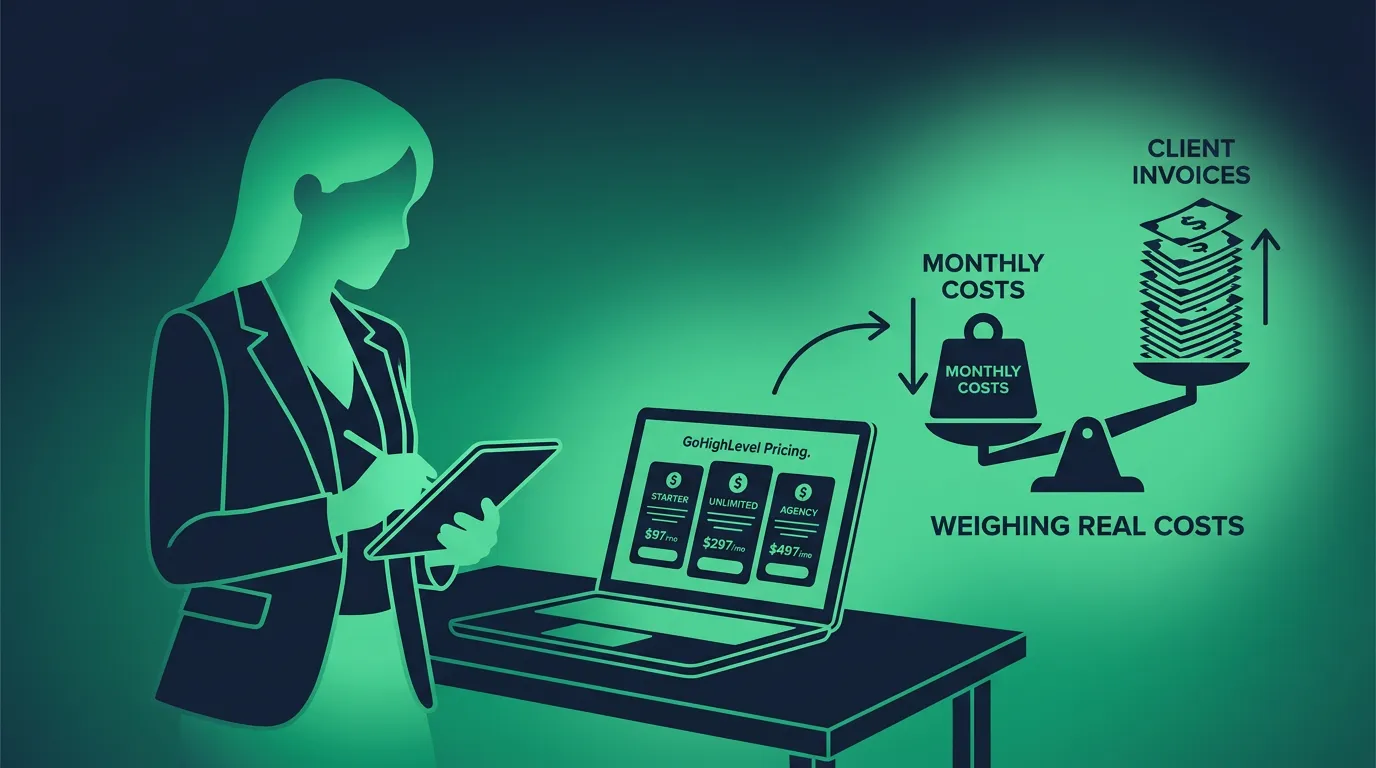
GoHighLevel. The Starter plan at $97 a month bundles everything one business needs into a single price, including missed-call text back and review requests. Unlimited at $297 a month adds unlimited sub-accounts and white-label branding, which is built for agencies. Our GoHighLevel pricing breakdown covers every tier.
HubSpot. The Free CRM never expires, which makes it the natural starting point for contact tracking. The ceiling arrives quickly, though. Real marketing automation sits in Marketing Hub Professional at $890 a month ($800 billed annually) plus a mandatory $3,000 onboarding fee, which is priced for a marketing department with a budget to match.
ActiveCampaign. Starts at $19 a month ($15 billed annually) for 1,000 contacts on Starter, with Plus at $59 and Pro at $89 at the same list size, per 2026 third-party pricing reviews (ActiveCampaign’s own page loads prices dynamically). It’s one of the better tools for email marketing when newsletters, nurture sequences and segmentation are the strategy. Price rises with list size, so a business with 10,000 contacts pays several times the entry rate.
None of these numbers include usage. GoHighLevel bills SMS, email volume and AI features separately, and ActiveCampaign’s list-size pricing is usage by another name. If you text leads heavily or send high email volume, add that before you compare.
The best free marketing tools for a small business
Can a small business do digital marketing for free? Yes, for a while. The free digital marketing tools available today cover more ground than they did five years ago. Google Business Profile costs nothing and is the best free marketing move most local businesses can make. Google Analytics and Search Console are free. Canva’s free plan covers basic graphics. HubSpot’s Free CRM tracks contacts for up to two users, and Mailchimp’s free plan sends up to 500 emails a month to 250 contacts. Organic social posting is free apart from your time. Among free email marketing tools, Mailchimp’s free plan is the usual starting point for small businesses with short lists. A new business with more time than cash can run on that stack until paid automation is what it takes to grow your business further.
Free stops working when something has to happen without a person remembering to do it. Automated follow-up, email sequences, missed-call text back and self-serve booking aren’t in any completely free tool in this category. What an all-in-one platform really sells is hours back, which is what helps small businesses grow without adding staff.
Most paid tools let you test before you pay. GoHighLevel offers a 14-day free trial with a card on file. ActiveCampaign’s 14-day trial needs no card but caps you at 100 contacts and 100 sends, and HubSpot’s paid trials revert to your previous plan when they end.
Should you run your digital marketing strategy yourself or hire help?
The same two variables decide this as the software question: time and complexity. A solo owner posting occasionally and following up by hand can run the free stack alone. A business running paid ads, email sequences, SEO and growing lead volume usually reaches the point where a marketing hire or an outside agency returns more than the owner’s evenings spent building workflows.
You’ll see rules of thumb for this. The “3-3-3” content rule some marketers use (roughly, a few pieces of content across a few channels in a few formats) and the 70/20/10 budget split (most of the spend on proven channels, some on promising ones, a little on experiments) are both useful for planning, though neither is a standard. Software handles the CRM and the automation. A person still has to make the content and decide where the marketing budget goes. Pick one or two digital marketing strategies you can sustain (say, Google Business Profile plus monthly email marketing campaigns to past customers) before adding more marketing activities.
How marketing platforms for small business integrate with other tools
None of these platforms runs in isolation. GoHighLevel connects natively to Stripe, Google, Facebook and Instagram, Shopify and Zoom, and uses Zapier or Make for the rest, plus a REST API. HubSpot has a large app marketplace with connectors for Gmail, Outlook, Slack and Zoom. ActiveCampaign integrates with ecommerce platforms and CRMs including Salesforce.
Newer channels matter too. GoHighLevel has offered WhatsApp since 2024 as a $10-a-month add-on per sub-account plus Meta fees, and ActiveCampaign now sells WhatsApp-only and email-plus-WhatsApp plans alongside its email marketing plans. If your customers reply to texts and messages faster than email, check channel support before you commit.
AI is the other variable. Every platform here now ships AI tools for writing emails and answering leads, and they price them differently. GoHighLevel’s Conversation AI, Voice AI, Content AI and Reviews AI are on every plan but billed per use, unless a sub-account is on AI Employee Growth ($50 a month) or AI Employee Unlimited ($97 a month).
Who needs an all-in-one marketing platform
The businesses that get the most from consolidating share a pattern. They get leads from more than one channel, they need follow-up that runs on its own, and they’re paying for three or four disconnected marketing and sales tools that don’t share data.
That describes a lot of home services businesses, where a missed call at 7 p.m. becomes a job for the competitor who answered, and automatic text-back and booking close the gap. It describes real estate agents running year-long nurture campaigns. Our guides to home services marketing software and real estate marketing software cover how that plays out by industry.
It also describes marketing agencies running the same stack for many clients. GoHighLevel’s higher tiers add white-label branding and SaaS Mode for reselling the platform under the agency’s name. That’s a different business model from a small business buying software for itself, covered in our white-label marketing software hub and our white-label software guide.
A business with one lead channel, a short sales cycle and no real need for automated follow-up usually doesn’t need an all-in-one platform. A free CRM and a decent email tool cover it.
Where these platforms fall short
Setup time is the cost pricing pages leave out. GoHighLevel has a real learning curve; user reports commonly describe several weeks of setup and a couple of months before a business runs it at full capability. HubSpot’s automation improves a lot at Professional, but the price jump from Starter is steep enough that many small businesses stay on the free or entry tier long after outgrowing it.
Email deliverability is where all-in-one platforms trail the specialists. GoHighLevel’s LC Email runs on Mailgun, and users report inbox placement problems when a sending domain isn’t set up and warmed properly. A business whose whole strategy is email newsletters is often better served by a tool built around deliverability, which is ActiveCampaign’s pitch.
How to choose the best marketing software without overbuying
Purchasing marketing software should start with your actual marketing needs today and ignore what a sales page says you’ll need in two years. If you’re missing calls you should be booking, you need automatic follow-up and a calendar before a fancy funnel builder. If you’re drowning in a contact spreadsheet, you need a CRM before SMS automation. Buying marketing software without matching it to an actual gap is the fastest way to overpay, and it’s why digital marketing efforts often stall three months in.
Set the marketing budget around the all-in cost and real marketing goals. Add likely usage (SMS volume, email sends, AI features) and any onboarding fee to the subscription before comparing. A $97 plan with $40 a month of texting and an $890 plan with a $3,000 onboarding fee are further apart than they look, and they aren’t interchangeable either.
Then weigh setup time against your capacity honestly. The marketing tools to grow a business are the ones you’ll actually configure and use, so choose the best fit for your hours as well as your budget. If you’re a solo owner running your business and its marketing projects without marketing team members to lean on, start simple and add automation later instead of building a full system in one weekend and abandoning it half-configured.
As for how long results take: automation pays back fast because it recovers leads you were already getting. SEO and content marketing take months, so judge them quarterly.
Our verdict
There’s no single best marketing software for every small business, but the sorting rule is clear. If you need lead capture, automatic follow-up, booking and a CRM in one place, GoHighLevel’s $97 Starter plan gives you the most for the money, provided you budget the setup time. If you only need contact tracking, start on HubSpot’s Free CRM and upgrade when it runs out of room. If email is your main channel and deliverability matters more than SMS or booking, ActiveCampaign is the better fit.
GoHighLevel’s 14-day trial is enough to build one follow-up workflow, connect a phone number and see whether the automation saves the hours it promises. Our GoHighLevel review covers the CRM, funnel builder and automation tools in more depth.