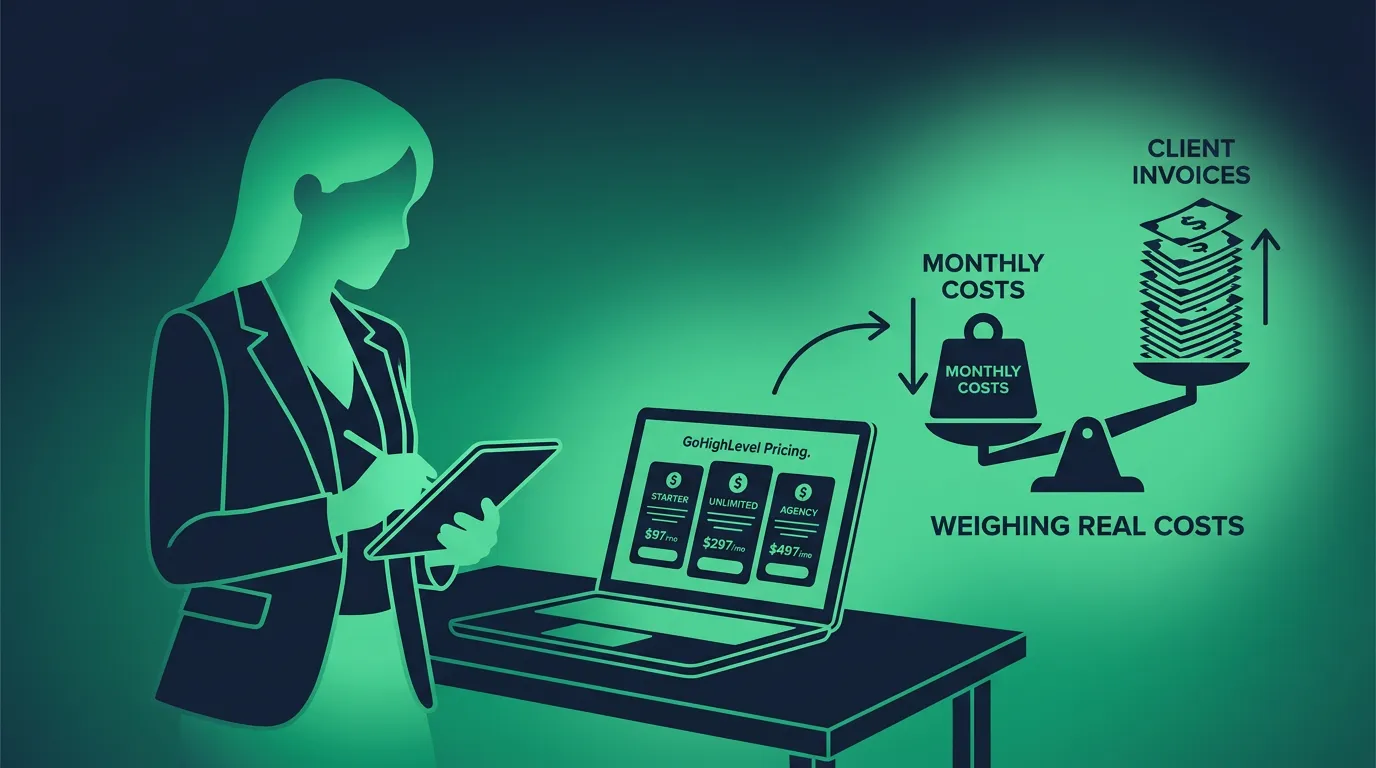
Yes, GoHighLevel is worth it if you’re an agency with a few clients or a service business that would otherwise pay for a CRM, funnel builder, email and SMS tool, booking calendar and review tool separately. It’s not worth it if you need one simple pipeline, run an online store, or won’t spend several weeks setting it up.
That answer depends on two numbers most reviews skip: what your current stack costs, and what GoHighLevel’s usage fees add on top of the plan. This page runs both and lays out the GoHighLevel pros and cons so you can decide before the trial clock starts.
What GoHighLevel really is: an all-in-one CRM and marketing platform
GoHighLevel (GHL), also sold as HighLevel, is an all-in-one marketing and sales platform, founded in 2018 in Dallas. GoHighLevel includes, under one login, a CRM with pipeline management, a funnel builder and website builder, landing page templates, email marketing, SMS, a multi-channel conversations inbox (texts, email, Facebook Messenger, Instagram and WhatsApp as a paid add-on), booking calendars, reputation management, courses and memberships, and a workflow builder that ties them together. Agencies get sub-accounts for each client and, on the top plan, SaaS Mode to resell the platform under their own brand. If you want the longer tour first, read our explainer on what GoHighLevel is or the GoHighLevel features breakdown.
How much does GoHighLevel actually cost in 2026?
The plan prices are simple. The real bill is not.
| Plan | Monthly | Annual | Sub-accounts | Best for |
|---|---|---|---|---|
| Starter | $97 | $970 | 3 | One business or a freelancer with a couple of clients |
| Unlimited | $297 | $2,970 | Unlimited | Agencies with 3+ clients; rebill usage at cost |
| Agency Pro | $497 | $4,970 | Unlimited | Agencies reselling via SaaS Mode with markup |
| Enterprise | Custom | Custom | Unlimited | Large agencies needing HIPAA, mobile app, custom development |
Every plan includes unlimited contacts and users. On top of the plan you pay for usage: SMS at $0.00747 per segment in the US and Canada plus a carrier fee of $0.0035 to $0.005, a local number at $1.15/mo, A2P 10DLC registration fees, email at $0.675 per 1,000 sends, and AI. Conversation AI, Voice AI, Content AI and Reviews AI are on every plan but billed per use unless a sub-account is on AI Employee Growth ($50/mo) or AI Employee Unlimited ($97/mo, fair use). The white-label mobile app is a separate $497/mo add-on that even Agency Pro doesn’t include.
For a single service business sending a few hundred texts and a few thousand emails a month, usage usually adds tens of dollars, not hundreds. For an agency texting on behalf of 20 clients, it adds up fast, which is why rebilling matters (Unlimited passes usage to clients at cost; Agency Pro can mark it up). Our GoHighLevel pricing breakdown covers every fee and add-on line by line.
One subscription vs multiple tools: the real comparison
GoHighLevel is actually worth it when it replaces different tools you’d pay for anyway. Here’s a typical small-business stack using published 2026 starting prices:
| Job | Separate tool | Starting price |
|---|---|---|
| Funnels and landing pages | ClickFunnels Launch | $97/mo |
| Email automation | ActiveCampaign Plus | from $59/mo (1,000 contacts) |
| CRM | HubSpot Starter | $20/seat/mo |
| Booking | Calendly Standard | from $10/seat/mo |
| SMS and review requests | A texting tool plus a review tool | varies |
That’s roughly $186 a month for one user before you add texting, reviews, or Zapier to connect them, and ActiveCampaign’s price climbs as your list grows. GoHighLevel Starter does all of it for $97 plus usage, with the data in one place so a lead’s form fill, texts, emails, appointment and pipeline stage sit on one record.
For an agency, the gap widens. Running separate tools for ten clients means ten sets of subscriptions or a tangle of shared accounts. On Unlimited, those ten clients share one $297 bill, so the platform costs $29.70 per client. That pricing model makes GoHighLevel popular with marketing agencies: an all-in-one platform whose cost per client falls every time you add one.
The honest caveat: each of those single-purpose tools is better at its one job. If you only need two of them, buying those two is cheaper and easier than learning GoHighLevel.
GoHighLevel pros and cons
Pros: CRM, pipeline management, multi-channel automation and SaaS resale
CRM, pipeline management and follow-up in one platform. Lead capture, follow-up, booking and review requests live in one system, so nothing falls through the gap between apps. Missed-call text-back alone recovers leads that a separate stack often loses.
Flat pricing for unlimited sub-accounts. Contacts and users are unlimited on every plan, and the Unlimited plan covers as many client accounts as you can manage, which is why agencies that manage multiple clients get the most out of a GoHighLevel account. That’s the opposite of per-contact or per-seat pricing.
Multi-channel automation depth. The workflow builder handles multi-step, multi-channel sequences with branching: text a new lead, email if they don’t reply, book them into a calendar, move them through the pipeline, then ask for a review after the job. You can automate most of the routine lead follow-up a front desk handles.
Built-in SaaS resale model. Agency Pro’s SaaS Mode lets an agency resell it to clients as its own software, with Stripe billing and usage markup. That turns software into a recurring revenue stream rather than a cost line.
Snapshots. You can package a whole sub-account setup (workflows, funnels, pipelines, calendars) as a snapshot and load it into a new client account, which speeds up onboarding when you serve one niche.
Cons: learning curve, usage fees and email marketing gaps
The learning curve is steep. User reviews consistently describe several weeks of setup and a couple of months before the workflow builder feels natural. Trial users who don’t finish setup often cancel before they see any savings.
Usage costs surprise people. The texts, calls, email and AI charges are small per unit and easy to underestimate in aggregate.
Feature polish trails specialists. The funnel builder is less refined than ClickFunnels, the CRM less intuitive than Pipedrive for a pure sales team, and the email editor more basic than ActiveCampaign’s.
Email deliverability needs work. LC Email runs on Mailgun. Users report spam-folder issues when the sending domain isn’t set up and warmed properly, a complaint that shows up across review platforms and Reddit threads. A dedicated email marketing tool handles this with less effort.
Weak for cold outbound. GoHighLevel is built for inbound leads and nurture. Teams that live on high-volume cold calling or cold email usually bolt on a separate outbound tool.
The funnel builder, AI tools and integrations: where the value really sits
Funnel and landing page builder
The funnel and website builder covers landing pages, multi-step funnels, order forms, surveys and full websites, with custom domains on every plan. It’s good enough that most service businesses won’t need ClickFunnels or a separate website host. Designers who care about pixel-level control will find it clunkier than dedicated page builders, and templates need work before they look premium.
AI: useful, but billed separately
GoHighLevel offers Conversation AI (a chatbot that answers texts, web chat and social DMs and can book appointments), Voice AI (an AI receptionist for inbound calls), Content AI for copy and images, and Reviews AI for review replies. All four are on every plan, and none are free. Without an AI Employee plan you pay per use: Voice AI starts at $0.045 a minute for the voice engine plus text-to-speech, model tokens and phone minutes, Reviews AI costs $0.01 per reply, and Content AI costs $0.063 per image. AI Employee Growth ($50/mo per sub-account) includes 1,000 Conversation AI responses and 100 Voice AI minutes; AI Employee Unlimited ($97/mo per sub-account) removes the caps under fair use.
Whether the AI tools are worth it comes down to call and message volume. A business that misses a lot of after-hours calls can book appointments it would otherwise lose. A business with a staffed front desk may not need them at all.
Integration options
Native integrations cover Stripe, Google (Calendar, Business Profile, Ads), Facebook and Instagram, Shopify and Zoom, with Zapier and Make for everything else and a REST API for custom work. For most small businesses that means the CRM talks to payments, calendars and ad accounts without a developer.
Why so many GoHighLevel reviews say it’s worth it
Most GoHighLevel reviews you’ll find say yes. One reason is that HighLevel runs a generous affiliate program: 40% recurring commission on referred accounts, plus 5% on a second tier. Plenty of review sites, YouTube channels and “honest GoHighLevel review 2026” posts earn that commission, and so do we, as our affiliate disclosure explains.
That doesn’t make the positive reviews wrong, but it’s why you should weigh the complaints as heavily as the praise. The criticisms that repeat across agencies and businesses are consistent: the learning curve, usage costs, email deliverability setup and feature polish compared with specialist tools. If none of those would sink your business, the platform is probably worth using. If one of them would, test that exact thing during the trial.
Who should use GoHighLevel (and who shouldn’t)
| Business type | Verdict | Why |
|---|---|---|
| Marketing agency, 3+ clients | Worth it | One flat fee across all client sub-accounts; per-client cost keeps falling |
| Local service business (contractors, med spas, dentists, law firms) | Worth it | Missed-call text-back, booking and review requests fix real revenue leaks |
| Coach or course creator | Often worth it | Funnels, memberships, email and booking in one, though Kajabi is simpler for course-first businesses |
| Solo consultant with one simple pipeline | Depends | Starter covers it, but a lighter CRM may be enough |
| E-commerce brand | Usually not | Built for lead capture and appointments, not storefronts |
| Outbound-heavy sales team | Usually not | Needs a dedicated outbound and dialer tool anyway |
Two agencies with the same client count can land on opposite sides of “worth it.” The difference is usually whether they finish setup and whether their clients use more than the CRM. If you plan to run an agency on the platform, our GoHighLevel for agencies guide goes deeper on sub-accounts, rebilling and SaaS Mode.
Is GoHighLevel difficult to learn?
Yes, and that’s the main reason people decide it wasn’t worth it. The platform does a lot, and the workflow builder, pipelines, calendars and phone setup (including A2P 10DLC registration for texting) all need configuring before anything runs.
Three things shorten the ramp. Start from a snapshot built for your niche rather than a blank account. Use HighLevel’s onboarding resources and community. And set up one workflow that pays for itself, such as missed-call text-back or appointment reminders, before you build the rest. HighLevel also sells a one-time Advanced Account Setup add-on for $1,000 if you’d rather pay for help getting started.
GoHighLevel vs HubSpot, ClickFunnels and other HighLevel alternatives
HubSpot’s Free CRM costs nothing for up to two users and beats GoHighLevel if contact tracking is all you need. Once you need marketing automation, HubSpot’s paid hubs get expensive quickly: Marketing Hub Professional is $800/mo billed annually ($890 billed monthly) with three seats. Our GoHighLevel vs HubSpot comparison covers that matchup.
ClickFunnels (from $97/mo on Launch) builds more polished funnels and checkout pages and is the stronger pick when funnels are the business. It caps workspaces per plan (one on Launch, five on Scale), which makes it awkward for an agency running many clients. ActiveCampaign (from $15 to $19/mo at 1,000 contacts) has the deeper email editor and reporting, with costs rising as your list grows. Each wins its own category. None of them replaces five or six categories at once for many clients at one flat price, which is the trade-off behind the question “is GoHighLevel worth it.”
If you want a wider list, our GoHighLevel alternatives roundup compares the main options side by side.
So, is GoHighLevel worth it in 2026? Our GoHighLevel review verdict
For agencies with a handful of clients or more, and for appointment-driven service businesses currently paying for four or more separate tools, yes. The consolidation savings are real, the flat pricing rewards growth, and the automation recovers leads a disconnected stack drops.
For a single business with one simple pipeline, an online store, or a team that won’t commit a few weeks to setup, no. The software works; you’d just pay for and maintain far more than you use.
The cheapest way to find out is the 14-day free trial. Remember a card is required and it bills when the trial ends, so set a reminder, build one real workflow, and judge it on whether that workflow books jobs. For our full scoring, including support, deliverability and the mobile app, read the in-depth GoHighLevel review.