Sales and marketing software is any tool that helps a business generate leads, market to them, move them through a sales process, and keep the customer relationship going after the sale. The best sales and marketing software for a small business is usually one all-in-one platform that holds the CRM, the email and SMS automation and the sales pipeline in a single system. Larger teams with complex sales processes tend to run a dedicated CRM plus a separate marketing tool.
Search the term and you’ll find CRM vendors, email tools, funnel builders and listicles that treat all of them as interchangeable. They each do a different job. This guide breaks down the categories, names the best tools in each with 2026 pricing, and explains how to choose without paying for features you’ll never touch.
What sales and marketing software includes
The category splits into four kinds of software, and most businesses end up needing at least two of them.
CRM software is the record of every contact, company and deal, plus the history of every touchpoint: emails, calls, form fills, meetings. It’s usually the first purchase, and everything else plugs into it. If the term is new to you, our explainer on what CRM stands for covers the basics.
Marketing automation software sends the email sequences, scores leads on behavior, segments contacts, and hands a qualified lead to sales when the prospect does something that signals intent. Inbound marketing runs on this layer.
Sales management and sales engagement tools sit on the sales side. Sales management software adds forecasting, quotas, territories and sales analytics and reporting for a sales manager. Sales engagement tools script outbound sequences, log every sales call and coach reps.
All-in-one platforms combine CRM, marketing automation and part of the sales toolkit in one product with one login and one bill. This is where most small businesses and agencies land, because it removes the integration work between tools.
The lines blur. Most CRMs have some automation built in, and most marketing automation tools track a pipeline. The useful question is what a tool was originally built to do: be the system of record for customer relationships, or run the campaigns that fill it.
Essential features of sales and marketing software
Feature lists vary by vendor, but a core set matters for nearly every business.
- A visual sales pipeline that shows every deal by stage, so you can see where the sales cycle stalls.
- Automated follow-up that runs email and SMS sequences and reacts to what a lead does.
- Lead capture: forms, landing pages and booking calendars that drop leads straight into the CRM.
- Sales analytics and reporting that shows which campaigns produce revenue and which reps convert, beyond counting activity.
- Native integrations with your payment processor, calendar, phone system and ad accounts.
- A usable mobile app so sales reps can log calls and update deals from the field.
How deep each piece needs to go depends on the team. A four-person team selling a simple product needs a pipeline, automated follow-up and basic campaign reporting. An enterprise team running complex sales with long cycles needs forecasting, territory management and sales engagement tooling. Buying enterprise depth as a small team means paying for configuration nobody has time to do. The reverse mistake, running forecasting for a 50-rep team off a starter plan, shows up just as fast.
The best sales and marketing software in 2026
There’s no single best sales tool for every business, and the right one depends on your business needs. These are the platforms worth shortlisting, grouped by who they fit. Prices were checked in October 2026.
GoHighLevel: best all-in-one for small businesses and agencies
GoHighLevel combines CRM and pipelines, funnel and website building, email and SMS marketing, booking calendars, reputation management, social media management and workflow automation in one platform. A lead can fill out a form, get an instant text, book a call and land in the right pipeline stage without touching a second tool.
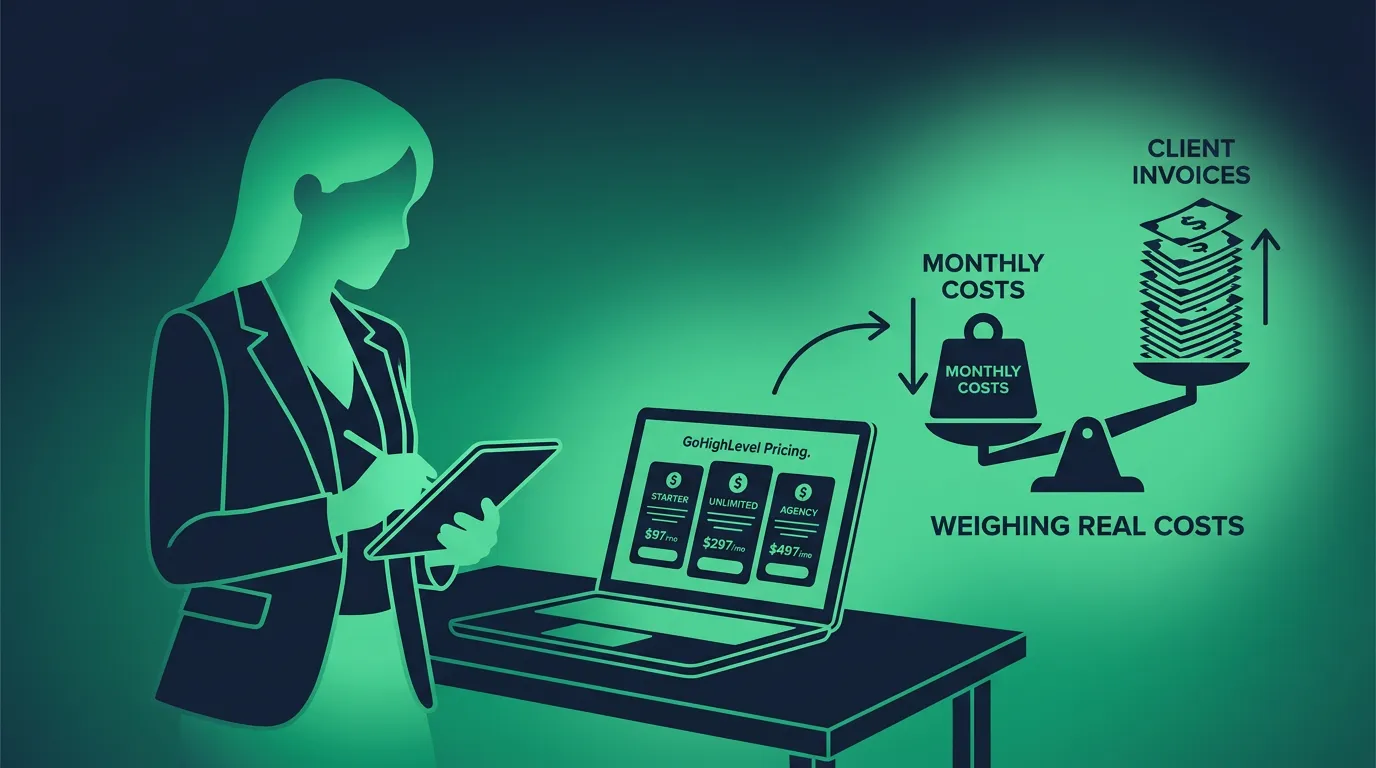
Pricing is flat: Starter is $97/mo ($80.83/mo billed annually) for up to 3 sub-accounts, and Unlimited is $297/mo ($247.50 annually) for unlimited sub-accounts, aimed at agencies. Contacts and users are unlimited on every plan. SMS, email sends and AI features are billed on usage on top of the subscription. AI tools such as Conversation AI and Voice AI are available on all plans but pay-per-use, or $50 to $97 per sub-account per month on an AI Employee plan.
The downsides: a real learning curve, and individual tools that are less polished than best-in-class products. The email editor is more basic than ActiveCampaign’s and the CRM less intuitive than Pipedrive’s. Our GoHighLevel review goes through the strengths and gaps in detail.
HubSpot: best for growing teams that want an ecosystem
HubSpot sells separate hubs on one shared CRM: Sales Hub, Marketing Hub, Service Hub and Content Hub, or all of them as the Customer Platform bundle. The Free CRM covers up to 2 users with no time limit, which makes it an easy start. Starter costs $20 per seat per month ($15 billed annually).
The jump to Professional is where the cost curve bites. Marketing Hub Professional is $890/mo billed monthly or $800/mo billed annually, with 3 seats, 2,000 marketing contacts and a mandatory $3,000 onboarding fee. Sales Hub Professional is $100 per seat per month ($90 annually) with a $1,500 onboarding fee. HubSpot’s reporting, usability and app marketplace are excellent. Our GoHighLevel vs HubSpot comparison covers where each one wins.
Salesforce: best for large sales organizations
Salesforce is a CRM. People sometimes lump it in with SAP, which makes enterprise resource planning (ERP) software for finance, supply chain and operations. Large companies often run both side by side. Salesforce Sales Cloud handles the sales process and Salesforce Marketing Cloud handles marketing at enterprise scale. It’s the most customizable option here and usually needs an admin or implementation partner to get the most from it.
Microsoft Dynamics 365 Sales: best for Microsoft-centric companies
Dynamics 365 Sales is Microsoft’s CRM, sold as part of the broader Dynamics 365 suite. Its main advantage is tight integration with Outlook, Teams and the rest of Microsoft 365, which suits organizations already standardized on Microsoft.
ActiveCampaign: best marketing automation tool for email-led businesses
ActiveCampaign is a marketing automation tool with strong email marketing and automation. Starter starts at about $15/mo billed annually ($19 monthly) for 1,000 contacts, Plus starts at about $49/mo annually and adds landing pages and lead scoring, and Pro starts at about $79/mo annually. Prices rise with contact count, and these figures come from 2026 third-party reviews because ActiveCampaign’s pricing page loads them dynamically. A full sales CRM is a paid add-on. See GoHighLevel vs ActiveCampaign.
Keap: best for small businesses that want guided setup
Keap sells one plan, starting at $299/mo ($249/mo billed annually) for 1,500 contacts and 2 users, with additional users at $39/mo. It combines CRM, email and SMS automation, invoicing and payments, and includes guided onboarding. It costs more than GoHighLevel’s Starter plan at the entry level and charges by contact count. Our GoHighLevel vs Keap comparison covers the trade-offs.
monday sales CRM and Pipedrive: best for simple, visual pipelines
monday sales CRM and Pipedrive are built around visual sales pipeline management. They’re easy for a sales team to adopt and good at tracking deals and sales activities, but both lean on integrations or add-ons for full marketing automation.
Sales and marketing tools compared
| Platform | Category | Starting price | Pricing model | Best for |
|---|---|---|---|---|
| GoHighLevel | All-in-one CRM and marketing | $97/mo | Flat fee, unlimited contacts; usage extra | Small businesses, agencies |
| HubSpot | CRM suite (Sales, Marketing, Service hubs) | Free; Starter $20/seat | Per seat plus marketing contacts | Growing teams |
| Salesforce | Enterprise CRM and Marketing Cloud | Varies by edition | Per user | Large sales organizations |
| Dynamics 365 Sales | Enterprise CRM | Varies by edition | Per user | Microsoft-centric companies |
| ActiveCampaign | Marketing automation | ~$15/mo (1,000 contacts, annual) | Per contact tier | Email-led marketing |
| Keap | CRM and automation | $299/mo ($249 annual) | Per contact tier | Small businesses wanting setup help |
CRM vs sales management software: which sales tool do you need?
People use the terms interchangeably, and the products overlap heavily. The distinction is still worth knowing. A CRM is the record-keeping layer: contacts, companies, deal stages and interaction history. Sales management software adds the operational layer a sales manager needs on top of that: quotas, territories, forecasting and team-level reporting.
Most modern platforms blur the line deliberately, because customers don’t want two products to run one workflow. HubSpot names its products Sales Hub and Marketing Hub to signal separate purchases sharing one CRM. When a vendor markets itself specifically as a sales management solution, its forecasting and reporting are usually deeper than its contact database. If pipeline visibility across a whole sales team is your priority, pick the management tool with the strongest reporting, even if its marketing features are thinner.
How automation changes the sales process
The best sales software removes steps from the sales process rather than adding another dashboard. A sales tool that puts follow-up reminders on autopilot changes behavior more than extra reporting, because a sales professional who isn’t tracking forty open sales activities in a notebook has more hours to sell.
Sales automation works when it’s triggered by what a prospect actually does: a form fill creates a deal and texts the lead, a booked call moves the deal stage, a no-show triggers a reschedule sequence. Automation bolted onto a process nobody mapped just moves the busywork around. Map the steps first, then automate the ones that repeat.
Marketing teams run the same play from the other side. Automated nurture sequences sit at the center of most marketing strategies, and they only pay off if a qualified lead reaches sales without someone exporting a spreadsheet. Done well, the automation covers the entire sales process from first click to signed contract, and the handoff between marketing and sales stops being where leads go missing.
Benefits for sales and marketing teams
The first benefit is time. Sales and marketing teams that re-enter the same contact into three tools, chase reps for status updates and export spreadsheets before every pipeline review get those hours back once one platform owns the record. Manual marketing tasks like sending follow-ups, tagging leads and building weekly reports become automations.
The second is fewer lost leads. When every form, call and message lands in one CRM, a lead can’t sit unseen in an inbox for two days. Speed to lead improves because the first text or email goes out automatically.
The third is alignment. Sales and marketing strategies stop clashing when both teams see the same pipeline. Marketing can see which marketing campaigns produced closed revenue, and sales can see what a lead read before the call. That shared view is what lets a business put budget behind the marketing efforts that actually work.
The fourth is a better customer experience. A customer who books online, gets a reminder text, and then receives one consistent follow-up feels the difference from a business juggling disconnected tools.
How sales and marketing software integrates with other tools
Integrations come in three kinds. Native integrations are built and maintained by the vendor: GoHighLevel connects natively to Stripe, Google, Facebook and Instagram, Shopify and Zoom, and HubSpot has a large app marketplace including a native Salesforce sync. Connector integrations run through Zapier or Make, which covers almost any app but adds a monthly bill and another place where data can break. APIs let a developer build a custom connection.
The integrations that matter most are the ones that move money and leads: your payment processor, your calendar, your phone system and your ad accounts. Ask each vendor whether those are native, and test them during the trial.
Choosing software for field sales teams and unique sales processes
A field sales team that visits customers needs a strong mobile app, offline access and route or territory tools. An inside sales team working from one office needs calling, sequences and a fast pipeline view. A service business taking inbound calls needs missed-call text-back, booking and reminders more than forecasting.
If your business has unique sales processes, such as multi-step quotes, approvals or long B2B cycles, check that the platform supports custom pipeline stages, custom fields and conditional automation before you commit. An all-in-one platform like GoHighLevel fits inbound service businesses well. It asks a large field sales organization to adapt more than Salesforce or Dynamics 365 would.
AI in sales and marketing platforms
Every major vendor now ships AI features: email and content drafting, call summaries, lead scoring, chat and voice agents. They’re worth checking, and worth checking how they’re billed. On GoHighLevel, for example, Content AI, Conversation AI and Voice AI are on every plan but charged per use unless a sub-account is on an AI Employee plan.
Treat AI-powered sales tools as a tiebreaker. A platform with weak core automation doesn’t get fixed by an assistant on top. Judge the CRM, pipeline and automation first.
Why small businesses consolidate onto one platform
A growing business often starts with a CRM, an email tool, a landing page builder, a texting app and a scheduler, connected through Zapier. For a solo operator with a short prospect list, that can work.
The gaps show up as volume grows. A lead fills out a form in one tool, and the sales rep working the CRM doesn’t see it for two days. A follow-up text goes out from one system while an email sequence keeps running from another, and the prospect gets contradictory messages. Nobody has the whole picture, because no single tool holds it.
An all-in-one CRM and marketing platform puts the form, the contact record, the follow-up sequence and the booking calendar in one data model, so a lead’s status updates everywhere at once. That’s the core argument for consolidation. Agencies make the same argument to their clients when they package a platform under their own brand. If that’s your situation, our guide to white label marketing software covers how rebranding and reselling works, and what white label means explains the term.
How much sales and marketing software costs
Pricing depends on the model: flat fee, per seat, or per contact.
Flat-fee platforms like GoHighLevel cost the same whether you have 500 contacts or 50,000. You pay usage on top: on GoHighLevel, SMS is $0.00747 per segment in the US and Canada plus carrier fees, and email is $0.675 per 1,000 sends. Our GoHighLevel pricing guide lists every rate.
Per-seat and per-contact pricing climbs as you grow. HubSpot charges per seat and by marketing contacts, and Professional tiers carry one-time onboarding fees from $1,500 (Sales Hub) to $3,000 (Marketing Hub), with Enterprise onboarding up to $7,000. ActiveCampaign’s entry price applies to 1,000 contacts and rises at each contact tier.
The fair comparison adds up every tool you’d otherwise need (CRM, email, SMS, landing pages, scheduling) against one subscription, then projects where your contact list and team size will be in 18 months, not where they are today.
How to choose the right sales and marketing platform
Start with workflow fit. Map how a lead becomes a customer today, step by step, and check each tool against that map. A platform with 200 features that doesn’t match your process is worse than a simpler one that does.
Check integration depth over integration count. A vendor listing hundreds of integrations often means most run through Zapier, which adds cost and more things that can break. Native integrations maintained by the vendor matter more.
Run a real trial. A demo shows the product at its best. A trial where your team imports real contacts and builds one real workflow shows the friction. GoHighLevel offers a 14-day free trial with a card on file. HubSpot’s 14-day trial of Professional features needs no card.
Model usage costs at your real volume. SMS, email, calls and AI often meter separately. Ask for the rate card.
Plan for ramp time. Every capable platform has a learning curve. GoHighLevel users commonly report several weeks to set up and a couple of months to become proficient. A single-purpose email tool can send its first campaign in a day.
Check who it’s built for. A platform built for inbound marketing and local service businesses is a poor fit for heavy outbound cold prospecting, and the reverse is also true. GoHighLevel, for example, is built for inbound lead handling and needs a separate tool for high-volume cold outbound.
All-in-one platform or a stack of point tools?
The fewer channels you run, the less consolidation matters. A business running email only, with no texting, funnels or booking, is better served by a dedicated email tool with a more polished editor and deliverability tooling.
Once a second or third channel enters the picture, coordinating campaigns across separate logins starts costing real hours. That’s the problem all-in-one marketing and sales platforms solve. Our guide to marketing campaign management software goes deeper on running campaigns across several channels.
However you track sales, one dashboard that follows a lead through the sales funnel to a closed deal beats five tools that each own one slice and don’t share data.
Common mistakes when buying
Buying on feature count instead of workflow fit is the most common mistake. Ignoring usage-based costs, then getting surprised by the first real monthly bill once SMS and email volume ramps up, is the second. The third is underestimating setup time and blaming the software when adoption stalls in month one. Budget onboarding for a new platform the way you’d budget onboarding for a new hire.
If GoHighLevel is the option you’re weighing, its 14-day trial is long enough to build one real workflow, from form to pipeline to follow-up, and judge the fit before paying for a full month.