White label means a product or service made by one company is sold by another company under its own brand name, as if the seller had made it. The goods or services are produced by one company but sold by many, each putting its own brand on them. The buyer adds its logo, colors and price; the original maker keeps doing the production, hosting or maintenance in the background, usually unnamed.
The name comes from the idea of a plain white label on the packaging that the seller fills in with its own branding, which is how Wikipedia’s entry on white-label products explains it. The product underneath stays the same no matter whose label goes on top.
How white labelling works: the white label process
The white label process has three parties. A white label manufacturer or supplier makes a finished, generic product. A reseller buys or licenses it, puts its brand on it, sets its own price, and sells it. The end customer buys from the reseller and deals with the reseller’s brand.
The supplier wins on volume: one product line sold to many resellers gives it economies of scale it couldn’t reach selling under its own name, and it keeps control over product quality across different brands. The reseller wins on speed. It can outsource production, expand its product lines or enter new markets without having to invest in a factory or an engineering team, and spend its effort on branding and marketing instead. White labeling allows businesses to offer a wider range of products without building them.
The arrangement runs on a supply or reseller agreement covering who owns the brand, who owns the product’s intellectual property rights (formulas, code, trademarks), quality control and support. Pre-made products are rebranded, but the supplier usually keeps the recipe or source code.
How white label products differ from private label products
White label and private label get used interchangeably, along with OEM, but they describe different deals.
| White label | Private label | OEM | |
|---|---|---|---|
| Who designs it | The supplier | Supplier and retailer together, to the retailer’s spec | The supplier, as a component |
| Who can sell it | Many resellers, identical products | One retailer, exclusive products | Built into another company’s finished product |
| What the seller changes | Branding, packaging and price | Formula, features, packaging design | Nothing the end customer sees |
| Example | The same DVD player sold as Saisho at Dixons and Matsui at Currys | A supermarket’s own-recipe snack line | A battery inside a laptop |
The practical difference between white label and private label is control. With white label products you sell what the supplier already makes, so the same product may be sold by multiple retailers under different names. With private label products you collaborate with manufacturers on product quality, ingredients and packaging and branding, and nobody else gets that exact item. Private label branding takes longer and costs more, and you get exclusive products in return. In both cases the products themselves are manufactured by a third party; what changes is how much of the product is yours.
A skincare example makes it concrete. A shop that puts its sticker on a moisturizer the factory sells to dozens of brands is selling a white label product. A brand that works with a contract manufacturer on its own formula, sold nowhere else, is running private label. A company buying a pump dispenser from a parts supplier to fit on its own bottle is buying OEM.
Real white label product examples
White label products are everywhere once you look, and store-branded products on a supermarket shelf are often made by someone else. Wikipedia names Richelieu Foods, which makes store-brand foods for retailers including Hy-Vee, Aldi and Sam’s Club. Consumer electronics have long been sold under several store brands from one factory, as with the Saisho and Matsui DVD players above.
Banking runs on it too. Chime’s footer states that its banking services are provided by, and its Visa debit card issued by, The Bancorp Bank or Stride Bank. The app and brand are Chime’s; the accounts sit with partner banks.
White label services work the same way. An agency sells “its” SEO reports, review monitoring or email marketing, and a white label provider delivers the work or the software behind the agency’s brand. Many software companies sell nothing to consumers at all; these white label companies exist only to supply white label solutions to resellers, in categories like digital marketing, payments and hosting.
How agencies use white label software
Marketing agencies are some of the heaviest users of white label software. An agency licenses a platform, adds its own logo, colors and custom domain, and gives clients what looks like the agency’s own CRM or marketing app. The client sees the agency’s brand, and the vendor handles the servers, updates and security.
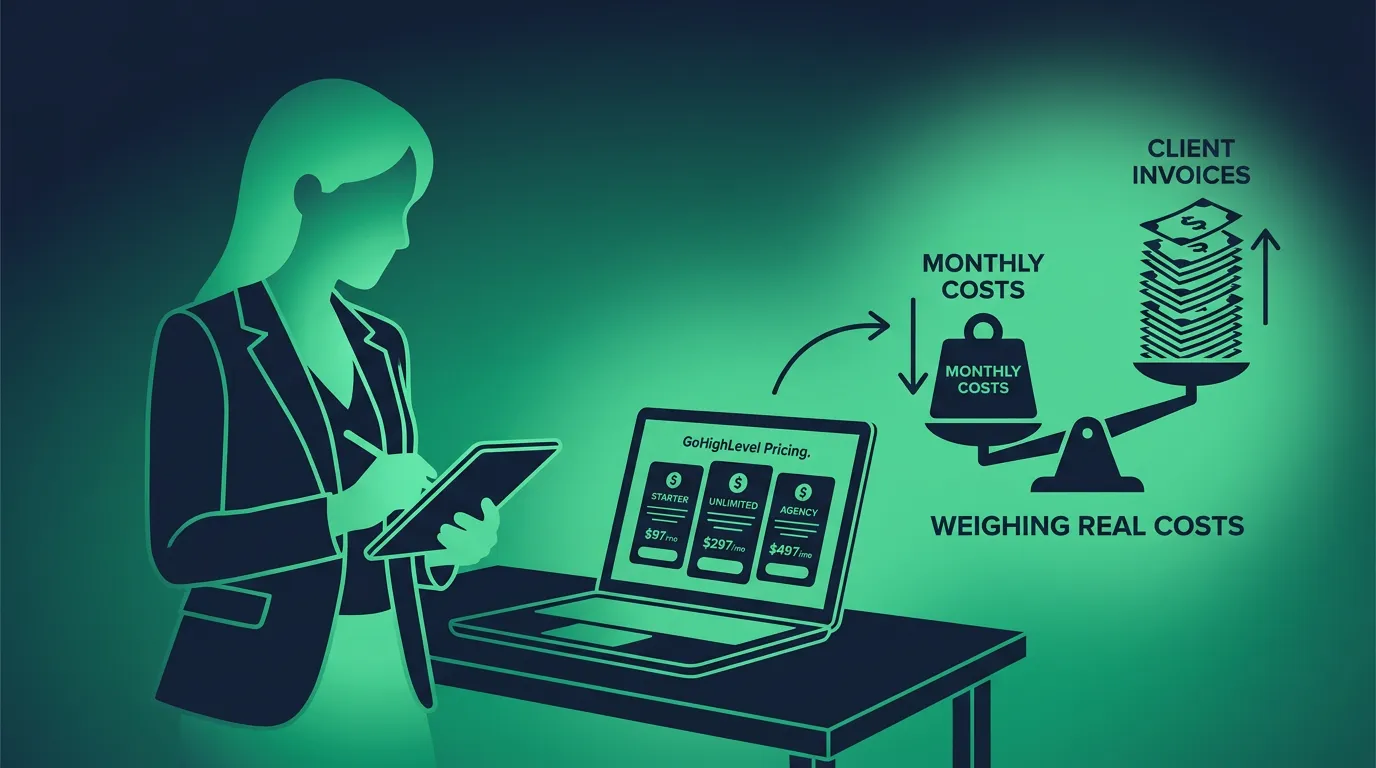
GoHighLevel is the common example in this space. Its tiers decide how much of the brand you control:
- Starter ($97/mo) has no white-label desktop app or custom domains.
- Unlimited ($297/mo) adds the white-label desktop web app, custom domains and unlimited client sub-accounts, and lets you rebill phone and email usage at cost.
- Agency Pro ($497/mo) adds SaaS Mode, so you can sell the platform as your own software with your own pricing and rebill usage, including AI, with a markup.
The white-label mobile app, with your brand in the app stores, is a separate add-on at $497/mo (or $1,491 a quarter) on every plan except Enterprise. Agency Pro doesn’t include it, despite what some older guides say. Our breakdown of GoHighLevel’s pricing tiers covers the full cost, and our GoHighLevel review looks at how the white-label setup holds up once clients are using it.
Benefits and risks of selling white label products
The benefits are speed and focus. When you use white label products you get a finished offer without product development, and you can differentiate on service, positioning and marketing strategy, which is where most resellers actually compete. For a small business, selling white label products is a low-risk way to test demand before committing to private label.
The drawbacks come from not owning the product. You depend on the supplier’s quality assurance processes, and you inherit its bugs, outages and price changes on their timeline. Your customers blame your brand when something breaks, even if the fix sits with someone else. Your margin depends on the supplier’s pricing. And because competitors can sell identical products, it’s harder to stand out on the product alone. Read the reseller agreement for termination terms, price-change notice and who handles support before you build a business on it.
Is white labeling illegal?
No. It’s a standard licensing and supply arrangement used by supermarkets, banks and software companies. Legal issues come from doing it without permission or lying about it: selling another company’s trademarked product as your own without an agreement, copycatting a brand’s packaging, or breaking consumer-protection rules about product claims. If you have a written agreement and your labeling is accurate, a white label business is ordinary commerce.
Starting a white label business
Starting a white label business comes down to choosing products that align with what your audience already buys, white label suppliers whose quality and support you trust, and a white label brand identity that gives customers a reason to pick you over other resellers of the same thing. For software, that usually means testing a platform on a real client before you put your name on it.
For the platforms agencies resell, our white-label marketing software guide compares the main options side by side, and GoHighLevel’s SaaS Mode explained covers the resale model in detail. If the “CRM” half of “white-label CRM” is the unclear part, start with what CRM stands for, and our guides to sales and marketing software and marketing campaign management software cover the tools usually sold alongside it.